
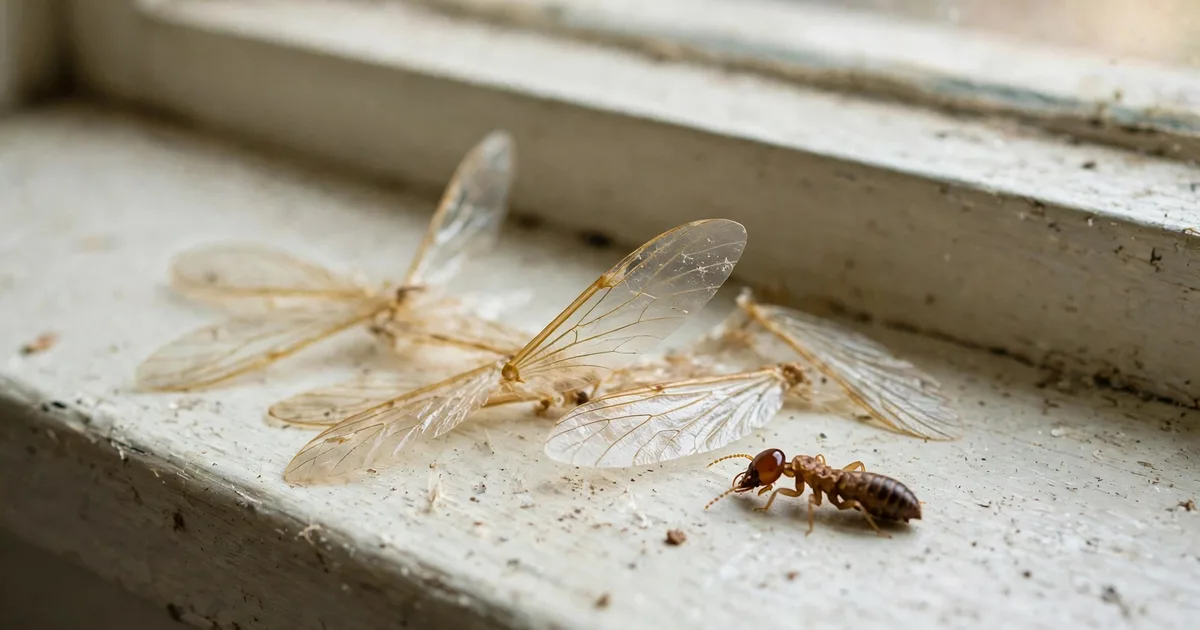
The early signs of termites are easy to miss because they are small and look like ordinary house debris: a few translucent wings on a windowsill, a pinch of pepper-like pellets under furniture, a thin line of dried mud on the foundation, or paint that looks slightly blistered. Termites feed inside wood, out of sight; what a homeowner notices is the evidence the colony leaves behind. Recognizing that evidence early, while feeding is still limited, is the difference between a contained problem and one that has had seasons to spread through framing, flooring, and trim.
Key Takeaways
- Discarded wings, pellet-like frass, and pencil-thin mud tubes are the three early signs homeowners most often sweep up, wipe away, or ignore.
- Early termite evidence is subtle: a small pile, a faint mud line, a blister in the paint — not the dramatic damage people picture.
- Wood that sounds hollow when tapped and doors that suddenly stick can both trace back to termites feeding inside the wood.
- A single sign rarely proves termites on its own; patterns, location, and more than one sign together are what matter.
- Finding a sign early usually means a smaller, more contained job than finding the same sign a few seasons later.
- Discarded Wings Near Windows and Doors
- Frass: Tiny Pellets That Look Like Pepper or Sand
- Mud Tubes on the Foundation
- Wood That Sounds Hollow When Tapped
- Blistered or Bubbling Paint
- Doors and Windows That Suddenly Stick
- Swarmers Inside the Home
- Early Sign or Something Else?
- Why Catching Signs Early Changes the Job
- When to Call a Professional
- Frequently Asked Questions
Discarded Wings Near Windows and Doors
When a termite colony matures, it sends out winged swarmers to start new colonies. After a short flight, the swarmers shed their wings, and the wings end up where a homeowner is likely to vacuum without a second thought: windowsills, door thresholds, and the floor below a porch light.
At the early stage, the sign is modest — a few dozen translucent wings, all about the same size, rather than a dramatic pile. Because winged ants also swarm and shed wings, wings alone do not prove termites. The insects themselves tell the story: termite swarmers have straight antennae, a broad waist, and wings of equal length, while flying ants have bent antennae, a pinched waist, and front wings longer than the rear pair. Our guide to termite swarmers vs flying ants walks through those differences. If you find wings, save a few insects in a sealed container before cleaning up — an intact specimen is far more useful for identification than a dustpan of wings.
Frass: Tiny Pellets That Look Like Pepper or Sand
Drywood termites live inside the wood they eat and push their droppings out through tiny kick-out holes. The result is frass: hard, oval pellets about the size of a grain of sand that collect in small piles below the infested wood, on a sill, a shelf, or the floor. Homeowners describe the piles as looking like ground pepper, coffee grounds, or a little heap of sawdust.
Early on, the pile is small and easy to mistake for dirt tracked in from outside. The giveaway is that it comes back: clean a spot, and if the same neat pile reappears in the same place days or weeks later, something above that spot is producing it. The pellets fall straight down, so the source is the frame, beam, or furniture directly above the pile. Our guide to what termite droppings look like covers how to separate frass from sawdust, rodent droppings, and grit. One caution: frass is only a drywood sign. Subterranean termites, the other main group in Stanislaus and San Joaquin Counties, leave no pellet piles, so a clean floor does not clear a home.
Mud Tubes on the Foundation
Subterranean termites live in the soil and travel into a home to feed, but they dry out in open air, so they build mud tubes — tunnels of soil and saliva roughly the width of a pencil — to cross exposed surfaces like concrete foundation walls, piers, and stem walls.
At the early stage there may be only one or two tubes, hiding where nobody looks: behind shrubs and mulch against the house, in the back corner of the garage, along a crawl space pier, or where a pipe passes through the foundation. A tube is easy to read past as a dirt smear, but up close it has structure — a raised, continuous tunnel, not a flat stain. Our article on termite mud tubes on your foundation explains the tube types and how to check for them. Leave any tube you find in place: its location and condition are evidence an inspector uses, and knocking it down does nothing to the colony in the ground.
Wood That Sounds Hollow When Tapped
Termites eat wood from the inside out, leaving a shell. Solid wood answers a knuckle tap with a short, dense knock; tunneled wood sounds dull, flat, or papery by comparison. Baseboards, door frames, and window trim are easy places to test as you clean or paint.
This sign gets missed because nobody taps their trim on purpose, and a hollow sound is often shrugged off as cheap materials or an old house settling. It also has more than one possible cause — water damage and carpenter ants can hollow wood too — so read the sound together with whatever else is nearby: frass below, tubes outside, or staining and softness pointing to moisture. Our article on hollow-sounding wood explains how to check by observation only, and termite damage vs water damage compares the two patterns.
Blistered or Bubbling Paint
Paint over termite-damaged wood sometimes blisters, bubbles, or looks faintly sunken, because the wood beneath it has thinned as termites fed below the surface. The paint film stays intact, so the wall or trim looks fine from a few feet away; the odd texture shows only when light hits it at an angle or a hand runs across it.
Blistered paint is far from proof of termites — moisture behind paint does the same thing, and it is the more common cause. What makes it worth a second look is company: blistering over wood that also sounds hollow, sits near a foundation with mud tubes, or has frass collecting below it deserves an inspection rather than a fresh coat of paint, which would bury the evidence and let any feeding continue unseen.
Doors and Windows That Suddenly Stick
A door that has swung freely for years and now scrapes its frame, or a window that has become hard to open, can be an early mechanical clue. Termite feeding hollows framing members, and the frame can shift or sag slightly as the wood loses substance. The change is gradual, so it is often blamed on humidity, settling, or a hinge.
Seasonal swelling is real, and a door that sticks only in the dampest weeks is usually just wood expanding. The pattern that raises a question is one that starts sticking and keeps sticking, in one spot, near other signs — hollow-sounding trim, frass below the frame, or wings on the sill each spring. On its own it is a carpentry annoyance; with the rest of the evidence, it is part of a pattern.
Swarmers Inside the Home
Finding live winged termites indoors is the least subtle of the early signs, and still one of the most commonly misread. Swarmers emerging inside usually come from a colony in the structure or directly beneath it — they fly toward light and collect at windows, then die quickly, so the event may be over in a day and easy to dismiss as flying ants.
The season is a supporting clue in the Modesto area: subterranean termites typically swarm on warm spring days, often after rain, while drywood swarmers appear in late summer and fall. A swarm outdoors at a porch light is less conclusive, since the colony may be in a fence or stump. A swarm indoors, or wings appearing inside spring after spring, is a sound reason to have the home inspected. Our signs of termites room-by-room checklist covers where to look next.
Early Sign or Something Else?
| Early sign | What it looks like at first | Often mistaken for |
|---|---|---|
| Discarded wings | A scatter of small, equal-size translucent wings on sills and thresholds | Flying ants, dead gnats, dust and debris |
| Frass piles | A small cone of hard, uniform pellets below wood | Dirt, sand, sawdust, coffee grounds |
| Mud tubes | A thin raised line of dried mud on concrete | Rain splash, a dirt smear, an old stain |
| Hollow-sounding wood | A dull, papery knock instead of a solid one | Cheap materials, an old house |
| Blistered paint | Slight bubbling or a sunken look over wood | Moisture damage, a poor paint job |
| Sticking doors and windows | A frame that gradually starts to scrape | Humidity, settling, a hinge problem |
None of these signs, alone, is a diagnosis; each is a reason to look for the others, which is what an inspection does systematically.
Why Catching Signs Early Changes the Job
Termite damage is cumulative: a colony feeds quietly month after month, and tunneled wood does not recover. Found early, a colony may have affected one piece of trim or a short stretch of sill; found after several seasons, it may have worked through framing in more than one area, and the repair side of the job grows with the pest side. Early detection also tends to mean more treatment options, because activity is still localized.
The early signs are also free information: wings, pellets, tubes, and sounds tell you where the colony travels and feeds, so a homeowner who recognizes them can point an inspector straight to the active areas. Our complete guide to termites in Central Valley homes puts these signs in the full context of how colonies live and spread. When treatment is needed, options depend on the species, the extent of activity, and the home’s construction. Treatments are applied according to the product label and California regulations.
When to Call a Professional
Call for an inspection when:
- You find wings, frass, or mud tubes and want them identified
- A cleaned spot keeps producing the same pellet pile
- Wood sounds hollow and any other sign is present nearby
- Swarmers appear indoors, or wings show up inside in more than one season
- You are buying a home and any of these signs turn up on your walk-through
Pentecost Pest Control is a family-owned company at 3501 Coffee Rd in Modesto, serving homes throughout San Joaquin and Stanislaus Counties. An inspection establishes whether the signs point to active termites, which type, and how far the activity extends. Our termite inspection guide for California homeowners explains what that visit involves.
Frequently Asked Questions
I found a few wings on one windowsill. Should I be concerned?
A few wings are a question, not a conclusion. If you can find an intact insect, check the antennae, waist, and wing lengths against the swarmer-versus-ant differences. Wings appearing once, outdoors near a light, are less concerning than wings appearing indoors or returning each season. When you cannot identify what left them, an inspection answers it directly.
Do pellet piles always mean termites?
Piles of uniform, hard, seed-like pellets below wood are the classic drywood termite sign, but coarse sawdust from carpenter ants and fine powder from wood-boring beetles can look similar at a glance. The uniform pellet shape and the pile reforming in the same spot after cleaning are the strongest field clues, and identification matters because the treatment for each cause is different.
Can I have termites with none of these signs visible?
Yes. Subterranean termites can feed in wood hidden inside walls, under floors, or behind siding, and drywood colonies deep in framing may drop frass where it is not visible. Absence of signs lowers the likelihood but does not settle it — inspections look in the places signs hide.
Should I knock down mud tubes or clean up frass before calling?
Leave both as you found them until an inspection: tube locations show where termites travel between soil and wood, and frass positions point to the wood the colony is feeding in. Cleaning up first erases that map. Photographs and a note of when you first saw the signs are more useful than removing them.
Spotted wings, pellets, or a mud line and want a definite answer? Call (209) 581-5562 or request a free estimate — tell us what you found and where, and we will start with an inspection and show you what the evidence means.
By the Pentecost Pest Control Editorial Team
This article is for general educational purposes only. Pest conditions, regulations, and treatment options vary by property and situation. Contact a licensed pest control professional for an inspection.