
Mud tubes on your foundation — pencil-width tunnels of dried soil running up concrete, piers, or stem walls — are built by subterranean termites as protected highways between their colony in the ground and the wood of your home. Subterranean termites dry out quickly in open air, so they travel inside these earthen tubes, which hold moisture and hide them from predators. Finding a mud tube means termites have reached your foundation and are, or were, commuting into the structure. It is one of the clearest exterior warning signs a Central Valley home gives, and it always deserves an inspection rather than a shrug.
What a tube does not tell you, on its own, is how much damage exists or whether the colony is active today. This guide explains what mud tubes are, what the different kinds look like, where to check for them, how to read what you find, and the steps to take — and avoid — once you spot them.
Key Takeaways
- Mud tubes are soil tunnels subterranean termites build to travel between their underground colony and wood in your home.
- Most foundation tubes are about the width of a pencil and run up concrete, piers, and stem walls, often starting at a crack or joint.
- A tube proves termites found a route to the structure; it does not by itself show how much wood they have eaten.
- An old, empty tube and an active one can look nearly identical from outside, so appearance alone cannot date a tube.
- Leave tubes in place until an inspection — an inspector reads tube locations and condition as evidence.
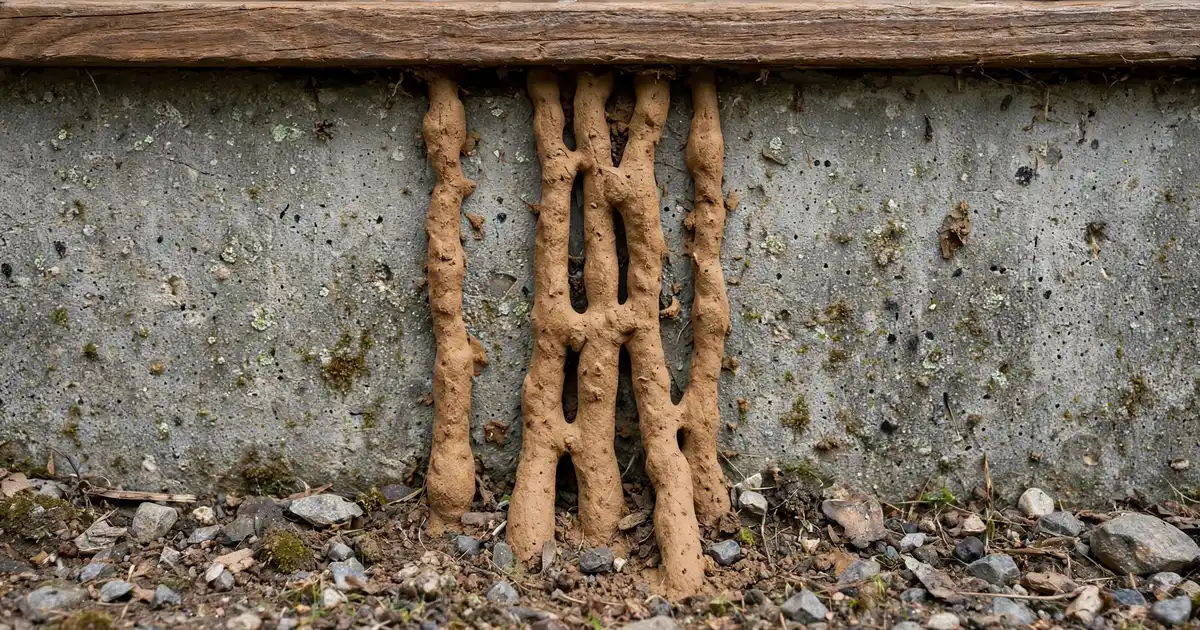
Table of Contents
- Why Termites Build Mud Tubes
- What Mud Tubes Look Like
- Where to Check for Mud Tubes
- Active Tube or Old Tube?
- What Mud Tubes Do Not Tell You
- What to Do When You Find Mud Tubes
- When to Call a Professional
- Frequently Asked Questions
Why Termites Build Mud Tubes
Subterranean termites live in colonies in the soil, sometimes well away from the house they are feeding on. The workers that eat wood are soft-bodied and lose moisture fast; exposed to dry Central Valley air and sunlight, they would not survive the trip between the colony and your floor framing. The mud tube solves that problem. Built from soil particles, saliva, and droppings cemented together, a tube is a humid, sealed tunnel that keeps workers moist and hidden while they commute.
That biology explains the tube’s location. Tubes appear where termites must cross an exposed surface they cannot eat — concrete foundations, masonry piers, metal, or a gap too wide to bridge through wood — on the way from ground to food. A tube climbing your foundation is, in effect, a sign that says: the colony is below, the wood is above, and this is the road between them.
The colony sending workers up that tube can be large, and the feeding happens out of sight, inside sill plates, studs, and floor joists. The tube is the part you can see of a system mostly hidden.
What Mud Tubes Look Like
A typical foundation mud tube:
- Width: Roughly pencil-width — a quarter to a half inch across — though tubes can merge into broader earthen sheets where a surface is heavily traveled.
- Texture and color: Dry, gritty, and earth-toned, matching local soil: tan, brown, or grayish. The surface looks like dried mud because that is mostly what it is.
- Path: Tubes run in fairly direct lines from ground to wood, often following a crack, a mortar joint, a plumbing penetration, or the seam where two building materials meet — anywhere that offers a sheltered route.
- Feel: An established tube is brittle and crumbly to the touch. (There is no need to test this; see the section below on leaving tubes in place.)
Inspectors also distinguish a few tube types, and you may spot more than one:
- Working tubes are the common foundation-to-wood highways described above.
- Exploratory tubes are thinner, more fragile tubes that wander across a surface as termites scout new routes or food sources.
- Drop tubes hang down from wood toward the ground, built where termites need to return to the soil from an elevated feeding site.
- Swarm tubes are wider, temporary structures built around the time a colony sends out winged swarmers, usually in spring.
You do not need to classify a tube you find. Noting where it is and what it connects is the useful part.
Where to Check for Mud Tubes
Tubes are easy to miss because they sit in the least-visited parts of a home. A slow walk with a flashlight, looking rather than touching, covers the main ground:
- Exterior foundation walls, especially where soil, mulch, or plantings touch the house and hide the wall’s base
- Crawl space piers and interior stem walls, where tubes often run in long, undisturbed lines
- Garage foundation walls and the interior sides of stem walls, behind stored items
- Around plumbing penetrations — where pipes pass through the foundation or slab, a favorite sheltered route
- Behind stucco or siding that extends below grade, where tubes can run hidden along the foundation face
- Along cracks in slabs and foundation walls, and at expansion joints
- On wood that contacts soil — fence posts, deck supports, and landscape timbers near the house can carry tubes too, and colonies working there can move to the structure
Our companion article, What Do Termite Droppings Look Like? A Guide to Identifying Frass, covers the drywood side of termite evidence; the two sign sets are different because the two termite types live differently. Our termite inspection guide for California homeowners describes how a full inspection works through these same areas systematically.
Active Tube or Old Tube?
This is the question every homeowner asks, and the honest answer is that you usually cannot tell from the outside. A tube that looks dry and dusty may still be in daily use — the workers are inside the sealed interior, not on the surface. A tube left from a colony treated or gone years ago can remain stuck to a foundation indefinitely, looking much the same as a live one.
A few observations can inform the picture without proving it:
- Tubes found alongside other fresh signs — swarmers, discarded wings, newly soft wood — suggest current activity in the area.
- A tube that appears in a spot you check regularly is newer than one unchanged for years, though even an unchanged tube is not proof of inactivity.
- Tubes that reappear along the same line after weather damage or cleaning hint at an active route being maintained.
Professionals determine activity as part of an inspection, looking at the tube and the wood it leads to together. Because the answer changes what should happen next, it is not a question worth settling by guesswork — and it is a reason not to scrape tubes off before anyone has read them as evidence.
What Mud Tubes Do Not Tell You
It helps to be clear about the limits of this one sign:
- A tube does not measure damage. Workers may have fed for a long time in wood you cannot see, or the route may be recent with little feeding so far. The damage question is answered by inspecting the wood the tube leads to, not by the tube itself.
- One visible tube does not mean one entry point. Termites commonly run several routes into a structure. The tube on the front foundation says nothing about the crawl space pier on the far side.
- No tubes does not mean no termites. Tubes can be hidden behind siding, below soil level, inside a wall, or unnecessary altogether where wood contacts soil directly and termites never need to cross an exposed surface. Drywood termites, which live in the wood itself, never build tubes at all.
- A tube does not identify urgency by size. A fat tube is not automatically worse than a thin one; colony size and damage are separate questions.
The fuller picture — signs, species, and how inspection findings fit together — is laid out in our complete guide to termites in Central Valley homes.
What to Do When You Find Mud Tubes
Sensible steps are mostly about observation and restraint:
- Note and photograph the locations. Which wall, how high the tube runs, and what wood it reaches. Photos with rough location notes give an inspector a head start.
- Check the other likely spots listed above, and note any tubes, soft wood, or wings you find elsewhere.
- Leave the tubes in place. Scraping them off erases evidence of where termites travel and how the routes connect, and it does nothing to the colony in the soil.
- Do not spray into or around the tubes. Over-the-counter spraying at one route can push activity to appear somewhere else and makes the colony’s actual routes harder to read, without reaching the colony itself.
- Reduce obvious invitations near the spot — firewood stacked against the foundation, wood debris in contact with soil, and mulch piled high against the wall are worth moving as ordinary maintenance.
Then have the situation inspected. Treatment decisions for subterranean termites — where the colony is, which wood is affected, and what approach fits — follow from findings. Treatments are applied according to the product label and California regulations. Our termite control service page outlines how that process starts.
When to Call a Professional
Call for an inspection when:
- You find any mud tube on a foundation, pier, or stem wall — new or old-looking
- You find tubes in more than one location on the structure
- Tubes appear near wood that also feels soft, sounds hollow, or shows blistered paint
- You find winged termites or piles of discarded wings indoors, especially in spring
- You are buying a home and tubes are present, so the question is answered before the sale rather than after
Pentecost Pest Control is a family-owned company based in Modesto, at 3501 Coffee Rd, Modesto, CA 95355. We provide termite inspection, monitoring, and treatment for homes across Stanislaus and San Joaquin Counties, and we walk you through what the tubes and the wood together actually show before recommending anything.
Frequently Asked Questions
If I break a mud tube and it is not rebuilt, is the colony gone?
Not necessarily. A broken section that stays broken can mean the route was abandoned — but colonies also reroute, use other tubes, or feed where wood touches soil and no tube is needed. A route going quiet is one data point, not a clearance, which is why activity is judged from the whole inspection rather than a single tube test.
Can I just knock the tubes down and spray?
Knocking tubes down removes the sign, not the colony, which lives in the soil. Spraying at the visible route does not reach the colony either, and it can make activity shift to less visible routes, which works against you. The tubes are most valuable left in place until an inspection has used them as evidence.
Do mud tubes mean I definitely have damage?
They mean termites have a route into the structure and a reason to use it — feeding in your wood. How much feeding has happened is a separate question answered by inspecting the sill plates, joists, and studs the tubes lead to. Some tube discoveries come with modest findings; others come with significant hidden damage. The tube alone cannot distinguish those cases.
Will termites leave on their own if I remove wood near the house?
Removing wood-to-ground contact and debris near the foundation is good maintenance and reduces invitations, but an established colony feeding in a structure does not relocate because the yard got tidier. The colony remains in the soil with its route into the house intact until the situation is addressed directly.
How much does it cost to deal with subterranean termites?
It depends on factors an inspection establishes: how many entry routes exist, which wood has been damaged and how much, the size and construction of the home, and which treatment and monitoring approach fits the findings. A single route with early findings is a smaller job than multiple routes with damaged framing. Honest pricing follows the inspection, and a written quote should spell out what it includes.
Found tubes climbing your foundation, in the crawl space, or along a garage wall? Call (209) 581-5562 or request a free estimate — tell us where you are seeing them, and we will start with an inspection and show you what the evidence means.
By the Pentecost Pest Control Editorial Team
This article is for general educational purposes only. Pest conditions, regulations, and treatment options vary by property and situation. Contact a licensed pest control professional for an inspection.