
During a termite inspection, an inspector examines the accessible areas of your home — the exterior, the interior, the attic, the crawl space if there is one, and the garage — looking for live termites, evidence such as mud tubes, droppings, and damaged wood, and conditions that make an infestation more likely. When the walk-through is done, you receive a written report describing what was found, where it was found, and what is recommended. That is the short version. The rest of this guide explains the process in full: what inspectors actually look for, what an inspection cannot see, how a California termite inspection fits into buying or selling a home, how to read the report when it arrives, and what your options are once you have it. If you are still at the identification stage, our complete guide to termites in Central Valley homes covers the two California species and their signs in depth; this article picks up where that one leaves off.
Key Takeaways
- A termite inspection is a visual examination of the accessible areas of a home, done to find live termites, evidence of current or past activity, damage, and conditions that invite termites in.
- Inspectors work from evidence: mud tubes, pellet-like droppings called frass, discarded wings, hollow or damaged wood, and conducive conditions such as wood touching soil, plumbing leaks, and poor drainage.
- The written report is the real product of the visit. It lists findings, usually with a diagram of the structure, separates active problems from conditions that could lead to them, and makes recommendations.
- An inspection is not an appraisal and not a general home inspection, and it can only cover areas that can be reached and seen. Activity hidden inside sealed walls cannot be confirmed visually.
- In California, termite inspections are commonly requested during home sales, and the report becomes the shared record that buyers, sellers, and lenders work from.
- What happens next depends on the findings: treatment, monitoring, repairs, correcting conditions, a follow-up inspection — or simply filing the report away and checking again later.
- Pentecost Pest Control provides termite control and termite inspections for homes and businesses across Stanislaus and San Joaquin Counties.
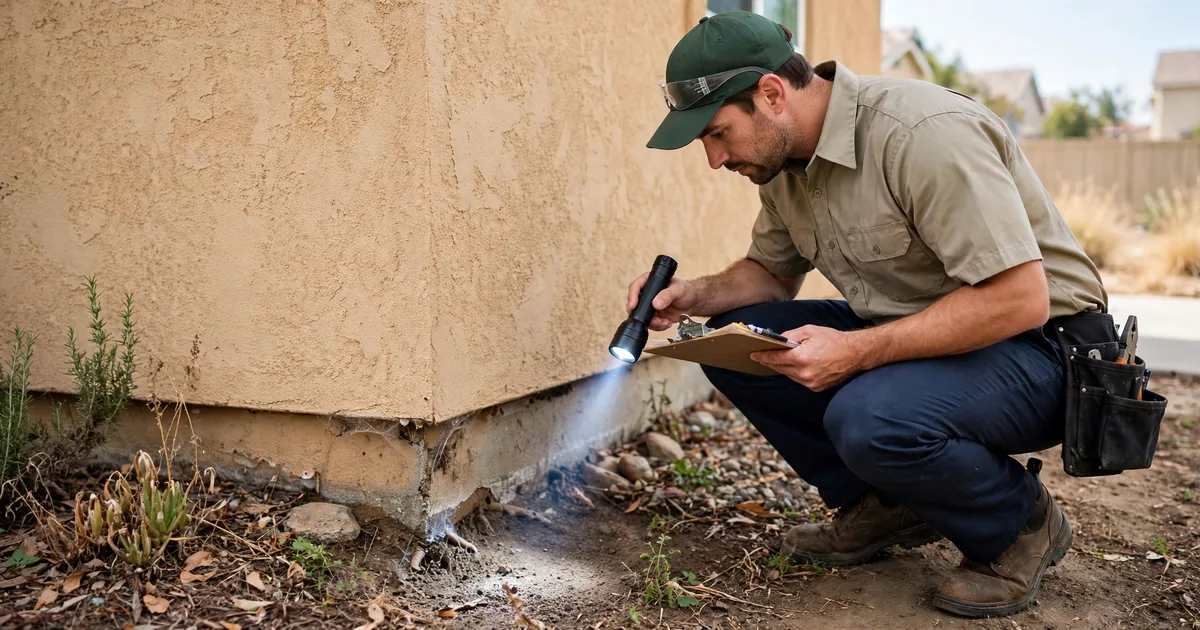
Table of Contents
- What a Termite Inspection Is and Is Not
- What Inspectors Look For
- Areas a Termite Inspection Covers
- What Limits an Inspection
- The Written Report and How to Read It
- Termite Inspections in a California Home Sale
- After the Report: Next Steps
- How to Prepare Your Home for an Inspection
- How Often Should a Home Be Inspected?
- When to Call a Professional
- Frequently Asked Questions
What a Termite Inspection Is and Is Not
A termite inspection — often called a wood-destroying pest inspection — is a focused examination of a structure for termites and the conditions associated with them. California reports in this field commonly address wood-destroying pests and organisms generally, which means an inspector may also note things like wood decay or other wood-destroying insect activity when they are visible, because they are part of the same picture: wood, moisture, and access. In California, this kind of structural pest control work is regulated, inspections are documented with written reports, and the state Structural Pest Control Board (spcb.ca.gov) is the agency that oversees licensing — a homeowner can verify any company’s standing there before hiring it.
Just as important is what an inspection is not:
- It is not an appraisal. An appraisal estimates a property’s market value for a buyer or lender. An appraiser may note a visibly damaged board or a stain, but appraisers do not crawl subareas looking for mud tubes, and an appraisal says nothing reliable about termites.
- It is not a general home inspection. A home inspector evaluates the overall condition of a house — roof, electrical, plumbing, heating and cooling, and so on. A home inspector who spots possible pest evidence will typically recommend a dedicated wood-destroying pest inspection rather than diagnose it, because the termite inspection is a separate specialty with its own report.
- It is not a promise that a home is termite-free everywhere. An inspection covers what can be seen in accessible areas on the day of the visit. It is a professional visual assessment, not X-ray vision, and an honest report describes its own scope and limits.
- It is not treatment. The inspection diagnoses. Whether anything should be treated, repaired, monitored, or simply watched is a separate decision that the findings inform.
Keeping those distinctions straight prevents most misunderstandings. Homeowners are sometimes disappointed that an inspector did not “check the roof” or alarmed that a report lists conditions when no termites were found — both reactions come from expecting a different document than the one a termite inspection produces.
What Inspectors Look For
Inspectors rarely start by finding a live termite. Colonies live hidden in soil or inside wood, so inspections are built around the evidence termites leave behind and the conditions that support them. Here is what an experienced inspector is scanning for, and why.
Mud tubes
Subterranean termites travel between their colony in the soil and the wood they eat through pencil-width tubes built from soil and saliva. Inspectors look for tubes on foundation walls, on piers and posts in a crawl space, where plumbing passes through a slab, and running up garage or interior walls. A tube proves termites made the trip at some point; its location shows where they were getting in. Whether a tube is currently active is something the inspector evaluates on site — either way, it belongs in the findings.
Damaged or hollow-sounding wood
Inspectors tap and gently probe suspect wood — baseboards, door and window frames, sill plates, joists, exposed attic framing. Wood that termites have been eating from the inside often sounds hollow or papery when tapped, and a probe may push through a painted surface that has almost nothing left behind it. Visible galleries in exposed or broken wood, blistered or uneven paint, and floors that feel spongy all get the same close look.
Frass (termite droppings)
Drywood termites push hard, oval droppings out of small holes in the wood they inhabit, and the pellets collect in piles below — under attic framing, on windowsills, in garages, beneath eaves. Inspectors note where frass appears, because the pile usually sits almost directly under the colony producing it. Frass that reappears after being swept away points to activity that is still going on above.
Discarded wings and swarmers
Reproductive termites shed their wings after a swarm flight. Inspectors check windowsills, door thresholds, spider webs in corners, and attic spaces for accumulations of similar translucent wings, and they ask whether anyone has seen winged insects emerging indoors. Wings inside a house can mean a colony in the structure itself; wings only outdoors may have come from landscape wood — the distinction matters, and the rest of the evidence usually settles it.
Conducive conditions
Half of a good inspection is not about insects at all. Inspectors note conditions that make infestation more likely, because correcting them is part of preventing the next problem:
- Wood in contact with soil — siding or stucco running below grade, deck posts, planter boxes, fence connections, and scrap lumber or form boards left in a crawl space
- Plumbing leaks and chronic moisture, especially in crawl spaces and under bathrooms, kitchens, and laundry rooms
- Poor drainage — soil or landscaping that slopes toward the foundation, clogged gutters and downspouts, standing water in the subarea, irrigation that soaks the foundation line
- Cellulose debris and stored wood near or under the structure, including firewood stacked against a wall
- Cracks and openings at foundations, joints, and utility penetrations that give subterranean termites a protected route in
In the Central Valley, irrigation does a lot of quiet work on this list. Lawns and drip lines keep the soil along a foundation moist through the whole dry summer, which is exactly what subterranean termites need, and a slow plumbing leak under a raised-foundation home can go unnoticed for a long time. Expect a thorough report from a Valley home to have something to say about moisture.
Areas a Termite Inspection Covers
An inspection proceeds area by area through everything that can be reached and seen without moving the household out or opening the structure up:
- The exterior. The inspector walks the full perimeter: foundation and slab edges, siding and stucco, eaves and fascia, door and window frames, wood-to-ground contact, fence and deck connections, stumps, stored wood, and the grade and drainage against the house.
- The interior. Accessible walls, baseboards, window and door frames, and closets are checked for frass, kick-out holes, bubbling paint, and hollow-sounding wood. Kitchens, bathrooms, and laundry areas get extra attention because of plumbing.
- The attic. For drywood termites especially, the attic is prime territory — exposed framing, frass on insulation or stored items, and swarm evidence. The inspector moves as far as safe access and headroom allow.
- The crawl space or subarea, if the home has one. This is where subterranean activity often shows first: mud tubes on piers and foundation walls, damaged sill plates and joists, plumbing leaks, debris in the soil, and standing water. Many raised-foundation homes in older Valley neighborhoods are decided here.
- The garage and attached structures, which share walls, framing, and slab edges with the house and are often where stored wood and cardboard give inspectors their first clues.
Detached structures — a separate garage, workshop, or outbuilding — may or may not be part of a given inspection, so if you have them, say so when you schedule and confirm what will be covered. On rural and agricultural properties around our counties, outbuildings and stored lumber deserve the same question.
What Limits an Inspection
An inspection is visual, and it is limited to areas that are accessible. Understanding the limits makes the report easier to read and its conclusions easier to trust:
- Inspectors do not open the structure. They do not remove wall coverings, pull up flooring, dismantle fixtures, or tear out insulation to chase a suspicion. If evidence suggests something hidden, the report says what was found and what further evaluation or exposure would be needed — it does not guess.
- Stored belongings block views. Boxes stacked against garage walls, furniture covering baseboards, and packed closets hide exactly the surfaces inspectors need to see. Areas that could not be reached are normally listed in the report as inaccessible, which is a statement of fact, not a finding of a problem.
- Some spaces restrict movement. Low crawl space clearance, ductwork, steep or cluttered attics, and unsafe conditions can limit how far an inspector can go, even where an access opening exists.
- Hidden activity can exist without visible evidence. A colony can be feeding inside a wall or a sealed member before any frass, tube, or surface damage reaches a place an inspector can see. “No evidence found” is not the same sentence as “no termites anywhere,” and any report that seems to promise the second is overpromising.
This is not a weakness unique to one company; it is the nature of a visual inspection, and it is exactly why periodic inspections and monitoring exist for homes in termite country. The report tells you what was found where someone could look — and tells you where nobody could.
The Written Report and How to Read It
The report is the deliverable. A verbal summary at the door is useful, but the written document is what you keep, share with a buyer or seller, and compare against at the next inspection. While formats vary, a California wood-destroying pest report generally contains the same building blocks:
- Property and scope information — the address, the date, what was inspected, and what was inaccessible.
- A diagram of the structure marking where findings are located, so “activity at the rear foundation” becomes a specific, findable place.
- Findings of infestation or damage — where evidence of termites or other wood-destroying problems was actually found, and what that evidence was.
- Findings of conducive conditions — the moisture, drainage, wood-to-ground contact, and similar items described above, listed even when no active infestation was found with them.
- Recommendations — what the company advises for each finding: treatment where activity exists, corrections for conditions, and referrals where work belongs to another trade, such as a plumber for a leak or a contractor for structural repair.
The single most useful thing to understand is the difference between the two kinds of findings. Reports in California commonly separate them: on one side, findings that show active infestation or damage — termites or their damage are there now; on the other, findings about conditions likely to lead to infestation or damage if they are not corrected — the leak, the earth-to-wood contact, the debris. Both kinds matter, but they call for different responses, and much of the confusion around termite reports comes from reading a condition as if it were an infestation, or the reverse.
A practical way to read yours:
- Start with the recommendations, then match each one back to its finding and to the spot on the diagram.
- Sort the findings into “activity/damage now” and “conditions to correct,” and note which recommendations go with each.
- Read the scope and inaccessible-areas notes, so you know what the report does not cover.
- For each recommendation, ask what it addresses, what it involves, and what happens if it is deferred.
- Keep the report. At a sale it is part of the transaction record, and at your next inspection it is the baseline that shows what has changed.
Pricing for any recommended work may be provided with the report or as a separate estimate from the company; the report itself is the findings document. If a recommendation is not clear, ask the inspector to walk you through it — explaining findings in plain language is part of the job.
Termite Inspections in a California Home Sale
Wood-destroying pest inspections are a familiar part of buying and selling homes in California, and for many homeowners the first termite report they ever see arrives in the middle of a transaction. A few general points help the process make sense.
A termite inspection is commonly requested once a home is under contract — and sometimes before a home is listed at all. Who orders it varies: a seller may have a home inspected before listing so findings can be dealt with, or priced in, ahead of time; a buyer may order one during their inspection period; and a lender connected to the purchase may require documentation about wood-destroying pests. Who pays, and which findings get corrected before the sale closes, is worked out between the parties as part of the negotiation — there is no single pattern that applies to every sale, and your agent and the inspector can explain how it is being handled in yours.
This is where the two kinds of findings described above do practical work. A report gives both sides the same facts: what shows active infestation or damage, and what shows conditions likely to lead to infestation or damage if they are left alone. The parties can then decide which items will be treated or corrected, which will be credited or left to the buyer, and which need no action. When agreed work is completed, a follow-up inspection or completion documentation can confirm that the items were addressed, which keeps the transaction record clean.
Two pieces of advice hold up in almost every transaction. First, read the report as soon as it is available and ask questions while there is still time in the process to act on the answers. Second, if you are the buyer, keep the report after closing. It is your baseline: the next inspector, and future you, will want to know exactly what was found and done before you owned the home.
After the Report: Next Steps
What happens after a termite inspection depends entirely on what the report says. The common paths look like this:
- No activity, few or no conditions. The simplest outcome. Correct whatever minor conditions were listed, file the report, and rely on periodic inspections from there. A clean report is a snapshot, not a lifetime pass — but it is a good snapshot to have.
- Conditions but no infestation. Treat this as the report doing its cheapest work. Fix the leak, clear the debris, correct the drainage, remove the wood-to-ground contact. These corrections are usually homeowner or handyman-scale tasks, and they remove the setup for a future finding that would cost more to answer.
- Active infestation. Treatment is recommended, and the kind follows the species and the extent: localized treatment where drywood activity is limited and accessible, whole-structure treatment where it is widespread, and soil- and foundation-focused treatment for subterranean activity. Our guide to termites in Central Valley homes explains these categories in general terms, and your inspector should explain why the recommended option fits your findings before any work is agreed to.
- Monitoring. For subterranean risk — past activity nearby, conducive surroundings, a home where early detection matters — monitoring stations checked on a schedule may be recommended, either after treatment or on their own as an early-warning measure.
- Repairs. Treatment addresses termites; it does not rebuild wood. Where damage affects structural members, the report’s findings give a contractor what is needed to evaluate and repair, and significant damage is worth a contractor’s eyes regardless of the treatment decision.
- Re-inspection. After treatment or corrections are completed, a follow-up inspection confirms the work addressed the findings — commonly part of a home sale, and sensible any time you want documentation that a listed item is resolved.
One more option deserves a mention: for a large or surprising recommendation, a second inspection from another company is a reasonable step. You are comparing findings first and proposals second — the companies should be describing the same house.
How to Prepare Your Home for an Inspection
A little preparation makes an inspection more complete, because the inspector can reach more of the home. None of it is complicated:
- Clear access to the attic hatch and the crawl space opening, if there is one — move stored items, vehicles, or shelving that block them.
- Pull stored items a foot or two away from garage and foundation walls where you can, so the wall bases and slab edges are visible.
- Empty or tidy the cabinets under kitchen and bathroom sinks, since plumbing areas are always examined closely.
- Unlock gates, sheds, and outbuildings included in the inspection, and make sure the water heater and furnace closets can be opened.
- Secure pets somewhere out of the way for the duration of the visit.
- Gather any previous inspection reports or treatment records you have; knowing what was found or done before helps the inspector compare.
- Make a short note of anything you have seen — wings on a sill, a pile of pellets, a soft spot in a frame — and where. Homeowners’ observations routinely point inspectors to the right wall.
If an area genuinely cannot be cleared, do not worry about it — the report will note it as inaccessible, and you can decide whether a return look is worth arranging.
How Often Should a Home Be Inspected?
There is no single schedule printed anywhere that fits every California home, and any company that hands you one without asking about your house is guessing. The sensible rhythm depends on your history and your structure: a home that has had activity before, a raised-foundation home with a crawl space, or a property with ongoing moisture or wood-to-soil conditions deserves more frequent attention than a newer slab home with a clean history and a dry perimeter. Many Central Valley homeowners fold termite checks into the same routine maintenance rhythm as the rest of the house — the way they already think about the roof — rather than treating the inspection as something that only happens during a sale.
Certain moments call for an inspection regardless of when the last one was:
- You are buying or selling the home
- You find any of the signs in this guide — tubes, frass, wings, soft or hollow wood
- A plumbing leak or drainage problem is discovered or repaired, especially under the house
- You are opening walls, replacing siding or decking, or remodeling anyway, which is a rare chance to look at what is normally hidden
- Neighbors on your street have treated for termites, or infested wood, a stump, or a fence has been removed nearby
Most of our residential pest control customers treat the periodic inspection the same way they treat prevention itself: a normal, unglamorous part of owning a home where termites are a normal, year-round fact of life.
When to Call a Professional
Reading about inspections is useful; knowing when to book one is the point. Call for a termite inspection when:
- You find mud tubes, frass piles that return after cleaning, discarded wings, or winged insects emerging indoors
- Wood sounds hollow, feels soft, or shows damage you cannot explain
- You are buying or selling a home and a wood-destroying pest inspection is part of the transaction — or you want your own before you commit
- The home has had termites before and you want to confirm nothing has returned
- A leak, a remodel, or a repair has exposed framing or subarea conditions you would rather have evaluated while they are open
- Your most recent report is old enough that you no longer trust it as a picture of the house today
A note on doing it yourself: homeowners do valuable work here — noticing signs early, controlling moisture, storing wood sensibly. But inspection findings carry weight in real estate transactions, and treatment decisions depend on correct species identification and a full picture of where activity is, which is the part a walk-around cannot reliably give you. Structural pest control in California is regulated for a reason, and you can verify a company’s license through the Structural Pest Control Board (spcb.ca.gov) before you hire — feel free to check any company, including ours.
Pentecost Pest Control is a family-owned company based in Modesto, at 3501 Coffee Rd, Modesto, CA 95355. We inspect homes and businesses across Stanislaus and San Joaquin Counties, explain what we find in plain language, and base our recommendations on the species and the extent of activity we actually document — not on a package decided before anyone looked at your house.
Frequently Asked Questions
How much does a termite inspection cost?
It depends on factors an inspector can only assess for a specific property: the size of the home, its construction (a raised foundation with a crawl space takes more time to examine than a slab), how accessible the attic and subarea are, how many structures are included, and what the inspection turns up. A report prepared for a real estate transaction can also involve documentation that a routine homeowner check does not. Honest pricing follows from those factors rather than a phone guess, and inspection cost is separate from the cost of any treatment or repairs the report may recommend.
Is a termite inspection the same as a home inspection?
No. A home inspection evaluates the overall condition of a house — roofing, electrical, plumbing, heating and cooling, and similar systems. A termite inspection is a separate, focused examination for wood-destroying pests, their evidence and damage, and the conditions that lead to them, and it produces its own written report. During a home purchase, the two are often both ordered, because they answer different questions.
Can the inspector see inside my walls?
No. A termite inspection is visual and covers accessible areas only. Inspectors do not open walls, remove flooring, or dismantle fixtures. What they can do is read surface evidence — frass, tubes, paint changes, hollow-sounding wood — and tell you where hidden activity is suspected and what further steps would confirm it. Areas that could not be reached are listed in the report as inaccessible.
The report lists conditions but found no termites. Should I care?
Yes — that is the report catching a problem at its cheapest stage. Conducive conditions such as a plumbing leak, wood in contact with soil, debris in the crawl space, or drainage running toward the foundation are the setup termites use. Correcting them does not require treatment, and it lowers the chance that the next report has a worse kind of finding on it.
Who orders and pays for the inspection when a home is sold?
It varies. Inspections are commonly requested during California home sales — by buyers during their inspection period, by sellers preparing to list, or at a lender’s request — and who pays, and which findings are corrected before closing, is decided in the negotiation between the parties. Your real estate agent can explain the arrangement in your transaction; the inspector’s job is to make sure the findings themselves are clear to everyone reading them.
What happens if the inspection finds termites?
The report will document what was found and where, and the company will explain the recommendations: treatment suited to the species and how widespread the activity is, corrections for any conducive conditions, and referrals for repair where damaged wood needs a contractor. Nothing proceeds until you understand the findings and agree to the work. After treatment or corrections, a follow-up inspection can confirm the items were addressed.
Ready to have your home checked? Call (209) 581-5562 or request a free estimate. Tell us what prompted the call — a home purchase, a pile of wings, a report you need explained — and we will schedule the inspection and walk you through what it finds.
By the Pentecost Pest Control Editorial Team
This article is for general educational purposes only. Pest conditions, regulations, and treatment options vary by property and situation. Contact a licensed pest control professional for an inspection.