
When winged insects pour out near a window or gather under a porch light, the quickest way to separate termite swarmers vs flying ants is to check three features: the antennae, the waist, and the wings. A termite swarmer has straight antennae, a broad waist with no pinched middle, and two pairs of wings that are all the same length. A flying ant has bent, elbowed antennae, a narrow pinched waist, and front wings that are noticeably longer than its rear wings. Getting this identification right matters in the Central Valley: a termite swarm can signal a colony in or near your home, while a flying ant swarm, though a nuisance, usually does not.
Key Takeaways
- Termite swarmers: straight antennae, broad waist, four wings of equal length that shed easily.
- Flying ants: elbowed antennae, pinched waist, front wings longer than rear wings.
- Both insects shed their wings, so piles of wings alone do not prove termites — check any intact insects you can find.
- In the Modesto area, subterranean termites usually swarm in spring after rain, while drywood termites swarm in late summer and fall; local ant species also swarm in warm months.
- Save a few insects in a sealed container — a confirmed identification guides every next step.
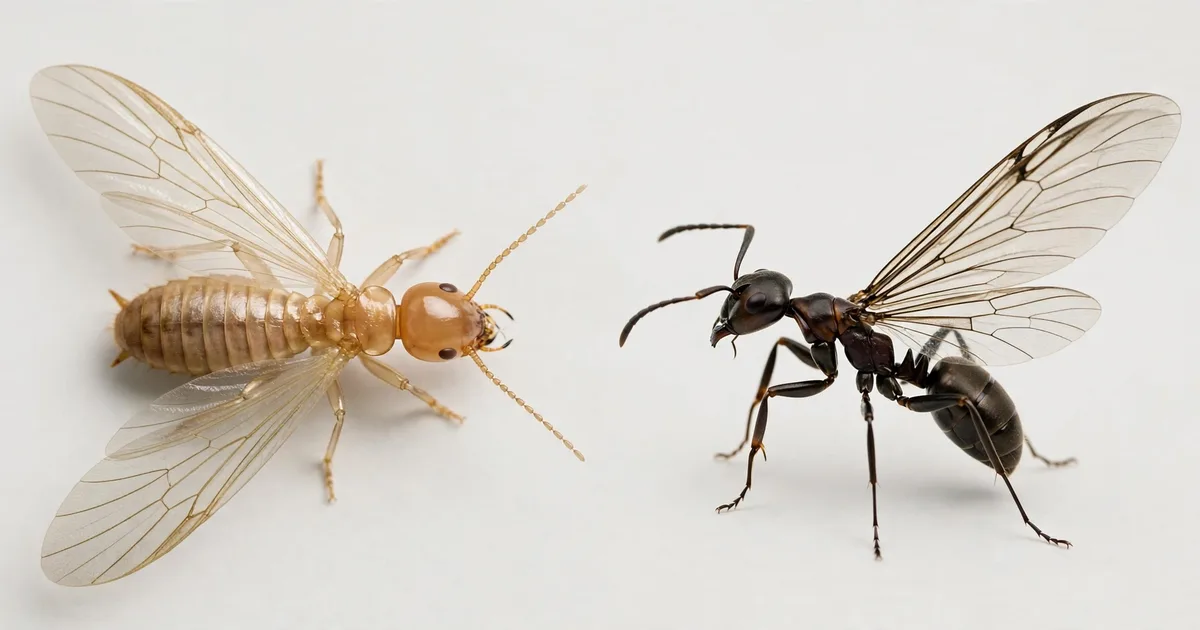
Table of Contents
- Why These Two Insects Get Confused
- The Three Features That Tell Them Apart
- Side-by-Side Comparison
- When Each One Swarms in the Central Valley
- What a Swarm Means — and What It Does Not
- What to Do When You Find Winged Insects Indoors
- When to Call a Professional
- Frequently Asked Questions
Why These Two Insects Get Confused
Termites and ants are unrelated insects, but their winged reproductive forms look similar at a glance: small, soft-bodied, roughly the same size, and suddenly present in large numbers. Both swarm for the same reason — mature colonies release winged adults that fly off, land, shed their wings, and attempt to start new colonies. Both are drawn to light, which is why they turn up at windows, lamps, and porch fixtures. And because both shed their wings shortly after landing, the evidence homeowners find first is often just a scatter of wings on a sill, which the two groups leave in nearly identical fashion.
The differences are clear once you look closely at a single insect, ideally with a phone photo you can zoom in on. Color alone is not dependable — both come in shades of brown and black — so use the structural features below instead.
The Three Features That Tell Them Apart
Antennae. This is the easiest check. Termite antennae are straight or gently curved, like a string of small beads. Ant antennae bend sharply in the middle, forming an elbow. If the antennae have an obvious angle in them, you are looking at an ant.
Waist. Look at where the middle of the body narrows between the thorax and the abdomen. Ants have a distinctly pinched waist — a thin, tight segment that gives them their familiar hourglass outline. Termites do not; their bodies run in one broad, fairly uniform line, so the waist looks thick and straight.
Wings. Both insects have two pairs of wings, but termite wings are all the same length as each other and extend well past the end of the body. Ant wings are mismatched: the front pair is clearly longer than the rear pair. Termite wings also detach very easily — they are designed to break off after the flight — so termites often leave wings scattered even where no insects remain.
Side-by-Side Comparison
| Feature | Termite Swarmer | Flying Ant |
|---|---|---|
| Antennae | Straight, bead-like | Bent with a distinct elbow |
| Waist | Broad, no pinched segment | Narrow, visibly pinched |
| Wings | Two pairs, all equal in length | Front pair longer than rear pair |
| Wing shedding | Wings break off very easily after landing | Wings shed after landing, somewhat less readily |
| Body outline | Uniform width, soft-bodied | Hourglass outline with defined segments |
| What the swarm suggests | A termite colony in or near the structure | An ant colony nearby, often outdoors or in a wall void |
One more distinction worth knowing: if the winged insects are large and you also find coarse sawdust-like material or smooth holes in wood, carpenter ants enter the picture. Carpenter ants are ants — the elbowed antennae and pinched waist still apply — but unlike most ants they excavate damp wood for nesting, so their presence in a structure deserves attention of its own. Our guide to termites in Central Valley homes covers the termite side of the comparison in full.
When Each One Swarms in the Central Valley
Timing offers a supporting clue, though never a certain one. Subterranean termites in the Modesto area typically swarm on warm spring days, frequently right after rain soaks the soil. Drywood termites swarm later, in late summer into fall, often on warm evenings. Our article Drywood vs Subterranean Termites: How to Tell the Difference goes deeper on how the two termite types behave.
Ants swarm across a broader stretch of the warm season. Various local ant species release winged reproductives in spring and summer, and indoor emergence from a colony nesting in a wall or under a slab can happen outside the usual pattern. Treat the calendar as a hint, and the insect’s body as the answer.
What a Swarm Means — and What It Does Not
A termite swarm indoors is significant because swarmers emerging inside have usually come from a colony in the structure or directly beneath it — they do not fly far, and they head toward light, which is why they collect at windows. A swarm just outside, in the yard or at a porch light, is less conclusive: the colony may be in a fence, a stump, or soil nearby rather than in the house. Either way, confirmed termite swarmers on your property are a sound reason to have the home inspected. Our termite inspection guide for California homeowners outlines how that inspection works and what it looks for.
A flying ant swarm means an ant colony is close by and mature enough to reproduce. Most house-invading ants in our area do not damage wood, so an ant swarm is mainly a nuisance event — but it does tell you a colony is established nearby, and if swarms appear indoors repeatedly, the colony may be nesting in the structure itself. Carpenter ants are the exception noted above and warrant a closer look when the insects are large.
What to Do When You Find Winged Insects Indoors
- Save samples. Collect a few intact insects — with wings attached if possible — in a sealed jar or container. Dead ones from a windowsill work fine.
- Note the details. Where they appeared, how many, the date, and whether it followed rain. A quick photo helps too.
- Do not spray the swarm and stop there. Killing the swarmers you can see does nothing about the colony they came from, and it can destroy the evidence needed for identification.
- Check for related signs. Look for mud tubes on the foundation, frass piles under wood, and other evidence from the room where the insects appeared. Our article Signs of Termites in Your Home: A Room-by-Room Checklist walks through where to look.
- Avoid sealing or repairing the area where insects emerged until the source is identified, since entry points are useful evidence during an inspection.
If treatment proves necessary, options depend on the pest and the extent of activity. Treatments are applied according to the product label and California regulations. For a sense of what influences the size of a termite job, see our overview of termite treatment cost factors, or review our termite control service page.
When to Call a Professional
Call if the insects you saved key out as termites, if you cannot tell what they are, or if swarms appear indoors more than once. Also call if a swarm is accompanied by mud tubes, frass, hollow-sounding wood, or any other termite sign. An inspector can confirm the identification, determine whether a colony is in the structure, and explain the options based on what is actually found. Pentecost Pest Control is a family-owned company at 3501 Coffee Rd in Modesto, serving homes throughout San Joaquin and Stanislaus Counties.
Frequently Asked Questions
I only found piles of wings, no insects. Can I still tell what they were?
Partially. If the wings are all roughly the same size and length, termites are more likely; a mix of longer and shorter wings points to ants. But wings alone are not a firm identification, so check nearby windows, lights, and spider webs for any intact insects, and consider having an inspector look at the area where the wings were found.
Do flying ants mean my house has a problem?
Usually not a structural one. Most ant species that swarm around Central Valley homes nest in soil, landscaping, or wall voids and do not damage wood. An indoor swarm does mean a colony is nearby or in the structure, which can be worth addressing for nuisance reasons, and large winged ants raise the possibility of carpenter ants, which do nest in wood and should be identified.
Should I be worried if termite swarmers appeared in my yard but not in the house?
A yard swarm means termites are active close to the home, possibly in soil, a stump, or a fence. It does not prove the house is infested, but it is a reasonable prompt for an inspection, since subterranean termites moving through the yard can reach the foundation. Peace of mind is a legitimate outcome of an inspection either way — the findings may simply be a recommendation to correct moisture and wood-to-soil contact.
Can termite swarmers start an infestation inside my house after they land?
Swarmers that land indoors almost always die quickly — they are poor crawlers, dry out fast, and pairs need suitable wood and conditions to found a colony. The swarm itself is a signal of an existing colony nearby rather than the start of a new one inside your living space. The colony they came from is the thing to find.
What time of year should I watch most closely?
Spring, especially warm days following rain, is the main subterranean termite swarm season in our area, and late summer through fall brings drywood swarmers. Winged ants appear across spring and summer. Any large indoor emergence of winged insects, in any season, is worth identifying while samples are fresh.
Found winged insects and want a firm identification? Call (209) 581-5562 or request a free estimate — bring or keep your samples, and we will tell you what you are dealing with and what, if anything, needs to be done.
By the Pentecost Pest Control Editorial Team
This article is for general educational purposes only. Pest conditions, regulations, and treatment options vary by property and situation. Contact a licensed pest control professional for an inspection.