
Most wildlife problems around Central Valley homes come from a short list of animals — raccoons, skunks, squirrels, bats, snakes, and birds — and nearly all of them start the same way: food, water, or shelter drew the animal close to the house, and a gap, vent, or uncapped chimney let it the rest of the way in. The homeowner’s first job is not to deal with the animal directly. It is to recognize the signs, identify which animal is involved, keep people and pets clear of it, and understand that in California the response runs through inspection, exclusion, and removal in line with California Department of Fish and Wildlife rules. This guide covers the six animals our customers ask about most, the signs each one leaves, how they get in, and when a problem stops being something to watch and becomes something to have inspected.
Key Takeaways
- The wildlife problems Central Valley homeowners deal with most involve raccoons, skunks, squirrels, bats, snakes, and birds — and each one leaves different signs and calls for a different response.
- Animals come to a house for food, water, and shelter, and they get in through predictable openings: uncapped chimneys, broken or unscreened vents, gaps at the roofline, crawl space openings, and pet doors.
- Noises are a useful first clue. Heavy, slow movement overhead at night suggests a larger animal; quick scurrying in the daytime points to squirrels; scratching and squeaking can mean bats or birds in a wall or vent.
- Many of these species are protected under California rules, or the work is restricted at certain times of year — bat work, for example, is timed around the maternity season — so identification and timing come before any other step.
- Never handle a wild animal, never seal an opening while animals may still be inside, and never try to move a snake. Each of those turns a manageable problem into a worse one.
- Exclusion — closing the entry points and removing what attracted the animal — is what keeps a solved problem solved. The same proofing approach used against rodents applies to most wildlife entry points.
- If you are hearing animals, finding droppings, or seeing damage at the roofline, start with an inspection. Pentecost Pest Control provides wildlife inspections for homes across Stanislaus and San Joaquin Counties.
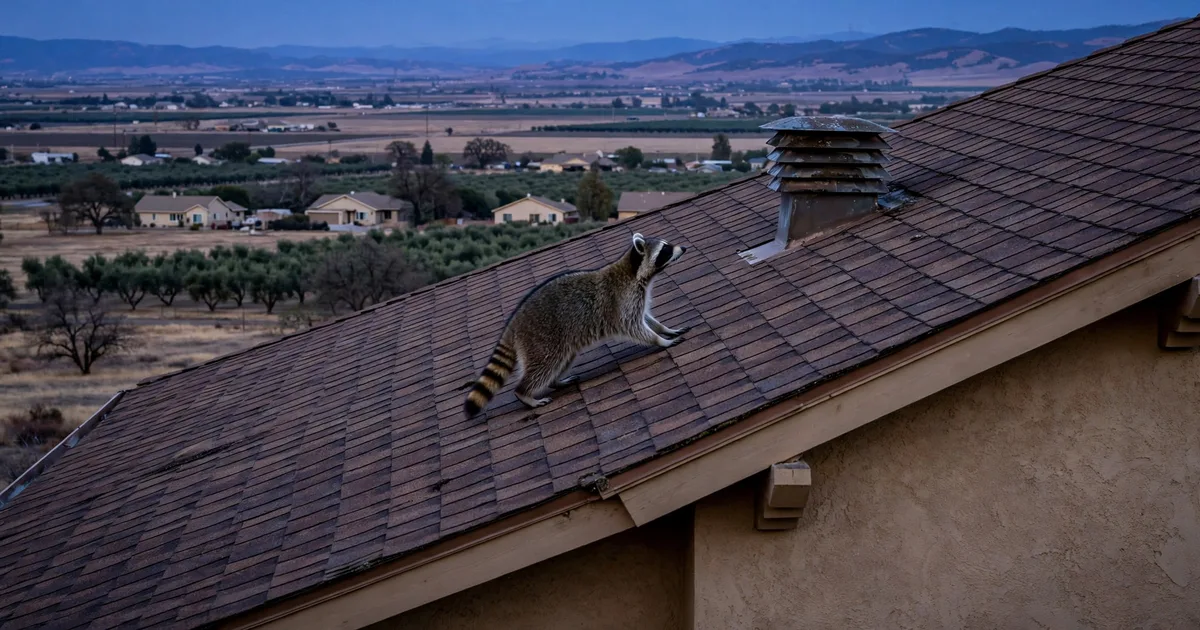
Table of Contents
- Raccoons: Attics, Chimneys, and Roof Damage
- Skunks: Under Decks, Porches, and Sheds
- Squirrels: Attic Gnawing and Roofline Entry
- Bats: Roosting in Structures
- Snakes: Yard Encounters
- Birds: Vents, Rooflines, and Droppings
- How Wildlife Gets Into a House
- Signs of Wildlife by Location
- Wildlife Work and California Rules
- Prevention and Exclusion
- What Not to Do
- When to Call a Professional
- Frequently Asked Questions
Raccoons: Attics, Chimneys, and Roof Damage
Raccoons are the largest and most destructive of the animals in this guide, and the ones most likely to move into the structure itself rather than just the yard. They are strong climbers, active at night, and remarkably good with their paws — a raccoon can pull up a loose shingle, bend back a vent cover, or work at a piece of fascia until it gives. In Modesto and the surrounding Valley towns, the classic raccoon call is heavy thumping or slow, deliberate movement in the attic at night, often with scratching or vocal sounds mixed in.
Where they shelter. Attics are the first choice, especially in late winter and spring, when a female raccoon is looking for a den to raise young. An uncapped chimney is another — the flue ledge and smoke shelf make an appealing den site, and homeowners sometimes first realize a raccoon is in the chimney when they hear movement or scratching above the damper. Raccoons also den in crawl spaces, under decks, and in outbuildings, and they will use the same site repeatedly once they settle in.
Signs. Torn or displaced shingles and fascia, a vent cover pulled loose, entry holes at the roofline that look ragged rather than gnawed, and insulation that has been pushed into matted trails or nesting areas. Raccoons also tend to use one repeated spot as a latrine — on a roof, in an attic corner, or at the base of a favored tree — and a latrine is often easier to spot than the animal itself.
Concerns. Raccoon droppings and urine contaminate insulation and attic surfaces, and accumulated latrine material is not something to stir up or handle casually; cleanup of an established attic latrine is work to discuss with the professional handling the job. The structural damage matters too: a raccoon that tore its way in has made a hole that rain, and the next animal, will use. If young are present in a den, timing and method change — a professional inspection establishes what is actually in the attic before anything is closed up.
Skunks: Under Decks, Porches, and Sheds
Skunks are quieter tenants. A striped skunk rarely enters the house itself; it digs in under a deck, porch, shed, or slab edge and sets up a burrow where the home’s perimeter gives it cover. Skunks are nocturnal and generally keep to themselves, and most homeowner contact happens by accident — a dog that corners one at night, or a burrow discovered when the odor gives it away.
Where they shelter. Any low, covered void at ground level: the space under a deck or porch, beneath a shed or outbuilding, under a concrete slab edge where soil has washed out, or in a hollow log or dense brush pile near the house. A skunk den usually has a modest entrance hole, roughly fist-sized to a little larger, with loose soil fanned around it.
Signs. The digging is distinctive: small, cone-shaped holes in a lawn, a few inches across, where a skunk has nosed into the soil after grubs and insects. A patch of turned-up lawn overnight often means skunks are feeding there. Entrance holes under structures, a lingering musky odor near a deck or crawl space vent, and — the sign nobody misses — the smell after a pet has been sprayed are the other common reports.
Concerns. The spray is the obvious one: a dog that confronts a skunk at close range will usually be sprayed, and the odor works its way into the house on the pet. Keeping dogs in at night or on a leash for late outings during periods when skunks are active around the house reduces the encounters. A skunk denning under a porch also means the burrow is gradually removing soil from under the structure’s edge. Skunks themselves are not aggressive, and the right response to one in the yard is to give it room and let it move off on its own — they are most active after dark and will usually be gone by morning.
Squirrels: Attic Gnawing and Roofline Entry
If raccoons are the heavy, nighttime presence in an attic, squirrels are the daytime one. Tree squirrels — fox squirrels are the familiar ones in Valley towns — are active during the day, and the sound is quick scurrying, rolling nuts or seeds, and scratching, often starting around dawn. Where a raccoon uses strength to get in, a squirrel uses its teeth, and it will gnaw an opening in fascia, soffit, or a vent edge until the hole fits.
Where they shelter. Attics are the main target, especially where a tree limb reaches or overhangs the roof — that limb is the bridge. Squirrels also enter at roof intersections, through damaged vent screens, and at gaps where two roof planes meet the siding. Inside, they nest in the insulation, usually near the entry point, and they come and go through the day.
Signs. Gnaw marks around a roofline opening, with the hole edges showing fresh, pale wood where chewing has been recent; shredded insulation gathered into nesting pockets; droppings in the attic near the entry; and daytime noise that stops when someone pounds on a wall — then resumes. Chewed material inside the attic sometimes includes stored items, and squirrels gnaw on wiring insulation as well, which is why damaged wiring found during an inspection is something to have an electrician evaluate rather than ignore.
Concerns. A squirrel opening in the roofline is a water problem waiting for the first rain, and it is also an open door for the next occupant — birds, bats, rats, and other squirrels all use existing holes. Squirrels have young in the attic in spring and again later in the year, so, as with raccoons, an inspection that establishes whether young are present comes before any entry point is closed.
Bats: Roosting in Structures
Bats are the animal on this list where the rules matter most, and they deserve a careful section. Several bat species live in the Central Valley, and colonies roost in structures — behind shutters and fascia, in attic peaks and wall voids, under roof tiles, and in the expansion joints and eaves of buildings. A homeowner may notice bats leaving at dusk from a roofline point, find droppings (guano) collecting below a roost, hear faint scratching or squeaking in a wall, or find a single bat that has found its way into the living space.
Protected, and timed by season. Bats are protected in California, and bat work is governed by rules that depend on the season. During the maternity season — broadly, spring through late summer — a colony includes young bats that cannot yet fly. Exclusion work done in that window would separate mothers from young and trap the young inside, so bat exclusions are timed for the parts of the year when the colony can leave and not return. This is one of the clearest cases where identification and timing come first: a bat job is scheduled around the bats’ biology and the rules that protect them, not around convenience.
Health, in plain terms. Never handle a bat — not one in the house, not one on the ground, not one that appears dead. Like other wild mammals, bats can carry rabies, and any situation involving possible contact — a bat found in a room with a sleeping person or a child, or a pet that got to one — is a question for your local animal control or a health professional, who can advise on the specific situation. Guano that accumulates under an established roost contaminates the surfaces beneath it and should not be disturbed casually; a professional inspection will tell you what an accumulation in your attic does and does not require.
Signs. Guano pellets collecting below a gap in the roofline or on a wall below a roost opening; dark staining around a small entry gap where bats slip in and out; bats emerging at dusk from one point on the structure; and squeaking or scratching sounds, often in the walls near the roost. A single gap an inch or so tall can serve a colony, so the entry point is frequently smaller than homeowners expect.
Snakes: Yard Encounters
Most snakes a Central Valley homeowner meets in the yard are non-venomous and are there for the same reason the homeowner dislikes having mice: they hunt rodents. Gopher snakes are the most common of the larger yard snakes and are frequently mistaken for rattlesnakes. The Northern Pacific rattlesnake does occur in our region — more often toward the foothills, dry grassland, and rocky ground at the Valley’s edges — so any snake you cannot identify should be treated with the same respect: look from a distance, keep people and pets away, and never attempt to move or handle it.
Where they shelter. Snakes follow prey and cover. Woodpiles, rock piles, stacked materials, tall grass and unmowed edges, dense groundcover, and the spaces under decks, slabs, and outbuildings are the usual shelter spots. A yard with an active rodent problem is a yard advertising itself to snakes, which is one more reason rodent pressure around a home is worth addressing on its own terms.
Signs. Shed skins in a garage, woodpile, or along a foundation; snakes seen moving through grass at the yard’s edges, most often in the warmer months and in the morning or evening; and occasionally a snake that has gotten into a garage or outbuilding looking for shelter or prey.
What to do in an encounter. Stop, give the snake room, and keep children and pets away from the area until it moves off — most yard snakes leave on their own when left alone. Note, from a distance, what it looked like and where it went; that information helps a professional identify it if the snake has gotten into a structure or is staying in a high-traffic area. Habitat reduction — the prevention section below — is what changes the pattern over a season. Snake work, where it is needed, is identification and exclusion handled in line with California Department of Fish and Wildlife rules, because some California snakes are protected.
Birds: Vents, Rooflines, and Droppings
Bird problems around houses are usually about nesting and roosting in the structure’s openings. Starlings and house sparrows nest in bathroom and kitchen exhaust vents, dryer vents, and attic vent openings. Barn swallows build mud nests under eaves and porch ceilings. Pigeons roost on rooflines, ledges, and under solar panels, and other birds will move into an existing roofline hole made by a squirrel or raccoon.
Signs. Nesting material sticking out of a vent, a vent cover pushed or pecked loose, birds seen entering and leaving the same spot repeatedly, scratching and chirping sounds in a bathroom wall or vent run, and droppings accumulating on the roof, walkway, or siding below a favored roost or nest site.
Concerns. A nest in an exhaust vent blocks the vent’s function and puts nesting material where it does not belong; droppings that accumulate under a roost contaminate the surfaces below and make walkways and patios unpleasant in a hurry. Protected status is the practical issue: many birds that nest around homes are protected under state and federal rules, and an active nest with eggs or young is generally left undisturbed until the young have left, after which the opening can be cleaned out and screened. As with bats, timing and identification shape the work — vent and roofline exclusion is planned for the right point in the nesting cycle.
How Wildlife Gets Into a House
By the time an animal is heard in an attic, the entry point has usually been there for a while. The openings wildlife uses are consistent from house to house:
- Chimneys without caps. An open flue is an invitation to raccoons, squirrels, birds, and bats; a cap in good repair closes it.
- Attic vents and vent screens. Gable, roof, and eave vents with torn, missing, or flimsy screening are among the most common entry points for squirrels, bats, birds, and rats.
- Roofline gaps. Where the roof meets the wall — at eaves, soffits, fascia, and roof intersections — small gaps and softened or damaged wood give squirrels and raccoons a starting point, and an existing hole gets used by a succession of animals.
- Plumbing and utility penetrations. Openings where pipes, vents, and lines pass through the roof or walls, if unsealed, are used by smaller wildlife and rodents alike.
- Crawl space access and vents. A loose crawl space door or a broken foundation vent admits skunks, raccoons, and other animals to the space under the house.
- Pet doors and garage gaps. A pet door that does not seal, or a garage door with a worn bottom seal or a corner gap, can admit skunks and raccoons that have learned to test them.
Rats and mice use many of these same routes at a smaller scale; our rodent control guide covers those smaller intruders in detail. The shared lesson is that wildlife problems are usually building problems first: the animal found the opening the house offered.
Signs of Wildlife by Location
Homeowners usually detect wildlife by sound, droppings, or damage rather than by seeing the animal. Reading the sign by location narrows down which animal is involved before an inspection confirms it.
In the attic. Sound is the main report, and its pattern matters. Heavy, slow thumps and movement at night point to a raccoon. Quick scurrying and rolling sounds in the daytime point to squirrels. Light scratching, squeaking, or rustling in one area can be bats roosting or birds in a vent or wall void. Droppings visible in the attic — where they are, and how much has accumulated — and insulation that is matted into trails, tunneled, or gathered into nests round out the picture.
On the roof and exterior. Torn or missing vent screens, displaced shingles, a bent-back vent cover, gnawed fascia or soffit edges, staining below a bat entry gap, nesting material in vents, and droppings collecting under a roost are all readable from the ground in many cases — and all of them point to where an inspector needs to look first.
In the yard. Cone-shaped digging in the lawn (skunks feeding), entrance holes under decks and slabs, shed snake skins, tracks in soft soil near a water source, and pet food or fallen fruit disappearing overnight all suggest which animals are working the property and what is drawing them.
Under the house. A skunk or raccoon denning in a crawl space often announces itself by odor and by a disturbed or enlarged access opening. Droppings and nesting material found during any crawl space look add to the evidence.
None of these signs is a diagnosis by itself — sounds in particular are easy to misread through a ceiling. What they confirm is that an inspection is worthwhile, and their location tells the inspector where to start.
Wildlife Work and California Rules
Wildlife is regulated in California in a way that household insects and rodents are not. Many of the species in this guide are protected, or the work involving them is restricted to certain times of year, and some species and situations require specific authorization under California Department of Fish and Wildlife rules. Bats cannot be excluded during the maternity season. Active bird nests are generally left until the young have fledged. Some snakes are protected. A raccoon den with dependent young is handled differently from a single animal passing through.
The practical shape of the work follows from that: inspection and identification first, because the species and the season decide what can be done and when; exclusion to close the entry points once the animals are out; and removal, where removal is part of the job, carried out in line with California Department of Fish and Wildlife rules. Any company doing this work should be able to tell you, in plain language, which animal you have, what the rules require in its case, and why the work is scheduled or sequenced the way it is. If the answer skips the identification step, keep asking questions — with wildlife, the species is not a detail. It decides the plan.
Prevention and Exclusion
Exclusion is the part of wildlife work that lasts. Removing an animal without closing its entry point leaves the opening — and usually the scent and the pathway — for the next one, while a house that has been properly proofed stops offering the opportunity. Our rodent exclusion and proofing guide explains the proofing approach step by step; the same principles apply to wildlife openings, adjusted for the size and strength of the animal involved.
- Cap the chimney and keep the cap in repair. An uncapped flue is the single most avoidable den site on a house.
- Screen and repair vents. Attic, roof, foundation, and exhaust vents should have intact, sturdy screening or covers that the relevant animal cannot push, peck, or gnaw through — and exhaust vent work should be timed around any active nesting.
- Close the roofline. Repair damaged fascia and soffits, seal gaps at roof intersections and around plumbing stacks, and replace softened wood that gives a gnawing animal a start. Because roofline condition decides so much of this, our home maintenance bundles pair pest control with a roof inspection and downspout maintenance — the roofline gets checked on a schedule instead of after an animal has moved in.
- Trim the bridges. Tree limbs that reach or overhang the roof give raccoons and squirrels their route. Keeping limbs cut back from the roofline removes the bridge, though a determined raccoon can also climb a corner or a downspout — trimming is one layer, not the whole answer.
- Remove the draw. Do not leave pet food outdoors, secure trash in containers with lids that close fully, pick up fallen fruit, and keep birdseed spills and feeding areas in mind — feed put out for birds and pets feeds other animals too, and rodents drawn by it draw snakes.
- Clear ground-level shelter. Move woodpiles and stored materials away from the house, clear brush and dense groundcover along the foundation, and address the washed-out soil and open gaps under decks and slabs that give skunks a den site.
- Mind the crawl space. Keep the access door fitted and latched and the foundation vents screened and intact; a broken vent at ground level is an open door to everything in this guide that walks.
A seasonal walk-around — roofline, vents, chimney, crawl space access, under decks — catches most of these items while they are still maintenance rather than a wildlife job.
What Not to Do
A few responses to a wildlife problem reliably make it worse. They are worth listing plainly:
- Do not handle or corner a wild animal. Not a bat, not a raccoon in a garage, not a skunk under a porch. A cornered animal defends itself, and handling is where bites, scratches, and spray incidents happen. Keep people and pets away and let a professional deal with the animal itself.
- Do not seal an opening while animals may still be inside. Closing the entry with animals in the attic traps them — and if young are present, it separates them from the adult. Trapped or separated animals cause new damage trying to get out or back in, and an animal that dies in a wall or attic creates a problem worse than the one you started with. Exclusion is timed to when the animals are out; that sequencing is the job.
- Do not try to move a snake, or kill one in the yard. Most yard snakes are non-venomous rodent hunters, a few California snakes are protected, and close contact with any snake is where bites happen. Observe from a distance and let it leave.
- Do not feed wildlife, deliberately or by routine. Pet food left out, unsecured trash, and scattered seed train animals to treat your house as a food source, and the habit outlasts any single animal.
- Do not disturb an active bird nest or a bat roost to “check” it. Both are protected situations, and prodding at them helps nothing. Note what you see from a distance and describe it when you call.
- Do not ignore the signs and hope the animal leaves. Sometimes an animal is passing through. But an animal that has denned in an attic or under a structure has usually settled, and damage and droppings accumulate the longer it stays. An inspection costs little time and settles which situation you are in.
When to Call a Professional
Observation from a distance is genuinely useful — most wildlife problems are first noticed by the person who lives in the house — but the animal itself, the exclusion work at height, and anything rule-dependent belong with professionals. Call for an inspection when:
- You hear recurring noises in the attic, walls, or chimney — especially heavy movement at night or scurrying that returns every day
- You find droppings in the attic or crawl space, or a latrine on the roof or in an attic corner
- You see damage at the roofline: torn vents, displaced shingles, gnawed fascia, or a new hole
- A bat is found inside the living space, or bats are seen leaving from a point on the structure at dusk
- A skunk has sprayed a pet, or a den entrance has appeared under a deck, porch, or slab
- A snake has gotten into a garage or outbuilding, or one you cannot identify is staying near doors or walkways
- Birds are nesting in an exhaust vent or attic vent, or droppings are accumulating under a roost
- You are buying a home and want the attic and crawl space checked for past or current wildlife activity along with everything else
Pentecost Pest Control is a family-owned company based in Modesto, at 3501 Coffee Rd, Modesto, CA 95355. We serve residential and commercial customers in San Joaquin and Stanislaus Counties, inspect before we recommend, and explain what we find in plain language. If something in this guide sounds like your attic, your roofline, or your yard, start with the inspection.
Frequently Asked Questions
I hear noises in my attic. How can I tell what animal it is?
The pattern is the most useful clue you have from below. Heavy, slow movement and thumping at night usually means a larger animal — a raccoon is the common one. Quick scurrying, scratching, and rolling sounds during the day fit squirrels. Faint scratching or squeaking concentrated in one spot can be bats roosting or birds in a vent. Timing matters too: attic young in spring make some sounds seasonal. Sound alone is not a diagnosis — animals are easy to misjudge through a ceiling — so treat what you hear as a reason for an inspection, and tell the inspector when the noises happen and where they seem to come from. That report genuinely narrows the search.
Can you just seal the hole where the animals are getting in?
Sealing the entry is the right goal, but the order and timing matter as much as the seal. If animals are inside when the opening is closed, they are trapped — or, with young present, separated from the adult — and the results are new damage, frantic activity, and sometimes a worse problem than the original one. Some situations also carry timing rules, as with bats during the maternity season and active bird nests. The sound sequence is inspection first to establish what is inside and whether young are present, then exclusion once the animals are out. Done in that order, exclusion is the step that actually ends the problem.
A bat got into my house. What should I do?
Do not touch it or try to catch it. Keep people and pets out of the room it is in, and contact your local animal control, who can advise on the bat itself — and if there is any question of contact, or the bat was found in a room where someone was sleeping, contact a health professional for guidance on your specific situation, because bats can carry rabies and exposure questions deserve a direct answer rather than a guess. Once the bat itself is dealt with, the remaining work is at the structure: an inspection finds where it got in and whether a roost is established, since a single bat indoors sometimes points to a colony in the building.
Are these animals protected? Does that mean nothing can be done?
It means the work follows rules, not that nothing can be done. Bats are protected and their exclusion is timed around the maternity season. Many nesting birds are protected while a nest is active. Some snakes are protected. Other species, like raccoons and skunks denning in a structure, can be addressed — through inspection, exclusion, and removal carried out in line with California Department of Fish and Wildlife rules. The species, whether young are present, and the season decide the method and the timing, which is why the identification step comes first. A professional should be able to explain which rules apply to your animal and how the plan accounts for them.
The animal seems to be gone. Can I skip doing anything?
Sometimes an animal does move on, and no further sign appears. But an opening that admitted one animal stays open for the next — and existing holes really are reused, by the same species and by others — and droppings, nesting material, and damage already in the attic do not resolve on their own. A walk-around of the roofline, vents, chimney, and crawl space access, or an inspection to have it done thoroughly, turns “seems to be gone” into something you actually know, and the exclusion work that follows is what keeps the next animal out.
How much does wildlife inspection and removal cost?
It depends on factors an inspection establishes: which species is involved and whether young are present, where the animal is — attic, chimney, crawl space, under a structure — how many entry points need to be closed and how much exclusion and repair work the roofline or vents require, how much droppings or nesting material has accumulated, and how many visits the situation takes. A squirrel hole in one vent and a raccoon family in an attic are different jobs at different scales. Because of that, honest pricing follows an inspection rather than a guess over the phone, and a written quote should say what it covers.
Ready to have your home checked? Call (209) 581-5562 or request a free estimate. Tell us what you are hearing or seeing — attic noises, droppings, a den under the deck — and we will start with an inspection and explain the next steps.
By the Pentecost Pest Control Editorial Team
This article is for general educational purposes only. Pest conditions, regulations, and treatment options vary by property and situation. Contact a licensed pest control professional for an inspection.