
Hearing scratching in a wall at night, finding droppings in a kitchen drawer, or noticing a chewed bag of pet food in the garage usually means the same thing: rats or mice have found a way in. Rodents are a year-round concern in Central Valley homes because they are looking for the same three things every house offers — food, water, and shelter — and they can use a surprisingly small opening to get to them. This guide walks through how to tell rats from mice, the signs to look for, what an inspection covers, and how control works in general terms, so you know what to expect and when to call for help.
Key Takeaways
- The rodents most often found in Central Valley homes are roof rats, Norway rats, and house mice. They behave differently, and identification shapes the plan.
- The most common early signs are droppings, gnaw marks, grease marks along walls, scratching or scurrying sounds at night, and nests made from shredded material.
- Mice can use an opening about the size of a dime; rats can use one about the size of a quarter. Sealing entry points — exclusion — is what keeps a treated home from being re-entered.
- A rodent inspection looks at the exterior, roofline and eaves, attic, garage, crawl space or subarea where present, and the kitchen and other food areas.
- Control in general terms combines inspection and identification, exclusion, removal of the rodents present, sanitation advice, and follow-up checks.
- Prevention is mostly food, water, and shelter control: store food in sealed containers, fix leaks, keep vegetation and stored items away from the house, and seal gaps.
- If you find droppings, gnawing, or sounds in walls or ceilings, get an inspection rather than guessing at the species or the entry point. Pentecost Pest Control provides rodent control for homes across Stanislaus and San Joaquin Counties.
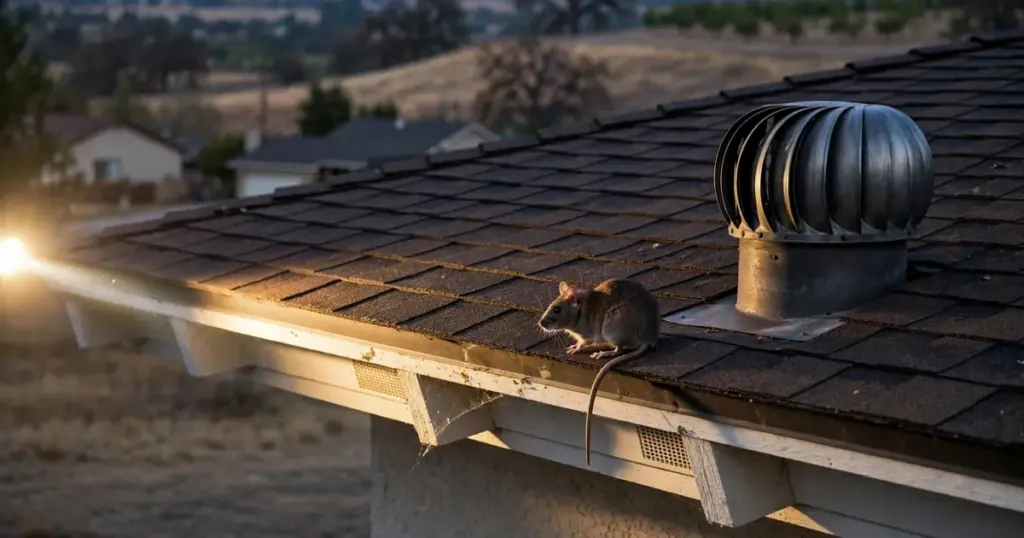
Table of Contents
- Rats vs. Mice: Why Identification Matters
- The Rodents Found Around Central Valley Homes
- Signs of Rats or Mice in Your Home
- Where Rodents Enter a House
- What a Rodent Inspection Includes
- How Rodent Control Works, in General Terms
- Exclusion: Sealing Rodents Out
- Preventing Rodents Around a Central Valley Home
- When to Call a Professional
- Frequently Asked Questions
Rats vs. Mice: Why Identification Matters
Rats and mice are not just different sizes of the same problem. They travel different routes, nest in different places, and enter through different openings, so the first job of any inspection is to identify which one is present — and whether more than one species is involved.
Mice are curious and tend to explore close to where they nest, often within a single room or a short run along a wall. They are most often found in kitchens, pantries, garages, and wall voids near a food source. Rats are more cautious about new objects and new routes, and they tend to follow established paths along walls, fences, and rooflines. Roof rats in particular travel above ground level, using trees, vines, fences, and utility lines to reach a roof, while Norway rats are more often found at ground level, in burrows, garages, and lower parts of a structure.
That difference matters for the plan. A mouse problem centred on a kitchen pantry calls for a different search than a roof rat problem centred on an attic, even though both start with droppings and sounds. An inspector who knows which species is involved knows where to look next, which entry points to check first, and which follow-up checks will actually confirm the problem is resolved.
The Rodents Found Around Central Valley Homes
Three species account for most rodent calls in Modesto and the surrounding Central Valley.
Roof rats are slender, agile climbers with large ears and a long tail. They nest in attics, trees, dense shrubs, and upper parts of structures, and they reach a house along branches, vines, fences, and rooflines. Fruit trees, palm trees, and dense ivy near a house are common harbourage for roof rats, and a branch touching a roof is effectively a bridge into the attic.
Norway rats are larger and heavier, with a blunt muzzle and a shorter tail relative to body length. They are ground dwellers, nesting in burrows outdoors and in garages, crawl spaces, and lower wall voids. They follow pipes, foundations, and ground-level openings, and they are often associated with garages, sheds, and areas where food or pet food is stored at ground level.
House mice are small, with large ears relative to body size and a long, thin tail. They nest close to food, in wall voids, cabinets, drawers, stored boxes, and appliances. A single pair of mice can produce many offspring over a season, which is why a small mouse problem noticed early is a very different job from one left for months — the population grows while the entry point stays open.
Other rodents occur in the Central Valley, including field mice and woodrats in more rural settings, but the three above are the ones most often found inside homes. If droppings or damage do not match these descriptions, an inspection can confirm what is present before any plan is made.
Signs of Rats or Mice in Your Home
Rodents are mostly active at night and avoid people, so the signs they leave are usually found before the animal itself is seen. Any one of these is a reason to inspect, not to wait for a sighting.
Droppings. Fresh droppings are dark and soft; older droppings dry out and turn grey. Rat droppings are larger, roughly the size of a raisin, while mouse droppings are smaller, roughly the size of a grain of rice. Droppings are most often found along walls, in cabinets and drawers, near food storage, in attics, and in garages. The location of droppings says a lot about where the animal is travelling and nesting.
Gnaw marks. Rodents gnaw constantly to wear down teeth that grow continuously. Look for gnaw marks on food packaging, wood, plastic containers, wiring insulation, and pipes. Fresh gnawing is lighter in colour; older gnawing darkens. Gnawed wiring is worth flagging promptly, since damaged wiring and insulation are a fire and repair concern as well as a rodent sign.
Grease marks and rub marks. Rats in particular follow the same paths repeatedly, and the oil from their fur leaves dark smudge marks along walls, pipes, beams, and entry holes. A dark streak along a beam in an attic or along a garage wall often marks a regular rat run.
Sounds. Scratching, scurrying, and gnawing sounds in walls, ceilings, or attics at night are a common first clue. Sounds that move from one part of a ceiling to another, or that stop and start, often indicate an animal travelling a regular route rather than a single animal in one spot.
Nests and shredded material. Rodents build nests from shredded paper, fabric, insulation, and plant material. Nests are found in attics, wall voids, stored boxes, drawers that are rarely opened, and behind appliances. A nest near droppings and gnaw marks confirms an active harbourage, not just a passing visitor.
Odour and urine marks. A persistent musky odour in a closed space, or staining along a regular travel route, can indicate ongoing activity, particularly in an attic or a rarely used room. Odour alone does not identify the species, but combined with droppings and gnaw marks it helps confirm that activity is current.
Tracks and burrows outdoors. Outdoors, look for burrow holes near foundations, runways through vegetation, and droppings along fences and walls. Burrows near a foundation or garage wall suggest ground-level entry is worth checking first.
Where Rodents Enter a House
Rodents do not need a door left open. They use gaps that are easy to miss because they are part of how a house is built and maintained.
Common entry points include gaps around roof vents, eaves, and fascia boards; openings where pipes, vents, and utility lines pass through walls; gaps under doors and around garage doors; damaged or missing vent screens; cracks in foundations; and gaps where the roof meets the wall. In the Central Valley, trees and vines touching a roof deserve special attention, since roof rats use them as a direct route to the attic, bypassing ground-level defences entirely.
An inspection works from the outside in: the roofline and eaves first, then the foundation and garage, then the interior. Finding every entry point matters, because sealing most of them and missing one leaves the problem in place. That is also why a homeowner sealing a single visible hole sometimes finds the problem unchanged — the animal simply uses the next opening.
What a Rodent Inspection Includes
A rodent inspection is a visual examination of the accessible areas of a property, inside and out, looking for the species present, the entry points, the nesting areas, and the conditions that are attracting rodents.
In general terms, it covers the exterior perimeter, foundation, and garage; the roofline, eaves, vents, and any trees or vines touching the structure; the attic, where roof rat activity and nesting often show; a crawl space or subarea, if the home has one; and the kitchen, pantry, and other food areas, where mouse activity most often shows. The inspector notes droppings, gnaw marks, grease marks, nests, burrows, and entry points, and separates evidence of current activity from old signs that may predate a previous repair.
After the inspection, you receive findings and recommendations. The findings explain which species is involved, where it is entering, where it is nesting, and what conditions — food, water, shelter, or access — are supporting it. Recommendations cover the work in priority order: what needs sealing, what needs removing, and what changes around the house will make the biggest difference. No plan should be agreed to before the inspection findings are explained, because the species and the entry points decide the plan.
You can help an inspection go well by clearing access to the attic hatch and crawl space opening where you can, moving stored items away from garage and foundation walls, unlocking gates and outbuildings, and noting where you have seen droppings, heard sounds, or found gnawed items — when and where you noticed each sign helps the inspector narrow the search.
How Rodent Control Works, in General Terms
There is no single method that fits every home, because the right approach depends on the species, where it is nesting, how it is entering, and how widespread the activity is. Treatments and devices are used according to the product label and California regulations, and the plan is built around the inspection findings.
In general terms, control follows a sequence. First, inspection and identification establish the species, entry points, and nesting areas. Second, exclusion seals the entry points so rodents already inside cannot be replaced by new ones from outside. Third, the rodents present are removed, using traps or other methods appropriate to the species and the location. Fourth, sanitation and habitat changes around the home remove the food, water, and shelter that attracted them. Fifth, follow-up checks confirm that activity has stopped and that sealed entry points are holding.
The order matters. Removing rodents without sealing entry points leaves the house open to the next animal. Sealing entry points without removing the rodents already inside traps them in the house, where they may cause more damage trying to get out or find a new route. A plan that pairs removal with exclusion, and then checks the result, is how a rodent problem stays solved rather than returning in a few weeks.
Ongoing service, where it is offered, is built around monitoring: checking traps or monitoring devices, re-inspecting entry points, and catching new activity early, before a population builds up again. For homes near orchards, fields, or dense vegetation, where rodent pressure from outside is constant, monitoring is often part of the long-term picture rather than a one-time fix.
Exclusion: Sealing Rodents Out
Exclusion is the structural part of rodent control: finding and sealing the openings rodents use, with materials they cannot easily gnaw through. It is the step that turns a one-time removal into a lasting result.
In practice, exclusion covers sealing gaps around vents, pipes, and utility penetrations; repairing damaged vent screens and roof vents; sealing gaps at the roofline, eaves, and fascia; closing gaps under doors and around garage doors; and repairing cracks and openings in foundations and walls. Materials are chosen for the location — a gap in a roof vent calls for a different repair than a gap under a garage door — and the work is checked against the inspection findings, so every entry point found is addressed, not just the most visible one.
Exclusion is also where a homeowner’s own maintenance matters most. Trimming branches and vines away from the roof, keeping firewood and stored items away from exterior walls, and keeping vegetation and debris from piling against the foundation all reduce the routes and harbourage that make exclusion harder. A house with a clear perimeter is a house where an inspector can actually see the entry points.
Preventing Rodents Around a Central Valley Home
Much of what attracts rodents is within a homeowner’s control, and prevention works best as routine rather than as a response to a problem.
Store food, including pet food and birdseed, in sealed, hard containers rather than in bags or cardboard boxes. Clean up fallen fruit from trees promptly, and keep compost and trash in closed containers. Fix plumbing and irrigation leaks, and avoid standing water near the house, since rodents need water as well as food. Keep the kitchen clean of crumbs and spills, and do not leave pet food out overnight where that is practical.
Outside, keep vegetation trimmed and pulled back from the house, keep firewood stacked away from exterior walls and off the ground, remove clutter and debris from around the foundation and garage, and keep stored items in sealed containers rather than cardboard boxes, which rodents nest in and gnaw through. Seal gaps as you find them, and check the attic and garage periodically for droppings or gnaw marks, so new activity is caught early.
A periodic professional inspection, and one any time you find the signs described above, is how small findings stay small. Rodent populations grow quickly once they are established, so the cheapest time to deal with a rodent problem is the week it is first noticed.
When to Call a Professional
Call for an inspection if you find droppings, gnaw marks, or nests; if you hear scratching or scurrying in walls, ceilings, or attics at night; if you see a rat or mouse indoors, or find one in a garage or outbuilding; if wiring, insulation, or food packaging has been gnawed; or if you have sealed a hole yourself and the problem has continued, which usually means another entry point is still open. Also call before a remodel that will open walls, replace siding, or change a roofline, since that work can disturb nesting areas and reveal entry points worth sealing while access is open.
For a fuller explanation of rats, mice, and the steps that keep them out, read our guides to rat control and mouse control, and our guide to rodent exclusion and proofing.
Pentecost Pest Control is a family-owned company based at 3501 Coffee Rd, Modesto, CA 95355. We serve residential and commercial customers in San Joaquin and Stanislaus Counties. Call (209) 581-5562 or email info@pentecostpestcontrol.com to request a free estimate.
Frequently Asked Questions
How do I tell a rat from a mouse?
Size is the first clue: mice are small, with large ears and a long, thin tail, while rats are larger, with a blunter muzzle. Droppings help too — mouse droppings are about the size of a grain of rice, rat droppings about the size of a raisin. Location helps as well: mice nest close to food, often in kitchens, while roof rats nest in attics and travel along rooflines. An inspection confirms the species when the signs are mixed.
How small an opening can a mouse get through?
Mice can use an opening about the size of a dime, and rats one about the size of a quarter. That is why exclusion work looks at gaps around pipes, vents, and rooflines that look too small to matter — to a rodent, they are not.
Do rodents leave on their own?
Rarely. A house that offers food, water, and shelter is a good habitat, and rodents that have found it will stay and breed unless the entry points are sealed and the animals present are removed. Waiting usually means a larger population and more damage, not a problem that resolves itself.
Is it enough to set traps myself?
Traps can remove individual animals, but they do not seal entry points, identify the species, or address nesting areas you cannot see. If trapping catches animals repeatedly, that usually means new animals are still entering, and an inspection to find the entry points is the next step.
How long does rodent control take?
It depends on the species, how widespread the activity is, and how many entry points need sealing. Removal and exclusion are usually completed over one or more visits, with follow-up checks to confirm activity has stopped. A plan built on inspection findings will give a clearer timeline than a guess made before anyone has looked.
What should I do before a rodent inspection?
Clear access to the attic hatch and crawl space opening where you can, move stored items away from garage and foundation walls, unlock gates and outbuildings, and note where and when you have seen droppings, heard sounds, or found gnawed items. Keep pets somewhere safe and out of the way during the visit.
This article is for general educational purposes only. Pest conditions, regulations, and treatment options vary by property and situation. Contact a licensed pest control professional for an inspection.