
Rodent control is priced from what an inspection finds, not from the name of the pest alone. The price is driven by which rodent is involved, how much activity there is and where it sits in the structure, how many entry points need sealing and how hard they are to reach, the size and construction of the home, and whether follow-up visits are part of the job. None of that can be seen over the phone, so a quote given without an inspection is a guess.
Key Takeaways
- There is no honest flat price for rodent control. A real figure follows an inspection, because the factors that set it are inside your attic, walls, and crawl space.
- Species comes first: roof rats, Norway rats, and house mice behave differently, nest in different places, and call for different work.
- Exclusion is often the largest part of the job. Finding and sealing entry points takes more time than setting traps, and a quote that skips it is pricing a different job.
- A good written quote itemizes the findings, the areas covered, the exclusion work, and any follow-up — that itemization is what lets you compare quotes fairly.
- If you have found signs of rodents, start with an inspection. Pentecost Pest Control provides rodent control for homes across Stanislaus and San Joaquin Counties.
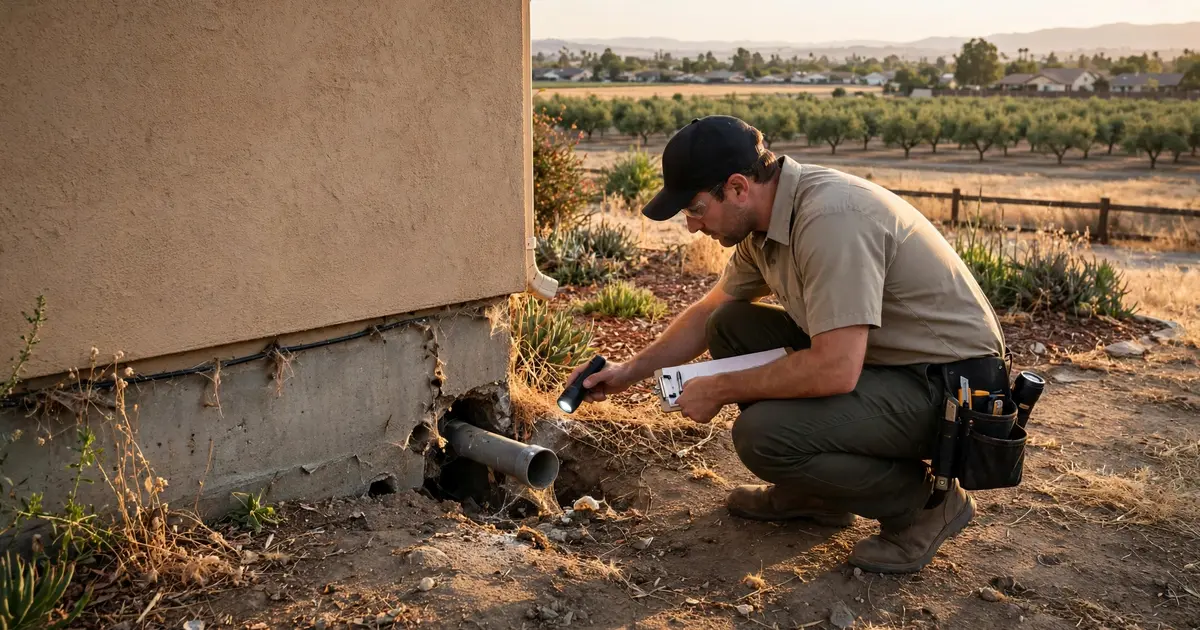
Table of Contents
- Start With the Inspection, Not the Number
- Factor 1: The Species Involved
- Factor 2: How Much Activity, and Where
- Factor 3: Entry Points — How Many, and How Hard to Reach
- Factor 4: The Size and Construction of the Home
- Factor 5: The Method the Findings Call For
- Factor 6: Cleanup and Repair of Rodent Damage
- Factor 7: Monitoring and Follow-Up
- Factor 8: Preparation and Access Work
- What a Written Quote Should Itemize
- Why the Lowest Quote Is Not Automatically the Best Value
- Questions to Ask Before You Sign
- When to Call a Professional
- Frequently Asked Questions
Start With the Inspection, Not the Number
The difficulty with rodent pricing is that it runs backwards compared with most purchases: the work your home needs cannot be known until someone has looked at the species, the activity, and the structure. Two homes on the same street, with the same floor plan, can need completely different work because one has a few mice in a garage and the other has roof rats moving between the attic, the roofline, and a fruit tree.
That is why this article gives you factors instead of figures. A number quoted without an inspection is built on assumptions, and when the assumptions turn out wrong, the number changes — or the work quietly shrinks to fit it. Our complete guide to rodent control for Central Valley homes covers identification and signs in full, and our rodent exclusion and proofing guide walks through sealing in detail. What follows is the money side: the factors that turn findings into a price.
Factor 1: The Species Involved
Species is the first factor because it decides the whole shape of the job. Roof rats climb and nest high — in attics, roof voids, and trees — and enter through gaps at the roofline. Norway rats stay lower, burrowing and nesting at ground level, in crawl spaces, and around foundations. House mice are smaller, need far smaller openings, and can live inside wall voids and cabinets with a much smaller home range.
They are priced differently because they are different work — different entry points to find, different nesting areas to inspect, and different trapping and exclusion plans. A quote for a mouse problem and a quote for a roof rat problem are not two prices for the same job. Only the inspection findings say which job your home needs, so if a proposal does not name the species behind it, ask why.
Factor 2: How Much Activity, and Where
The second factor is the extent of the infestation: how many areas are active, and how accessible they are. Activity confined to one garage or a single storage area is a limited, reachable problem. Activity spread across an attic, wall voids, and a crawl space is a larger job: confirming its full extent, placing traps where the rodents actually travel, and checking each area again takes more visits and more time on site.
Location matters too: activity in an attic with blown insulation, or in wall voids behind finished surfaces, is harder to inspect and work in than activity in an open garage. Activity near food storage, pet food, or a kitchen raises sanitation questions that activity in an outbuilding does not.
Factor 3: Entry Points — How Many, and How Hard to Reach
For rodents, entry points are often the factor that moves the price most, and the one homeowners least expect. Mice can pass through openings far smaller than most people imagine, and rats need only a little more. A thorough inspection checks the roofline, eaves, vents, pipe and wire penetrations, gaps around doors and garage doors, foundation cracks, and openings where utilities enter the home.
A home with two or three accessible gaps is a different job from a home with a dozen gaps, some of them on a second-story roofline or behind a deck, or in a crawl space with low clearance. Each gap must be found, and then sealed with a material suited to that location — a vent cover, a sealed penetration, a repaired screen, or a reinforced gap. Our exclusion guide explains the common materials in general terms; the point for pricing is that sealing is skilled, time-consuming work, and it is the part of the job that keeps rodents from coming back after trapping ends. A quote that covers trapping only, with no exclusion, is not the same job as one that includes it.
Factor 4: The Size and Construction of the Home
Rodent work is physical work done on a physical structure, so the structure itself is a pricing factor:
- Overall size and roofline length. A larger home has more roofline, more vents, and more penetrations to inspect and seal, and more attic space to check.
- Slab versus raised foundation. A raised foundation with a crawl space gives access to the underside of the home, where Norway rat activity and entry points are often found. A slab home limits that access and changes where entry points are likely to be. Many Central Valley homes mix the two, and additions are often built differently again.
- Attached structures and vegetation. Garages, sheds, patio covers, and fruit trees share walls, rooflines, and travel routes with the house and are often part of the inspection. Tree limbs touching a roof give roof rats a direct route in, and trimming them back is part of the job in some cases.
- Attic access and insulation. An attic that can be moved through safely is different from one with low clearance, dense blown insulation, or blocked openings, and that difference shows up in the time the work takes.
Factor 5: The Method the Findings Call For
Once species, extent, and entry points are known, the method follows. In general terms, the main approaches are:
- Trapping in the areas where activity was found, placed along the travel routes rodents actually use, and checked on a schedule until activity stops.
- Exclusion, sealing the entry points found during inspection so new rodents cannot take the place of the ones removed.
- Monitoring, with traps or devices checked on a schedule, to confirm activity has ended and to catch new activity early.
- Habitat and food-source work, such as removing harborage near the structure, securing food and pet food storage, and trimming vegetation away from the roofline — work that is often shared between the company and the homeowner.
Each approach involves different labor, equipment, and follow-up, so each is priced differently. The key point when comparing proposals: the method should be traceable to the findings. If two companies recommend different methods, ask each why its method fits its findings. A proposal that jumps straight to a single method, without naming the species and entry points it is based on, has skipped the step that justifies it.
Factor 6: Cleanup and Repair of Rodent Damage
Removing the rodents does not undo what they did while they were there. Rodents can damage insulation, wiring, ducting, and stored items, and leave droppings and nesting material in attics and wall voids. Cleanup and repair are a separate scope, and whether they are part of your budget depends on what the inspection found.
Ask whether a quote includes any cleanup, insulation work, or repair, and if so, exactly which areas it covers. Some damage — chewed wiring, damaged ducting, or structural repair — may belong with an electrician, an HVAC contractor, or another trade rather than the pest control company; your inspector should say plainly when that is the case.
Because damage varies so widely from home to home, it is one of the most common reasons two quotes for “the same house” are not actually quotes for the same work.
Factor 7: Monitoring and Follow-Up
A one-time trapping visit and an ongoing plan are different products. Follow-up visits to check traps, confirm activity has ended, and re-check sealed entry points spread work across weeks rather than a single visit, and quotes reflect that. Follow-up matters because rodents are persistent: a single missed entry point, or a new gap opened by weather or work on the home, can restart a problem that looked finished.
When comparing proposals, check whether follow-up is included, offered as a separate plan, or not mentioned at all. Many of our residential pest control customers fold rodent monitoring into their general pest routine, but whether that makes sense depends on your property and findings.
Factor 8: Preparation and Access Work
Some of the cost of a rodent job is the work around the work. Preparation can include clearing stored items away from walls and out of the attic access area, securing food and pet food in sealed containers, opening access to the attic and crawl space, and trimming vegetation back from the roofline. Most preparation is the homeowner’s responsibility, and doing it well keeps the crew’s time on inspection and sealing rather than moving boxes. A good proposal spells out who handles what.
What a Written Quote Should Itemize
A written quote you can actually compare against another should put the following in writing:
- The species found, and where activity was located, area by area
- The entry points found, and which ones the price covers sealing
- The method recommended, and why it fits those findings
- The areas the price covers — and anything it does not
- Cleanup and repair scope, if any is included, and what is excluded or referred to another trade
- Preparation responsibilities: what the company does and what you do
- Follow-up: any monitoring, re-inspection, or return visits included, and over what period
- What happens if more activity is found once work begins or new entry points are found
If a quote is a single number on a card, ask for the itemized version.
Why the Lowest Quote Is Not Automatically the Best Value
Quotes differ mostly because scopes differ. A lower figure may reflect a genuinely simpler job — limited activity, a few accessible entry points, a trapping-only plan — and then it is a fair price for the work your home needs. Or it may reflect a narrower scope: fewer areas covered, exclusion quietly left out, no follow-up, or damage left unaddressed. You cannot tell which until you line the quotes up against the findings.
The useful comparison is not number against number; it is scope against findings. Does this proposal address everything the inspection found, by a method that fits, with the exclusion and follow-up the situation calls for? When a quote is still hard to account for, “what does this not include?” is the most valuable question a homeowner can ask.
Questions to Ask Before You Sign
- Which species did you find, and in which areas?
- How many entry points did you find, and which ones does this price seal?
- What method are you recommending, and why does it fit the findings?
- Exactly which areas does this price cover — and which does it not?
- Is any cleanup or repair included? If damage is worse than it looks, how is that handled?
- What preparation is my responsibility?
- What follow-up is included — monitoring, re-inspection, return visits — and for how long?
- Will I receive the inspection findings and this quote in writing?
When to Call a Professional
Do not wait for a pricing question to become urgent. Call for an inspection if you find droppings, gnaw marks, nesting material, scratching or movement sounds in walls or ceilings, or rodents seen indoors — the signs are walked through in our rodent guide for Central Valley homes. An inspection is also the right step before buying or selling a home, and when planned work will open walls, replace roofing, or change the structure anyway.
Ready for a price based on your actual home rather than a guess? Call (209) 581-5562 or request a free estimate. Tell us what you found, and we will start with the inspection and explain the factors behind the quote before any work is agreed to.
Frequently Asked Questions
Why can’t a company just give me a price over the phone?
Because what sets the price — species, extent, entry points, construction, access — cannot be seen from a phone call. A firm number given sight unseen will either change when the home is inspected or quietly narrow the work to fit the number. Honest pricing follows an inspection.
Does rodent control mean trapping, or sealing, or both?
Usually both, in that order of logic: trapping addresses the rodents already inside, and exclusion addresses how they got in. Trapping without sealing leaves the door open for the next rodents. Sealing without first addressing the rodents inside can trap them in the structure. A complete plan covers both, sequenced correctly.
Why did two companies give me such different prices for the same house?
Most often because the scopes differ: different methods, different entry-point counts, or follow-up and repair included in one and not the other. Line each quote up against its findings using the list above, and ask what each price does not include — the gap usually explains itself.
Will one visit take care of a rodent problem?
Rodent work is rarely a single visit. Traps must be checked, activity must be confirmed as ended, and sealed entry points must be re-checked. A plan with follow-up visits built in is not padding; it is how the end of the problem is confirmed rather than assumed.
Is exclusion work included in every rodent quote?
Not always, and that is the most important scope question to ask. Some quotes cover trapping only. If exclusion is not mentioned, ask whether it is included, priced separately, or left to the homeowner — and get the answer in writing before comparing prices.
By the Pentecost Pest Control Editorial Team
This article is for general educational purposes only. Pest conditions, regulations, and treatment options vary by property and situation. Contact a licensed pest control professional for an inspection.