
Commercial pest control is a planned, documented service built around a specific facility — not a larger version of treating a house. It starts with an inspection that maps where pests enter, live, and travel; continues with treatment in general terms aimed at those findings; adds monitoring that catches new activity early; and produces written records a manager can hand to a health inspector or an auditor. The pests themselves are familiar Central Valley ones: cockroaches and flies where food is handled, rodents where goods and waste are stored, ants almost anywhere, and bed bugs where guests sleep. What differs from a home is the exposure. A business answers to customers, tenants, guests, and inspectors, and a pest problem that would be a private annoyance in a house can become a citation, a complaint, or a lost account at a business.
This guide is written for business owners, property managers, and facility managers in the Central Valley. It covers why pest management works differently for a business, the problems each kind of facility tends to face here, what a service visit actually involves, the documentation a sound program produces, how service frequency is set, and the employee habits that decide whether a program holds between visits.
Key Takeaways
- For a business, a pest problem is also a reputation problem and a records problem: customers see the pest, and inspectors and auditors ask what was done about it.
- The pests differ by setting. Food service fights cockroaches, flies, and rodents; warehouses fight rodents, stored-product pests, and birds; lodging fights bed bugs; offices mostly fight occasional invaders and ants.
- A commercial service visit is built on inspection and documentation: findings in writing, treatment directed at those findings, monitoring devices checked and recorded, and a service report left with the business after every visit.
- Employee practices — how deliveries are received, how waste is handled, whether sightings get reported the same day — decide whether a program holds between visits.
- Service frequency is set by the risk of the operation, the findings, and the season, not by a one-size schedule. Food operations generally need more frequent service than low-risk offices.
- Honest pricing follows an on-site assessment. Size, business type, pest pressure, frequency, and documentation needs all shape the figure.
- If pests are showing up at your business, start with an assessment. Pentecost Pest Control provides commercial pest control for businesses across Stanislaus and San Joaquin Counties.
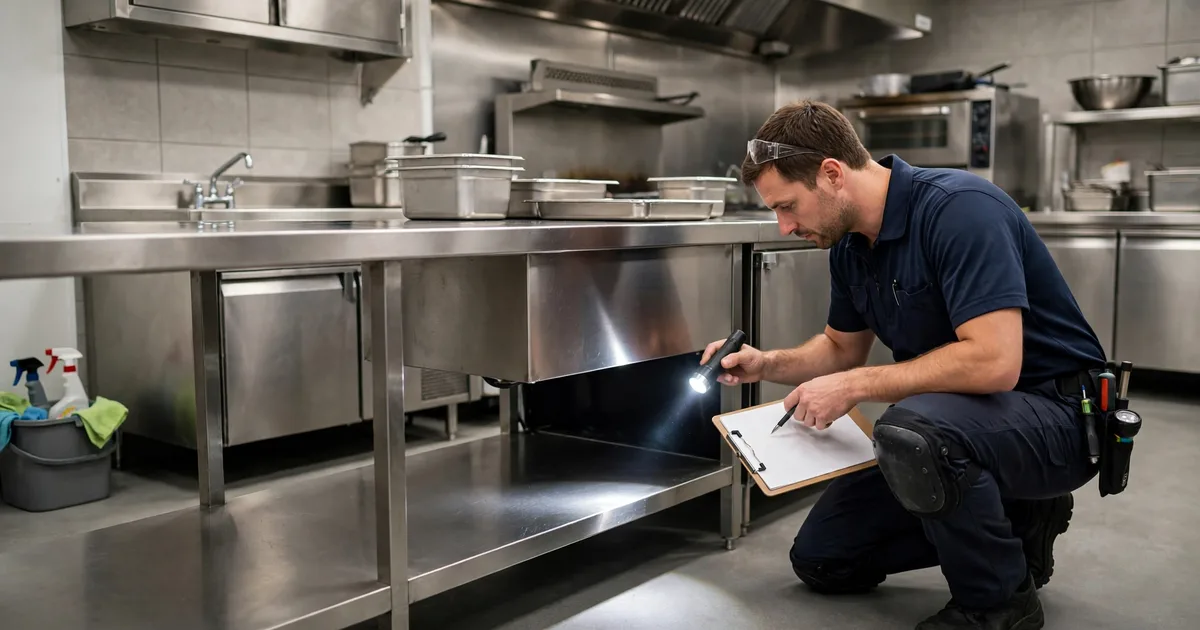
Table of Contents
- Why Pest Control Is Different for a Business
- Common Commercial Pest Problems in the Central Valley
- What a Commercial Service Visit Involves
- Documentation and Compliance Support
- Employee Practices That Make or Break the Program
- How Service Frequency Is Set
- What a Commercial Proposal Should Itemize
- When to Call a Professional
- Frequently Asked Questions
Why Pest Control Is Different for a Business
A homeowner with ants in the kitchen has a nuisance. A restaurant with ants in the pantry has a nuisance, a possible inspection finding, and a customer-relations problem if a guest sees them first. The insects are the same; almost everything around them is different.
Reputation and customer perception. Customers rarely distinguish between a pest that wandered in this morning and a facility with a standing problem. A cockroach seen in a dining room, a rodent crossing a sales floor, or flies over a bakery case becomes the story a customer tells — in person and online — and it attaches to the business, not to the pest. Lodging, food service, and retail live on repeat business and word of mouth, which is why pest management in those settings is as much about prevention and early detection as it is about treatment.
Health inspections and audits. Food facilities in Stanislaus and San Joaquin Counties are inspected by county health departments, and pest activity — live insects, droppings, nesting, entry points that let pests in — can appear in inspection findings and require corrective action. Many food businesses also undergo third-party food safety audits arranged by their customers or corporate offices, and those audits review pest management and its records. A business does not need a pest problem to fail an inspection point; it only needs pests present, conditions inviting them, or no documentation that a program exists. No pest control company can promise how an inspector or auditor will score a facility — outcomes belong to the inspector — but a documented program is the part of that picture the business controls.
Shared walls, shared problems. Many Central Valley businesses operate in multi-tenant buildings: strip centers, office parks, mixed-use properties, and food facilities sharing walls with neighbors. Pests do not respect lease lines. Cockroaches move along shared plumbing and wall voids, rodents travel through connected ceiling spaces and utility runs, and a shared dumpster enclosure can supply the whole center. Property managers sit in the middle of this: a tenant’s pest problem may trace to a neighboring space, a common area, or the building shell itself, which is why commercial findings often separate what belongs to the tenant, what belongs to the landlord, and what belongs to the building.
Deliveries and constant traffic. A home receives a few deliveries a week. A restaurant or warehouse receives pallets, produce, dry goods, and packaging every day, and pests arrive in shipments — cockroaches in corrugated cardboard and appliance packaging, stored-product pests inside infested goods, rodents riding along in loads and nesting in stored pallets. Doors open constantly, customers and staff stream through, and propped loading doors are an open invitation. Commercial pest pressure is renewed daily in a way residential pressure is not.
Larger, more complex structures. Commercial buildings have loading docks, drop ceilings, floor drains, utility chases, rooftop equipment, and long runs of wall and conduit that give pests protected travel routes and harborage a homeowner never has to think about. Finding activity in that complexity — and proving where it is coming from — is inspection work, and it is why commercial service is documented rather than casual.
Common Commercial Pest Problems in the Central Valley
Every facility has its own findings, but pest pressure in Central Valley businesses follows recognizable patterns by setting. What follows describes the usual problems in general terms; an on-site assessment is what confirms which of them a given facility actually has.
Restaurants and food service
Food service is the highest-pressure commercial setting, because it concentrates everything pests need — food, water, warmth, and harborage — in a building that is inspected for exactly these problems.
- German cockroaches are the defining food-service pest. Unlike the large outdoor cockroaches that wander in from landscaping, German cockroaches live and breed indoors, in the warm, moist, tight spaces around kitchen equipment: behind and beneath cooking lines, inside motor housings and hinges, around plumbing, and in storage shelving. They arrive in deliveries and equipment, reproduce quickly, and cannot be solved with exterior treatment, because the population is inside the building.
- Flies come in two patterns. Small flies breed in the wet organic material that builds up in floor drains, floor sinks, mop areas, and soda and beer line drip areas, and a population that seems to come from nowhere usually has a breeding source in one of those places. Larger flies enter from outside and concentrate at doors, windows, and waste areas, especially in Valley heat.
- Rodents work the perimeter and the back of house: dumpster enclosures, receiving doors, dry storage, and the wall voids and ceiling spaces above them. Roof rats climb and enter high; Norway rats work at ground level around waste and foundations.
- Ants, most often Argentine ants, trail to water and sweets and can appear in dining areas as readily as in kitchens during summer heat and winter rains.
Warehouses and distribution
Warehouses trade customer traffic for scale: enormous interior volume, racking that shelters activity from view, stored goods that feed pests, and docks where the building opens to the outdoors all day.
- Rodents are the central warehouse pest. They nest in stored pallets, quiet racking, and insulation, travel along walls and beams, and contaminate goods and packaging with droppings and gnawing. Our rodent control guide explains how rats and mice use structures; the same behavior plays out at warehouse scale, with more harborage and longer travel routes.
- Stored-product pests — small beetles and moths that live in and on stored dry goods such as grains, feed, pet food, and dried products — are the quiet warehouse and food-storage problem. They are usually found through damaged packaging, webbing or debris in product, or insects in traps, and the response centers on finding the infested goods, not on treating empty space.
- Birds roost and nest in rafters, dock canopies, signage, and rooftop equipment, and their droppings accumulate on walkways, stored goods, and equipment below. Bird work is exclusion first: sealing, screening, and removing the ledges and openings birds use, carried out in line with California Department of Fish and Wildlife rules, because many bird species are protected and the timing and methods available depend on the species involved.
Offices and retail
Office and retail pest pressure is lower, but it is customer- and employee-facing, and it concentrates in the support spaces nobody watches.
- Occasional invaders — earwigs, crickets, silverfish, spiders — turn up in restrooms, janitor closets, storage rooms, and ground-floor spaces, driven in by irrigation, heat, and seasonal weather. They rarely indicate an indoor infestation; they point to gaps, moisture, and harborage near the foundation.
- Ants in break rooms and kitchenettes are the most common office complaint, trailing to sinks, coffee areas, and food kept in desks and lockers.
- Rodents appear in stock rooms, storage areas, and ceiling voids, especially in buildings that share walls with food tenants or sit near open ground and orchards at the edge of town.
Lodging
Hotels, motels, and other lodging properties face one pest above all: bed bugs. Bed bugs are hitchhikers that arrive in luggage, and a property with constant guest turnover is constantly re-exposed, no matter how clean it is. The work is early detection — housekeeping staff who can recognize the signs, rooms taken out of service when activity is suspected, and inspection and treatment in general terms before a problem spreads to adjoining rooms. Our bed bug guide for Central Valley homes covers the signs and how infestations behave; the same biology applies in a guest room, with the added complication that the room next door has different occupants every night. Larger properties also manage the standard food-service pests in their kitchens and dining areas.
Healthcare and care facilities
Clinics, care homes, and similar facilities share the food-service pest list — ants, cockroaches, flies, rodents — with an added layer of sensitivity about where people are vulnerable and where work can take place. In practice, service in these settings is planned closely with facility management: monitoring carries more of the load, treatment is directed at specific findings rather than applied broadly, scheduling works around the facility’s operations and occupants, and documentation is kept thoroughly because these facilities answer to their own oversight as well as to customers. The pest findings are ordinary; the planning around them is not.
| Setting | Pests most often involved | Where pressure concentrates |
|---|---|---|
| Restaurants and food service | German cockroaches, small flies and house flies, rodents, ants | Kitchens, drains, dry storage, waste areas, receiving doors |
| Warehouses and distribution | Rodents, stored-product pests, birds | Racking, loading docks, stored goods, rooflines and rafters |
| Offices and retail | Occasional invaders, ants, rodents | Break rooms, restrooms, stock rooms, entry doors |
| Lodging | Bed bugs, plus cockroaches and flies in food areas | Guest rooms, laundry areas, kitchens |
| Healthcare and care facilities | Ants, cockroaches, flies, rodents | Kitchens, waste handling, utility and storage areas |
The pattern across all five settings is the same one that drives residential work: pests go where food, water, and harborage are reliably available, and they enter through gaps nobody sealed. The commercial difference is that a business must also be able to show what it did about it — which is where service visits and documentation come in.
What a Commercial Service Visit Involves
A commercial visit is a working inspection with treatment attached, and it leaves a paper trail. In general terms, a visit to a Central Valley business involves the following.
Inspection first, every visit. The technician walks the exterior and the interior: dock and receiving doors, the dumpster enclosure, door sweeps and thresholds, vegetation and stored items against the building, and inside, the kitchens, storage areas, restrooms, utility spaces, and any area where activity has been reported or found before. Monitoring devices are checked, entry points and conducive conditions are noted, and new findings are compared with what previous visits recorded. In a commercial building, the inspection is where most of the value is, because the findings decide everything that follows.
Treatment directed at the findings. Treatment follows what the inspection found — the pest involved, where activity is concentrated, and how it is getting in. Treatments are applied according to the product label and California regulations. Interior treatment is aimed at the harborage and travel routes the inspection identified; exterior work addresses entry points, waste areas, and the perimeter where rodents and crawling pests approach the building. In food-handling and care settings, placement is planned around the operations and occupants of the space, and your technician should be able to explain, area by area, what was done and why.
Monitoring devices, checked and recorded. Commercial programs lean on monitoring in a way residential work usually does not. Rodent stations are placed along exterior walls, at docks, and near waste areas; insect monitors sit in kitchens, storage rooms, and other areas where early detection matters; and each device is checked on every visit, with the result recorded. A single visit’s counts say little. The value is in the series: rising activity at one dock door is a finding with a cause — a failed door seal, a new harborage, a change in waste handling — and the records are what let a technician and a manager see it forming.
A service report left with the business. After each visit, the business receives a written record: the date and areas serviced, what was found, what treatment was performed, the state of the monitoring devices, and the corrective actions recommended — a leak to repair, a door sweep to replace, a storage practice to change. That report is the business’s evidence that a program exists and is being worked, and it is written to be shown: to a health inspector, to an auditor, to a landlord or tenant, or to the property’s own management.
The prevention-first structure behind this kind of program — inspection, identification, sanitation and exclusion first, treatment directed by findings, and monitoring to verify — is described in our companion article, Integrated Pest Management for Businesses: A Practical Guide, which walks through that approach in full.
Documentation and Compliance Support
Businesses do not get to keep their pest control casual, because other parties review it. County health departments inspect food facilities in Stanislaus and San Joaquin Counties. Many food businesses also face third-party food safety audits arranged through their customers or corporate offices, and lodging, healthcare, and retail properties answer to their own chains of oversight. Pest management — and specifically its paperwork — is a standard part of what gets reviewed. The business cannot control how an inspector or auditor scores it. What it can control is whether a real program exists and whether the records show it working.
Documentation that does its job has a few recognizable features:
- A service report for every visit, dated, naming the areas serviced, the findings, the treatment performed, and the recommendations made — not a stack of identical invoices with no findings on them.
- A map of monitoring devices, so an inspector can see where stations and monitors are placed and a manager can see that each one is checked and accounted for.
- Corrective actions with follow-through. When a report notes a gap under a dock door or standing water at a mop sink, the next reports should show whether it was corrected. A finding that repeats visit after visit with nothing changing is the pattern inspectors and auditors notice, whichever side of it is responsible.
- Trend notes over time. Records that show where activity is rising or falling — and what was done in response — tell a more useful story than any single clean report. They also steer the program: repeated rodent pressure at one enclosure is a waste-handling or exclusion problem to fix, not a reason to simply add more stations.
Two honest limits belong in this section. First, the pest control provider’s records support the business’s file; they do not replace it. The business remains responsible for the conditions reports identify — sanitation, storage, repairs — and for keeping its own copies organized and available when an inspection or audit happens. Second, documentation is evidence of a working program, not a lever on outcomes: no provider can promise that records will produce a particular score, and a business should be cautious with any company that suggests otherwise. What a documented program genuinely provides is proof that pests are being looked for, findings are being treated, and conditions are being corrected — which is what the review process is designed to check.
Employee Practices That Make or Break the Program
More commercial pest programs are undermined at the loading door and the break room than in any treatment decision. A service program visits on a schedule; employees live with the building every day, and their habits either starve the program’s pests or feed them.
Receiving deliveries. Shipments are the main door through which cockroaches and stored-product pests enter a facility. Staff who receive goods should look at what is coming in — corrugated cardboard carried straight into dry storage, infested product set beside clean stock, and pallets stored wherever they land all move pests from the dock to the shelves. Suspect goods should be isolated and reported, not shelved. Stock rotation matters for the same reason: product that sits undisturbed in a corner for months is where stored-product pests complete their life cycles unnoticed, and goods stored off the floor and away from walls leave room to inspect.
Waste handling. Dumpsters and compactors are rodent and fly engines when they are mismanaged: lids left open, waste piled beside a full container, grease and food residue building up on the pad, and enclosures rarely cleaned. Lids closed, waste inside the container rather than beside it, spills cleaned up, and the enclosure itself kept in reasonable order remove the single largest food source most commercial properties offer pests.
Door discipline. A propped loading door or a back door held open through a shift defeats the building’s own defenses; birds, rodents, and flies use open doors more than any gap in the structure. Doors kept closed, and door sweeps kept in repair, close the route most pests actually take.
Reporting sightings promptly. A line cook who mentions droppings in dry storage the day they appear gives the program a small, findable problem. The same sighting mentioned a month later — or never, because no one knew whom to tell — gives it an established one. Facilities that run a simple reporting path (sightings go to one designated manager, who logs them and passes them to the provider between visits when they cannot wait) catch problems while they are still local. A photo and a location, taken when the pest is seen, are worth more to the responding technician than a detailed description a week later.
Not freelancing with store-bought products. Well-meaning employees spraying a product they brought from home can scatter cockroaches deeper into equipment and wall voids, contaminate areas the service program is managing carefully, and leave no record of what was applied where — which matters in food and care settings. Within a service program, sightings should be reported, not treated individually, so the response is recorded and fits the plan.
Break rooms, lockers, and desks. Ants find the food employees keep: open snacks in lockers, sugar and creamer at coffee stations, lunch waste in desk bins. Sealed containers, regular cleaning of break areas, and food waste going to proper bins rather than desk trash remove the attractant that brings trails indoors in offices and warehouses alike.
None of this is complicated, and most of it is free. It is also the part no provider can do for the business — which is why a realistic proposal talks about it instead of pretending treatment alone settles everything.
How Service Frequency Is Set
There is no correct visit schedule for “a business” in general; there is a correct schedule for a particular facility, and it is set by risk and revised by findings. The inputs are straightforward:
- Type of operation. A facility that cooks and serves food, stores open product, or houses guests overnight carries more pest risk — and more inspection exposure — than an office with a break room. Risk sets the starting frequency.
- Pest pressure and history. A building with past rodent activity, a German cockroach history, or heavy ant pressure from surrounding landscaping needs eyes on it more often than a building with a quiet record.
- Building size, condition, and setting. Large footprints, aging structures with many entry points, shared walls with food tenants, and properties at the edge of orchards or open ground all raise pressure. Summer heat in the Central Valley raises fly and ant pressure; the wet, cooler months drive rodents and occasional invaders toward shelter.
- What monitoring shows. Frequency is not fixed at signing. If device counts and findings stay quiet, a program can hold its schedule; if activity trends upward, visits increase or the plan changes — the records from the documentation section are what make that judgment possible.
In general terms, higher-risk food operations are commonly serviced more frequently — some on a weekly rhythm, many monthly — because their pest pressure and inspection exposure justify it, while lower-risk offices and retail spaces are often on monthly or quarterly schedules. Those are patterns, not promises: your facility’s schedule should come out of its own assessment, and it should be revisited when the findings change — a new tenant next door, a remodel, a change in what the building stores, or a season that shifts the pressure.
What a Commercial Proposal Should Itemize
Commercial proposals are hard to compare when each one is a single figure and a handshake. A proposal you can actually evaluate — and hold a provider to — puts the scope in writing:
- The areas and buildings covered — which spaces, outbuildings, and exterior areas are in the program, and which are not
- The pests covered, and how pests outside that list are handled when they appear
- Visit frequency and the reasoning behind it for your facility’s risk level
- Monitoring included — how many devices, where they will be placed, and who checks and records them
- Documentation provided — the service report you will receive each visit, device maps, and how findings and corrective actions are tracked over time
- Responsibilities on your side — the sanitation, storage, waste, and repair items the program assumes the business will handle
- How between-visit sightings are handled — whom your staff contact, and what response to expect
- What is excluded — structural repairs, wildlife work, and other items outside the program’s scope, stated plainly rather than discovered later
The useful comparison is the same one that applies to residential quotes: not figure against figure, but scope against findings. A lower proposal may cover fewer areas, fewer visits, no monitoring, or thinner documentation — or it may genuinely fit a lower-risk facility. Lining the scope up against your own building’s findings is how you tell the difference, and “what does this not include?” remains the most valuable question a manager can ask.
When to Call a Professional
Businesses sometimes wait on pest problems because no single sighting feels like an event. The sightings below are the ones worth acting on promptly, because each of them tends to be the visible edge of something larger:
- Live cockroaches, droppings, or nesting material found in kitchens, storage, or customer areas
- Rodent droppings, gnaw marks, or sounds in walls and ceilings — or a rodent seen anywhere customers go
- A pest-related finding on a health inspection, or an audit approaching and no organized records to show
- Guest, tenant, or customer complaints about pests, or bed bug signs in a lodging room
- Birds roosting or nesting in rafters, docks, or signage, with droppings accumulating below
- A delivery found infested, or stored-product insects turning up in goods
- Taking over a new facility, opening a new location, or changing what a building is used for — an assessment at the start is far easier than inheriting a previous operator’s problem
- Sightings that keep recurring despite your staff’s cleaning and reporting efforts
A few honest words about the alternative. Businesses that handle pests reactively — a store-bought product here, a call only after a complaint there — usually spend their effort on the pests that were seen, in the places customers happened to look, while the harborage, entry point, or breeding source a few feet away keeps producing more. They also accumulate no records, which is the part that hurts when an inspection or audit arrives. A standing program reverses both problems: findings drive the work, and the work leaves documentation.
Pentecost Pest Control is a family-owned company based in Modesto, at 3501 Coffee Rd, Modesto, CA 95355. We serve commercial and residential customers across San Joaquin and Stanislaus Counties, inspect before we recommend, and explain what we find in plain language. If something in this guide sounds familiar from your own facility — droppings in a storeroom, flies that keep returning to a drain, a finding you need to answer — start with the assessment.
Frequently Asked Questions
How much does commercial pest control cost?
It depends on factors an assessor can only judge at the facility: the size of the building and the areas covered, the type of business and its risk level, the pest pressure and history the inspection finds, the visit frequency those findings call for, and how much monitoring and documentation the program includes. A small office and a food production facility are not the same job at different sizes; they are different jobs. Because of that, honest pricing follows an on-site assessment rather than a phone guess. What we can promise is a clear explanation of findings and options before you agree to anything — call us and we will start with the assessment.
How often will a technician visit our facility?
As often as your facility’s risk and findings call for. Food-handling operations, lodging, and facilities with a pest history are commonly serviced more frequently; lower-risk offices and retail spaces often need less. The schedule is set at the assessment from the type of operation, the building, and its history, and it is revisited as monitoring records show pressure rising or falling. Beware of any proposal that names a frequency before anyone has walked the building — the schedule should follow the findings, not precede them.
Will service disrupt our operations?
Service is planned with your management, not imposed on it. Much of a commercial visit is exterior work — perimeter, waste areas, docks, monitoring devices — plus inspection of service areas, and interior treatment is directed at specific findings rather than applied throughout customer areas. Scheduling, access, and any areas that need to be cleared or closed briefly are agreed with the facility in advance, and in food and care settings the work is planned around the operations and occupants of each space. Your technician should leave you knowing what was done, what was found, and what happens next, every visit.
What documentation will we receive?
A written service report at every visit: the date, the areas serviced, the findings, the treatment performed, the condition of monitoring devices, and the corrective actions recommended. Over time, those reports — together with the device map and trend notes — form the record a business presents during health department inspections and third-party food safety audits: evidence that a program exists, that findings are treated, and that conditions are being corrected. Keep your copies organized and together; the record only helps if it can be produced when someone asks for it.
An inspector cited us for a pest finding. What should we do now?
Start by keeping the finding in writing and acting on it while it is current. The practical sequence is an on-site assessment to establish what is present and where it is coming from; correction of the conditions the finding points to, which usually includes sanitation, storage, or repair items on the business’s side; and the start of documented service, so the visits that follow show the findings, the actions taken, and the results. No provider can promise how a re-inspection will be scored — that outcome belongs to the inspector — but a facility that can show prompt, sustained, documented correction is in a materially different position from one that can only say it sprayed something once.
Can our staff just treat pests themselves between visits?
It works against the program. Employee-applied products can scatter pests like cockroaches deeper into equipment and wall voids, put applications in food and care areas that were never planned or recorded, and leave gaps in the documentation a business may later need to show. The productive version of staff involvement is the one in this guide: careful receiving, disciplined waste handling, closed doors, and sightings reported the same day through the agreed contact. That is what lets the provider respond to a small, located problem instead of a rumor of one.
Ready to talk about your facility? Call (209) 581-5562 or request a free estimate. Tell us what kind of business you run and what you are seeing — activity in a storeroom, flies at a drain, a finding on an inspection report — and we will start with an on-site assessment and explain the next steps.
By the Pentecost Pest Control Editorial Team
This article is for general educational purposes only. Pest conditions, regulations, and treatment options vary by property and situation. Contact a licensed pest control professional for an inspection.