
Most household pest problems in a Central Valley home come from a short list of insects, a few conditions that invite them in, and the seasons. Ants trail to water during the hot, dry summer. Cockroaches settle where food, grease, and plumbing meet. Spiders take the corners nobody disturbs, fleas ride in on pets, and a rotating cast of occasional invaders — earwigs, silverfish, crickets — slips in through gaps when outdoor conditions push them toward shelter. The pattern behind nearly all of it is simple: pests come indoors for food, water, and harborage, and they stay where those three things are easy to get. This guide covers how to identify the common household pests of Central Valley homes, why each one shows up, what a homeowner can do about it, and what professional service involves in general terms — so you can tell a minor nuisance from a problem that needs an inspection.
Key Takeaways
- Identification comes first. Two pests that look similar at a glance — two kinds of ants, two kinds of cockroaches — can need completely different responses.
- Food, water, and harborage are the three things indoor pests are after. Sanitation, moisture control, and sealing gaps address all three and do most of the preventive work.
- Central Valley seasons drive the calendar: summer heat and irrigation push ants, fleas, and outdoor cockroaches toward homes, and cooler, wetter winters drive ants, rodents, and occasional invaders indoors.
- Most household spiders are not dangerous to people. Even black widows, which do live in the Central Valley, are shy and bite uncommonly — the practical response is care around cluttered storage, not alarm.
- Bed bugs, rodents, and termites each have their own dedicated guides linked below, because each one is a specialty problem with its own signs and plan.
- If you are not sure what you are looking at, an inspection settles it. Pentecost Pest Control provides residential pest control for homes across Stanislaus and San Joaquin Counties.
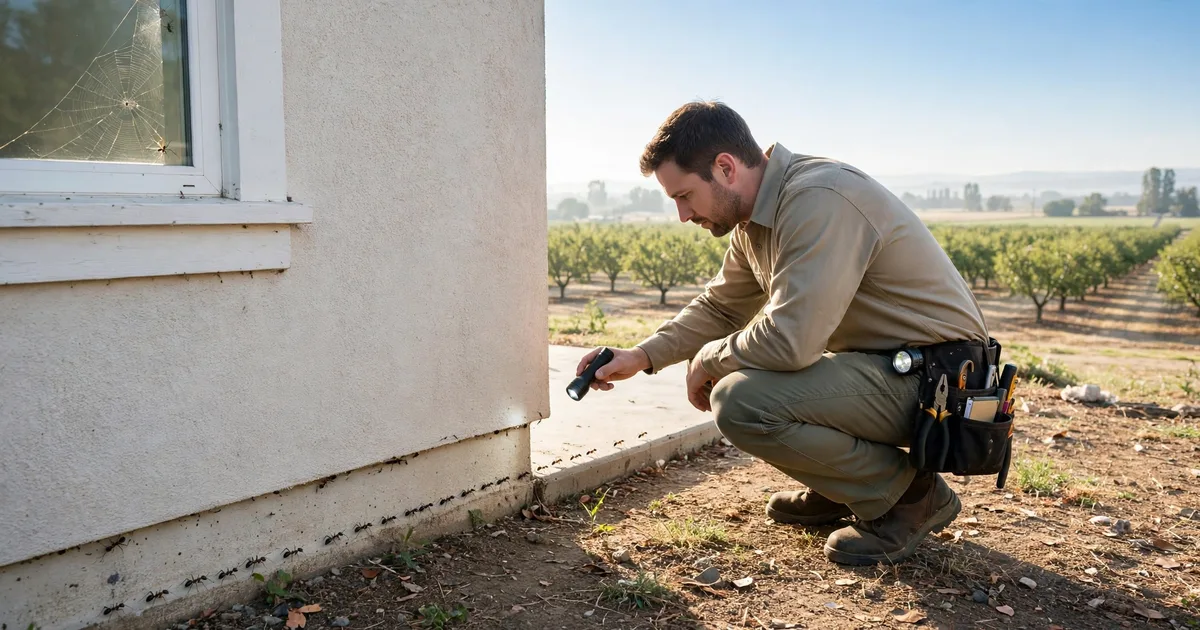
Table of Contents
- Why Central Valley Homes Get Household Pests
- Ants: The Most Common Indoor Invader
- Cockroaches
- Spiders
- Fleas
- Bed Bugs: A Brief Overview
- Rodents: A Brief Overview
- Termites: A Separate Problem Worth Recognizing
- Occasional Invaders: Earwigs, Silverfish, and Crickets
- Common Household Pests at a Glance
- What a Professional General Pest Service Involves
- Prevention: The Habits That Do Most of the Work
- When to Call a Professional
- Frequently Asked Questions
Why Central Valley Homes Get Household Pests
Household pests are rarely random. A Central Valley home sits in a landscape that produces insects in large numbers — irrigated yards and gardens, orchards and farmland around our towns, and a long warm season — and the house offers what the outdoors periodically does not: water in summer, shelter in winter, and food all year.
Summer heat and water. Valley summers are hot and dry, and for much of the season the only reliable water near a home is at the home — irrigation lines, dripping faucets, pet bowls, condensate, and the moisture around bathrooms and kitchens. Ants in particular forage far from their nests looking for water in midsummer, and a trail into a kitchen in July is very often a water run, not a food run. Irrigation also sustains outdoor populations of cockroaches, earwigs, and crickets in mulch, groundcover, and planting beds right up against the house, so the distance between an outdoor population and your doorstep is short.
Orchard and farm edges. Many Central Valley homes sit near orchards, vineyards, or open fields. In general terms, when surrounding ground is harvested, disked, or dries out late in the season, some of the insects living there move — and homes at the edge of town can see a brief increase in crickets, spiders, and other invaders looking for shelter. This is a normal seasonal pattern here, not a sign that a home is dirty or poorly kept.
Cooler, wetter winters. When the rains come, the pressure reverses. Outdoor colonies flood or chill, and ants, rodents, and occasional invaders move toward the dry, warm voids of a house — wall voids, attics, garages, and the spaces under appliances. Winter ant trails indoors are commonly a shelter problem rather than a food problem, which is why the same home can have ants for entirely different reasons in January and July.
The structure itself. Finally, every home has entry points: gaps under doors, weep holes, vents, plumbing and utility penetrations, garage door corners, and the small cracks that open as a house settles. A pest does not need much of an opening. Prevention, covered in its own section below, is largely about making the house harder to enter and less rewarding once something gets in.
Ants: The Most Common Indoor Invader
Ants are the household pest Central Valley homeowners ask about most, and the small dark ants that trail across counters and into bathrooms in this region are most often Argentine ants. Argentine ants are small, dull brown to dark in color, and travel in well-defined trails along edges — countertops, baseboards, window frames, fence lines, and the edges of sidewalks. Their colonies are large and interconnected outdoors, in soil, mulch, and under pavement, which is why killing the ants you can see rarely ends the problem: the trail is a fraction of the colony.
Up close, a few identification points matter, because not every ant in a house is an Argentine ant:
- Argentine ants are small and fairly uniform in size, trail in large numbers, and do not nest in wood. Indoors they are usually after water or food, and their nests are outside or in wall voids near moisture.
- Carpenter ants are noticeably larger, usually black, and are associated with damp or damaged wood. They do not eat wood, but they excavate galleries in it for nesting, so finding large black ants — especially near moisture-damaged trim, window frames, or a leaking roof area — raises a different set of questions than a trail of small ants at the sink.
- Odorous house ants and pavement ants also turn up in the region and can look similar to Argentine ants at a glance. Size, trail behavior, and where they are coming from help separate them.
A separate article, Argentine Ants vs Carpenter Ants, covers the identification differences in detail, because the distinction drives the response: one is mainly a foraging problem to be managed at its sources, the other can point to a moisture and wood problem in the structure.
Why they come in. Water in summer, shelter in winter, and food in every season — spilled juice under a refrigerator, grease residue around a stove, an open bag in a pantry, pet food left out overnight. Ants are efficient recruiters: one scout that finds a resource lays a trail that hundreds follow.
What a homeowner can do. Clean up sweet and greasy spills promptly, including under appliances; store pantry food in sealed containers; rinse recyclables; fix dripping faucets and under-sink leaks; avoid leaving pet food out overnight; wipe up water around sinks and tubs. Outdoors, trim shrubs and tree branches so they do not touch the house (ants use them as bridges over treated or sealed areas), keep mulch and stored items from piling against the foundation, and seal the cracks where trails enter — around windows, pipes, and door frames.
What professional service involves, in general terms. Identification of the species first, because treatment is chosen for the ant involved. Service focuses on the sources — nesting areas, trails, and entry points — rather than only the ants visible on a counter, and typically includes the exterior of the home where colonies and foraging trails are. Your technician should be able to explain where the activity is coming from and what the plan targets.
Cockroaches
Two very different cockroach problems live in Central Valley homes, and confusing them leads to wasted effort, because one breeds indoors and the other mostly visits from outside.
German cockroaches are the indoor species. They are small, light brown, with two dark parallel stripes behind the head, and they live and breed inside the home — in kitchen and bathroom cabinets, behind refrigerators and dishwashers, inside appliance motors and hinges, and around plumbing. They are almost always introduced in infested items, packaging, or appliances rather than walking in from the yard, and once established they reproduce indoors year-round. Seeing small cockroaches in a kitchen during the day, or droppings that look like dark specks or smears in cabinet corners, are typical signs. A German cockroach problem does not go away with outdoor treatment, because the population is inside.
American cockroaches — and related large outdoor species common in the Valley — are the visitors. They are much larger, reddish-brown, and live outdoors and in garages, crawl spaces, drains, sewer systems, woodpiles, and irrigated landscaping. They come indoors opportunistically, especially during summer heat or after heavy watering, often through drains, door gaps, and vents. One large cockroach in a garage or bathroom is usually an outdoor insect that wandered in, not evidence of an indoor infestation — a pattern of them, or activity concentrated near drains and crawl space access points, is worth a closer look.
A separate article, German Cockroaches vs American Cockroaches, walks through telling them apart step by step. The short version: small and indoors in the kitchen points one way; large and occasional, near the garage or a drain, points the other.
What a homeowner can do. Sanitation is the foundation for both. Degrease around and under the stove and refrigerator, clean up food residue daily, store food and pet food in sealed containers, take out kitchen trash regularly, and reduce clutter — especially cardboard boxes stored on floors, which shelter cockroaches and their egg cases. Fix plumbing leaks and dry out under-sink cabinets. For the outdoor species, seal door sweeps and gaps, keep garage clutter off the floor where you can, and reduce the damp, sheltered harborage against the house.
What professional service involves, in general terms. An inspection to identify the species and find where activity is concentrated. For German cockroaches, treatment is directed at the indoor harborage the inspection found — cracks, hinges, appliance voids, and cabinet areas — and follow-up visits are a normal part of the plan because egg cases already in place can hatch after the first visit. For outdoor species, the plan centers on the exterior, entry points, and harborage. Treatments are applied according to the product label and California regulations. The inspection findings decide which of those plans your home needs.
Spiders
Spiders are a normal part of a Central Valley home, and most of them are working in your favor — house spiders and cellar spiders in corners, closets, and garages spend their lives catching the insects that wander in. Identification still matters, because the region also has one spider that deserves genuine respect.
Common house spiders and cellar spiders build webs in undisturbed corners: window frames, garage ceilings, closets, behind stored boxes. They are a sign that insects are getting in and that the corner is quiet, more than a problem in themselves. Removing webs, reducing clutter, and sealing gaps lowers their numbers, and addressing the insects they feed on removes the reason they stay.
Western black widows are the exception to keep in mind. A mature female is glossy black with a red hourglass marking on the underside of a rounded abdomen, and she builds a strong, irregular web close to the ground in sheltered, undisturbed places: garages, sheds, woodpiles, meter boxes, block walls, and stored items that sit a long time. Widows are a regular fact of life in Central Valley garages and yards.
A measured word about risk, because widows attract outsized fear. Most spiders found in homes are not dangerous to people. Black widows are not aggressive and do not go looking for anyone to bite; bites are uncommon and usually happen when a widow is trapped against skin — a hand reaching into a woodpile or a stored box, clothing or gloves left undisturbed in a garage. The sensible response is not alarm but habit: shake out stored clothing and gloves, wear gloves when moving firewood or clearing garage corners, and keep stored items from sitting undisturbed in widow habitat for months at a time. If someone is bitten and you are concerned, contact a medical professional or poison control for advice rather than guessing — that is their area, not a pest article’s.
What professional service involves. Our spider control service starts with identifying where spiders are established and what they are feeding on, and addresses webbing areas, typical harborage, and the entry points and insect activity that support them. Treatment is only part of it — a garage cleared of webbing and clutter, with the corners reachable, is a garage widows recolonize slowly.
Fleas
Fleas in a Central Valley home are almost always tied to animals — usually the household’s own dogs or cats, and sometimes wildlife passing through the yard. A home with no pets can still get fleas when raccoons, opossums, or feral cats rest in a crawl space or shaded yard area and leave eggs behind, which surprises people; the first question in a flea call is often about animals the homeowner does not own.
The life cycle explains why fleas are stubborn. Adult fleas live and feed on the animal. Eggs fall off wherever the pet rests — carpet, rugs, pet bedding, sofas, and along baseboards — and develop there through larval stages into pupae that can wait, protected, until vibration and warmth signal an animal is near. That is why a vacant home can produce fleas weeks after everyone left, and why a single treatment of any kind rarely ends a problem on the spot: the stages already in the carpet keep emerging on their own schedule.
What a homeowner can do. Vacuum frequently and thoroughly — carpet, rugs, upholstered furniture, pet resting areas, and along baseboards — and empty the vacuum outside afterward. Vacuuming removes a share of every life stage and the vibration prompts waiting pupae to emerge, where they can be dealt with. Wash pet bedding and the household’s soft items pets rest on, on the hottest settings the fabrics tolerate. For the animals themselves, talk to your veterinarian about flea control for your pets: treating the home while the pet side goes unaddressed, or the reverse, is the most common reason flea problems drag on. We do not treat animals, and we will tell you plainly that your veterinarian owns that half of the problem.
What professional service involves. Our flea control work covers the indoor areas where fleas develop — carpet, rugs, and pet resting areas — and yard areas where animals rest, in general terms, planned around the life cycle with follow-up as needed. Preparation matters: floors cleared, items picked up, and access to the areas pets use most. Your technician will explain the preparation for your home before the visit.
Bed Bugs: A Brief Overview
Bed bugs get only a short section here because they are a specialty problem with their own complete treatment in our bed bug guide for Central Valley homes. The essentials: bed bugs are hitchhikers, not a sanitation problem. They arrive in luggage after travel, on used furniture, and with guests, and they hide in mattress seams, box springs, headboards, and upholstered furniture near where people sleep. The reliable signs are physical — live bugs, shed skins, and small rusty or dark spots along seams — and bites alone cannot diagnose them, because reactions vary so much from person to person.
If you find those signs, the response is an inspection, not a shopping trip for sprays, which used on your own can scatter bed bugs deeper into hiding. Our bed bug control service covers inspection and treatment for homes and businesses, and the guide above walks through signs, treatment options in general terms, and preparation in full.
Rodents: A Brief Overview
Rodents are the other specialty problem summarized here, covered in full in our rodent control guide for Central Valley homes. Roof rats are the Central Valley’s signature rodent — they climb, nest in attics and trees, and enter at the roofline, using overhanging branches and utility lines as highways. Norway rats burrow and stay low, around foundations and crawl spaces. House mice need very small openings and live indoors in wall voids, garages, and storage areas.
The homeowner’s share is familiar: store food and pet food in sealed, rigid containers; clear the clutter rodents nest in, especially in garages and attics; trim branches back from the roof; and seal the gaps, vents, and penetrations they enter through. The long-term answer to rodents is exclusion — sealing the structure — supported by trapping and monitoring, which the guide covers in detail, including how cost is driven by species, entry points, and follow-up. Signs worth acting on promptly: droppings, gnaw marks, nesting material, and scratching or movement sounds in walls or ceilings at night.
Termites: A Separate Problem Worth Recognizing
Termites are not usually counted among household pests, and their treatment is a separate discipline — but every Central Valley homeowner should be able to recognize the basic signs, because termites feed quietly and the cost of missing them is damage to the structure itself. Mud tubes on a foundation, piles of dry pellet-like droppings under wood, discarded wings on windowsills after a warm day, and wood that sounds hollow when tapped are the signs that call for a termite inspection. Our termite guide for Central Valley homes covers the two types that matter here, subterranean and drywood, the inspection process, and treatment options in general terms. If anything in that list looks familiar from your own home, do not fold it into a general pest visit and forget it — ask for the termite inspection specifically.
Occasional Invaders: Earwigs, Silverfish, and Crickets
“Occasional invaders” is the trade’s name for pests that live outdoors or in damp, hidden places and turn up indoors incidentally. They rarely establish breeding populations inside a maintained home, and their appearance usually points to moisture, harborage, or a gap rather than an indoor infestation.
Earwigs are flat, dark brown insects with pincers at the rear that look more threatening than they are — the pincers are not a danger to people. Earwigs live in mulch, leaf litter, and damp groundcover, feed at night, and come indoors through gaps, especially during hot, dry stretches and after heavy watering moves them around. Indoors they turn up in bathrooms, laundry rooms, and kitchens. Reducing moisture, pulling mulch and debris back from the foundation, and sealing entry gaps handles most earwig pressure.
Silverfish are small, silvery, teardrop-shaped insects that live indoors full-time in humid, undisturbed places — bathrooms, attics, closets, and stored boxes. They feed on starchy materials: paper, book bindings and glue, cardboard, wallpaper paste, and some fabrics. They do not bite and are not a health concern, but a growing silverfish presence can damage stored books and papers. Lowering indoor humidity, ventilating bathrooms and attics, and storing paper goods in sealed plastic bins instead of cardboard are the practical responses.
Crickets are outdoor insects that become indoor nuisances mostly in late summer and fall, gathering in garages, laundry rooms, and ground-floor rooms, where a single cricket’s chirping can fill a quiet house. They enter at door gaps and garage door corners and are attracted to lights at night. Sealing those gaps, reducing outdoor lighting right at entry doors where practical, and clearing the harborage against the house — stored items, dense groundcover, debris — reduces their numbers indoors.
Carpet beetles deserve a mention in this group as well. The adults are small, round beetles often seen at windows; the larvae feed on wool, feathers, lint, and other natural materials in closets, under furniture, and in stored fabrics, and their shed hairs can irritate skin and be mistaken for bites. Thorough vacuuming of closets, baseboards, and under furniture, and sealed storage for natural-fiber clothing, are the main household responses.
The shared lesson of the occasional invaders: the fix is almost never aimed at the individual insect you found. It is aimed at the moisture, the gap, or the harborage that let it in.
Common Household Pests at a Glance
| Pest | Where you usually find it | What attracts it | First response |
|---|---|---|---|
| Argentine ants | Kitchens, bathrooms, along counters, baseboards, and window frames | Water during hot months; food residue and shelter during winter rains | Clean up food and spills, fix drips, store food sealed, note where trails enter |
| German cockroaches | Kitchens and bathrooms, inside cabinets, behind appliances, near plumbing | Food, grease, warmth, water, and clutter close to appliances | Deep sanitation, reduce clutter and cardboard, fix leaks, and call for an inspection — this species lives and breeds indoors |
| American cockroaches | Garages, crawl spaces, drains, and yards; wander indoors in summer heat | Outdoor harborage, moisture, drains, and easy entry at doors and vents | Seal door sweeps and gaps, reduce outdoor clutter and moisture, keep floor drains in use |
| House spiders and cellar spiders | Corners, closets, garages, window frames | Other insects to eat, and undisturbed corners | Remove webs, reduce clutter, seal gaps, and address the insects they feed on |
| Black widows | Garages, sheds, woodpiles, meter boxes, and stored items | Undisturbed, sheltered spots close to the ground | Wear gloves moving stored items and firewood; clear clutter carefully; call for service |
| Fleas | Carpets, rugs, pet bedding, and sofas where pets rest | Pets, and wildlife passing through the yard | Vacuum frequently, wash pet bedding, and ask a veterinarian about flea control for your pets |
| Earwigs | Bathrooms, laundry rooms, under mulch and stored items near the house | Moisture and cool, damp harborage | Reduce moisture, pull mulch back from the foundation, seal entry gaps |
| Silverfish | Bathrooms, attics, and stored paper and books | Humidity and starchy materials — paper, glue, stored fabrics | Reduce humidity, store paper goods in sealed bins, ventilate bathrooms and attics |
What a Professional General Pest Service Involves
General pest control is the service most homeowners mean when they call a pest company: an ongoing or as-needed program for the common crawling pests above. In general terms, it works like this.
It starts with an inspection and identification. The technician looks at the exterior and the areas of concern, identifies the pests involved and where they are coming from, and notes the conditions helping them — a leak, a gap, a harborage. Identification is not a formality: as the ant and cockroach sections show, the correct plan for one species can be the wrong plan for a look-alike.
Treatment follows the findings. Treatments are applied according to the product label and California regulations, and they are placed where the inspected pests live, travel, and enter — which for most household pests means the exterior of the home and its entry points get much of the attention, with interior treatment directed at specific findings rather than applied everywhere by default. Your technician should be able to explain, in plain language, what is being treated and why.
Then comes the part homeowners provide, which the next section covers: the sanitation, moisture, and sealing habits that keep a treated home from being re-invited. And finally, scheduling. Some problems are one-visit situations — a single wasp nest, a confirmed identification, an occasional invader traced to one gap. Recurring pest pressure, though, is the Central Valley norm for ants and general pests, because the outdoor populations around a home renew themselves every season. Whether ongoing service or a one-time visit fits your home is a judgment made from the inspection: the size of the home, the pests involved, how much pressure the property gets, and how much activity you are seeing. Pentecost Pest Control’s residential pest control is built around that inspection-first approach for homes in Stanislaus and San Joaquin Counties.
Prevention: The Habits That Do Most of the Work
Professional service handles pests that are established. Prevention is what keeps the next ones out, and most of it is ordinary home maintenance aimed at food, water, and harborage.
In the kitchen and pantry
- Store dry goods, cereal, and pet food in sealed, rigid containers rather than open bags and boxes.
- Wipe up sweet and greasy spills promptly, including under and behind appliances, and degrease the stove area regularly.
- Take kitchen trash out regularly and rinse recyclables, especially in summer.
- Do not leave pet food sitting out overnight, and store the bag sealed.
Water and moisture
- Fix dripping faucets, under-sink leaks, and running toilets promptly — in a dry Valley summer, a slow leak is a water source pests will find.
- Keep under-sink cabinets dry, and check the areas around water heaters, dishwashers, and washing machines for slow leaks.
- Run bathroom exhaust fans and ventilate attics and crawl spaces so humidity does not build up — silverfish, earwigs, and cockroaches all prefer damp.
- Check irrigation so sprinklers and drip lines water the yard, not the foundation, and correct drainage that leaves soil against the house wet.
Sealing and storage
- Seal cracks and gaps around windows, doors, plumbing, and utility penetrations, and keep door sweeps and weatherstripping in repair — garage door corners are a common entry.
- Keep attic and crawl space vents screened and intact.
- Store items in sealed plastic bins rather than cardboard, especially in garages, attics, and closets, and keep stored goods off the floor where you can.
- Clear clutter from garage corners and along walls so harborage is limited and activity is easy to spot.
In the yard
- Trim shrubs, groundcover, and tree branches back from the house so vegetation does not touch the structure.
- Pull mulch and leaf litter back from the foundation, and keep firewood stacked away from the house rather than against it.
- Reduce items stored against the house — lumber, planters, and debris are harborage with a roof.
- Keep outdoor trash and recycling areas clean and lids closed.
None of these habits is heroic on its own. Together they change what your home offers: less food, less water, fewer hiding places, and fewer ways in. That is the ground professional service works from — and in many homes it is the difference between pests as an occasional sighting and pests as a recurring problem.
When to Call a Professional
Homeowners do the most good on observation and prevention: noticing what is appearing, where, and what changed. Identification of look-alikes, treatment, and anything involving products applied in or around a home belong with professionals. Call for an inspection when:
- Ants keep returning despite cleanup, or trails appear in more than one area of the home
- You see small cockroaches in a kitchen or bathroom — the indoor-breeding species does not resolve on its own
- You find black widows in areas people use, or spiders in numbers that suggest a larger insect problem feeding them
- Fleas persist after vacuuming and pet care steps, or appear in a home without pets
- You find bed bug signs — live bugs, skins, or rusty spots in a bed — or rodent signs such as droppings, gnawing, or sounds in walls and ceilings
- You find termite signs — mud tubes, pellet droppings, discarded wings, or hollow-sounding wood
- Occasional invaders keep appearing indoors in numbers, which usually means a gap or moisture condition worth finding
A few honest words about doing it yourself. The homeowner side of pest control — sanitation, moisture repair, sealing, storage — is genuinely effective, and this guide is built around it. The failure pattern we see is different: treating without identifying. A product chosen for the wrong ant, the wrong cockroach, or the wrong problem entirely spends money, loses weeks, and can scatter some pests deeper into hiding while the real population keeps growing. Any product, professional or store-bought, may only be used according to its label, and a label cannot tell you which pest you have. Identification first is not a sales line; it is the step everything else depends on.
Pentecost Pest Control is a family-owned company based in Modesto, at 3501 Coffee Rd, Modesto, CA 95355. We serve residential and commercial customers in San Joaquin and Stanislaus Counties, inspect before we recommend, and explain what we find in plain language. If something in this guide looks familiar from your own counters, cabinets, or garage, start with the inspection.
Frequently Asked Questions
What is the most common household pest in Central Valley homes?
Ants — Argentine ants in particular — are at the top of the list for most homes here, because their colonies are large, outdoors, and constantly foraging, and the Valley’s seasons give them reasons to come inside in both summer and winter: water during the hot months, shelter during the rains. Cockroaches, spiders, and fleas round out the most common calls, and which one leads at a given home depends on the property — pets, irrigation, nearby fields or orchards, and the home’s own gaps and moisture.
Are the spiders in my house dangerous?
Most are not. Common house spiders and cellar spiders are not considered dangerous to people, and they eat the insects that wander indoors. The Central Valley exception is the western black widow, which lives in garages, sheds, and woodpiles and does deserve respect: keep gloves on when moving stored items and firewood, shake out stored clothing, and keep those areas from sitting undisturbed. Widow bites are uncommon and usually defensive. If someone is bitten and symptoms are a concern, contact a medical professional or poison control — medical questions belong with them.
Why do I keep seeing pests right after I clean the house?
Cleaning removes food and residue, which matters, but pests usually live somewhere cleaning does not reach — colonies outdoors or in wall voids, harborage in garages and crawl spaces, egg cases and flea stages in carpet. Activity disturbed by cleaning can also flush insects out of hiding temporarily, so a brief increase in sightings after a deep clean is common. If pests persist, the source is structural or outdoors, and an inspection finds it faster than repeated cleaning does.
Can I handle a household pest problem myself?
Partly, and the part matters. Sanitation, moisture repair, sealing, decluttering, and vacuuming are homeowner work and genuinely reduce pest pressure — for occasional invaders they are often the whole answer. Where self-help falls short is identification and treatment: look-alike species need different plans, and products applied without a correct identification commonly waste effort or scatter the problem. If activity continues after the household steps, or the pest is one of the specialty problems — bed bugs, rodents, termites, German cockroaches — professional service is the practical next step.
How often does a home need pest service?
It depends on the pest pressure around the property, the pests involved, and what you are seeing. A home at the edge of orchards with heavy irrigation gets different pressure than one mid-block in a dry neighborhood, and a single invader traced to one gap is different from a recurring ant problem with colonies around the foundation. Many Central Valley homes choose ongoing service because outdoor populations renew every season; others need a visit only when something appears. An inspection produces a recommendation that fits your property rather than a default schedule.
How much does general pest control cost?
It depends on factors an inspector assesses at the property: the size of the home, which pests are involved and how much activity there is, whether the situation calls for a one-time visit or ongoing service, how much interior work the findings require, and what follow-up is included. Because of that, honest pricing follows an inspection rather than a phone guess. What we can promise is a clear explanation of findings and options before you agree to anything — call us and we will start with the inspection.
Ready to have your home checked? Call (209) 581-5562 or request a free estimate. Tell us what you are seeing — trails on the counter, a cockroach in the garage, fleas after the dog comes in — and we will schedule an inspection and explain the next steps.
By the Pentecost Pest Control Editorial Team
This article is for general educational purposes only. Pest conditions, regulations, and treatment options vary by property and situation. Contact a licensed pest control professional for an inspection.