
If termites are in your attic, they are almost certainly drywood termites. Drywoods live their whole lives inside the wood they eat, need no contact with the soil, and typically start colonies in attic framing, rafters, and eaves after winged swarmers slip in through vents, gaps at the roofline, and openings around the eaves. Subterranean termites, by contrast, live in colonies in the ground and stay tied to soil moisture; to reach an attic they would need mud tubes running the height of the house, which inspectors occasionally find along a wall, but it is the exception, not the pattern. So when pellets, wings, or damaged wood turn up overhead, the working assumption is a drywood colony in the framing above you.
That distinction shapes everything that follows: where to look, what the signs mean, and what an inspection needs to cover. The sections below walk through how drywoods get in, the signs they leave, what an inspection examines, and what happens after a colony is found. Our complete guide to termites in Central Valley homes gives the broader picture of both termite types in this region.
Key Takeaways
- Attic infestations are usually drywood termites that entered as swarmers through vents, eaves, and gaps at the roofline, not subterraneans climbing from the soil.
- The most common attic sign is frass: small pellets pushed out of the wood that collect on insulation or stored items below infested framing.
- Kick-out holes, discarded wings, and hollow-sounding rafters or joists are other signs an inspection looks for.
- An attic inspection covers roof framing, eaves, vents, and stored items, and maps how far the activity extends.
- What happens next depends on extent: a colony confined to one member leads to a different treatment discussion than activity found in several areas.
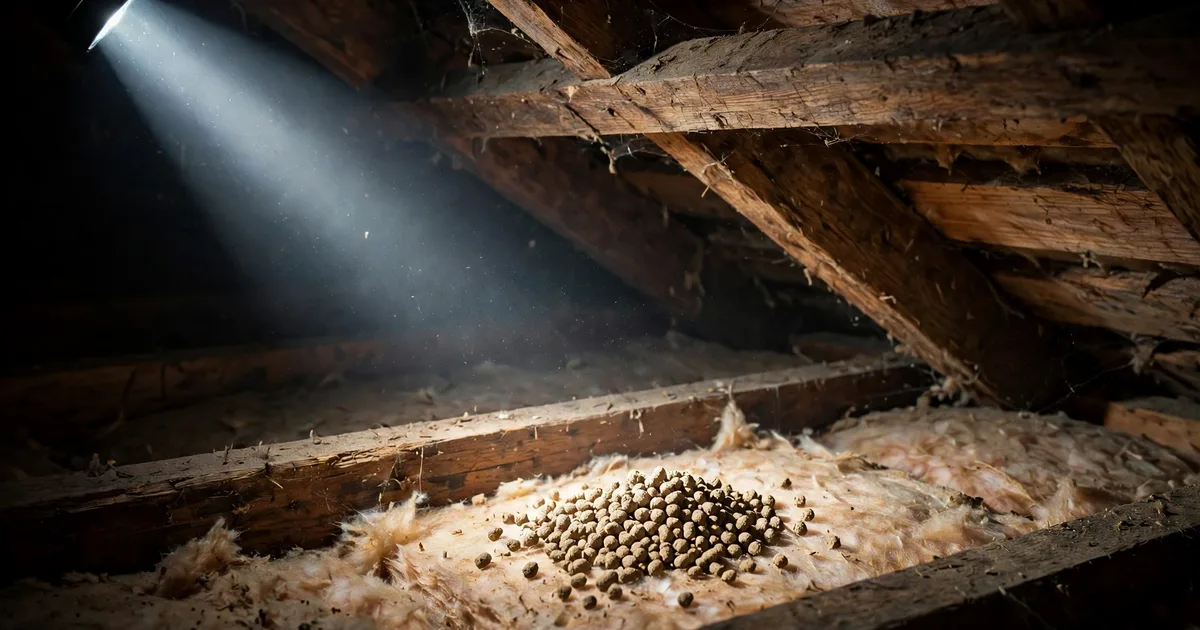
Table of Contents
- Why Attic Termites Are Almost Always Drywood
- How Drywood Termites Get Into an Attic
- Signs of Termites in the Attic
- What an Attic Inspection Covers
- Stored Wood, Cardboard, and Other Attic Food Sources
- What Happens After Termites Are Found in the Attic
- When to Call a Professional
- Frequently Asked Questions
Why Attic Termites Are Almost Always Drywood
The two termite groups that matter in Central Valley homes live very differently, as our comparison of drywood vs subterranean termites explains. A subterranean colony is centered in the soil, and its workers travel up into a structure to feed and survive only where moisture is dependable. An attic is about as far from that world as a house gets: high, hot in summer, and dry. A drywood colony, on the other hand, lives inside a single piece of wood or a connected run of framing, gets the moisture it needs from the wood itself, and never needs to touch the ground at all. Roof framing, eaves, and fascia are natural drywood habitat, and the attic is where that framing is exposed and easy to examine.
Subterranean activity in an attic is not impossible, just uncommon. It generally means mud tubes running up through a wall void or along a surface from the soil, or framing kept damp by a long-term roof leak. An inspector keeps the possibility in mind and checks for tubes on the walls below, but pellets and kick-out holes in attic framing point to drywood, and that is where the investigation starts.
How Drywood Termites Get Into an Attic
Drywood colonies begin with a swarm. Mature colonies release winged termites, called swarmers, which fly out, shed their wings, pair up, and look for a piece of wood with a crack, joint, or gap they can enter to start a new colony. The top of a house offers plenty of entry points: attic vents whose screens are torn or missing, gaps where the roof meets the walls at the eaves, openings around fascia and exposed rafter tails, and joints in exposed framing. A swarmer pair needs only a small opening to get into a rafter or a piece of trim, and once inside, the colony grows slowly within the wood, which is why attic infestations are often well established by the time the first pellets appear below.
There is a second route that has nothing to do with flying. Infested furniture, picture frames, or lumber brought up into the attic for storage can carry a colony with them. In that case the termites arrived as stowaways, and the activity may be confined to the stored item rather than the house framing, a distinction an inspection can sort out by looking at where the frass is falling from.
Signs of Termites in the Attic
Frass piles. The signature attic sign is frass: the hard, oval pellets a drywood colony pushes out of its galleries through a tiny kick-out hole. Pellets rain down from infested rafters or joists and collect in neat piles on insulation or on top of stored boxes and furniture below the framing. Our guide to what termite droppings look like shows how to tell frass from sawdust and other debris. Frass sometimes gives the colony away from the rooms below, too, sifting through a ceiling gap or light fixture and appearing on furniture or flooring under the attic.
Kick-out holes and damaged wood. Looking up at the framing, you may spot pinpoint holes in a rafter or joist with pellets caught around the rim. The wood around an active gallery can look blistered or slightly sunken where the surface has thinned, and severely damaged members may show exposed, layered galleries if the surface breaks.
Wings and swarmers. Discarded wings collect near attic vents and in the rooms below near windows after a swarm, and finding them indoors season after season suggests a colony inside the structure rather than one outside.
Hollow-sounding framing. Rafters and joists that have been tunneled can sound papery or hollow when tapped, compared with the solid knock of sound wood. Our article on hollow-sounding wood explains how that check works and what it can and cannot tell you.
What an Attic Inspection Covers
An attic inspection works through the exposed structure methodically. The inspector examines the roof framing itself: rafters, ceiling joists, the ridge, and the junctions where framing members meet, sounding wood that looks suspect and checking for kick-out holes and frass patterns that show which members are involved. The eaves and fascia are checked from inside where they can be reached, since the roofline is both a common entry zone and a common colony site. Vent openings are checked too, as entry points and because wings and swarmers tend to collect near them. Our walkthrough of what a termite inspection includes describes how the attic portion fits into a full inspection of the home.
The inspection also maps extent. One rafter dropping pellets over one bay of the attic is a different finding from kick-out holes in framing on both sides of the house, and the inspector traces frass patterns and probes suspect wood to draw that map. Areas over bathrooms and kitchens get attention because plumbing and moisture history can matter to wood condition, and the inspector notes stored items that show damage or are shedding pellets. Access has limits in most attics: low clearance at the eaves, deep insulation, and the absence of flooring mean some framing simply cannot be reached, and a good inspection states which areas were examined and which could not be.
Stored Wood, Cardboard, and Other Attic Food Sources
Attics double as storage, and much of what gets stored is termite food. Cardboard is the item that surprises people: it is made of cellulose, and drywood termites can feed on it, so a colony can live in or under a stack of boxes, and frass found on a box might be coming from the box itself, from another stored item, or from the rafter above it. Spare lumber, wood scraps, and wooden furniture stored overhead are direct food sources and can harbor colonies of their own. Part of reading attic signs correctly is separating damage to stored belongings from damage to the house, because the responses are different.
| Stored item | Why it matters | What to do |
|---|---|---|
| Cardboard boxes | Made of cellulose; can be fed on and can hide frass from above | Move contents into plastic bins and take cardboard out of the attic |
| Spare lumber and wood scraps | A ready food source sitting inside the attic | Store lumber in the garage or shed instead, off the floor where possible |
| Wooden furniture | Can carry or develop its own drywood colony | Inspect pieces for pellets and kick-out holes before storing them overhead |
| Books and paper records | Cellulose that can be fed on once a colony is nearby | Keep paper in sealed plastic bins rather than open boxes |
What Happens After Termites Are Found in the Attic
The findings drive the next conversation, and extent is the deciding factor. When activity is confined to one accessible member or a stored item, the discussion is about addressing that wood directly: treating the infested member or, for a stored piece, removing it from the house altogether. When pellets and kick-out holes show up in framing in several separated areas, the discussion widens to whole-structure approaches, because treating one rafter at a time does not address colonies that have not yet shown themselves. Badly damaged members may also need repair or replacement once the termites are dealt with, which is carpentry work separate from the termite treatment itself. Treatments are applied according to the product label and California regulations. What matters at this stage is that the recommendation follows the map the inspection drew, rather than a one-size answer given before anyone climbed up and looked.
When to Call a Professional
Call a professional if you find a pile of pellets in the attic or in a room below it that comes back after you clean it up, if wings keep appearing indoors, or if attic framing sounds hollow or looks blistered. Call as well if you are storing wooden furniture or lumber overhead and notice holes or pellets on it, since sorting out whether the colony is in the item or the framing is an inspection job. Pentecost Pest Control is a family-owned company in Modesto providing termite inspection, monitoring, and treatment across San Joaquin and Stanislaus Counties, and an attic check as part of a full inspection will establish which members are affected and how far the activity extends.
Frequently Asked Questions
Can subterranean termites really not reach an attic?
They can, but it is uncommon. Subterraneans need a dependable connection to soil moisture, so attic activity usually means mud tubes running up through or along the walls from the ground, or framing kept damp by a long-standing roof leak. An inspector checks the walls and foundation for tubes before ruling it out, but the great majority of attic colonies turn out to be drywood.
I found pellets on a box in the attic. Does that mean my rafters are infested?
Not necessarily. Pellets fall straight down from a kick-out hole, so the source is in the wood above the pile, but that wood could be a rafter, a stored piece of lumber, or the box and its contents themselves. An inspection identifies the source member by examining what sits above the pile and checking the framing around it, and that identification decides what actually needs attention.
How do drywood termites get in if my vents are screened?
Screens help, but they are not the only route. Swarmers also enter through small gaps at the eaves, joints in exposed framing, and openings around the roofline that are hard to seal completely, and colonies can arrive inside infested furniture or wood brought into the attic. A well-maintained house lowers the odds; it does not reduce them to zero.
Will attic termites spread to the rest of the house?
A drywood colony grows slowly and mostly stays within the wood it occupies, expanding into connected framing over time. The bigger spread risk is swarming: a mature attic colony releases swarmers that can start new colonies in other wood in the structure. That is why an established attic infestation is worth addressing even though the colony itself moves slowly.
Can I just remove the infested wood I can see?
If the colony is confined to a stored item, removing that item can remove the colony with it. Framing is different: rafters and joists cannot simply be taken out, and the activity you can see may not be all the activity there is. A professional inspection maps the full extent first, so the response covers the whole infestation rather than the part that happened to drop pellets where you noticed them.
If you have found pellets, wings, or suspicious wood in your attic, Call (209) 581-5562 or request a free estimate and we will inspect the attic and the rest of the structure and explain what we find.
By the Pentecost Pest Control Editorial Team
This article is for general educational purposes only. Pest conditions, regulations, and treatment options vary by property and situation. Contact a licensed pest control professional for an inspection.