
Termite damage and water damage look alike because both weaken wood from within and both can leave blistered paint, sagging surfaces, and wood that sounds hollow — but they leave different fingerprints. Termite damage is patterned: tunnels and galleries that follow the wood grain, mud packed inside subterranean workings, or pellet droppings near drywood feeding, usually in wood that is otherwise dry. Water damage is tied to a water source: staining and discoloration, wood that feels soft or spongy, swelling and warping, and paint that peels, all clustered around plumbing, windows, roofs, or ground moisture. Reading the pattern, the texture, and the location together usually separates the two — and it matters, because one calls for a pest inspection and the other for finding and fixing a leak, and sometimes a home needs both.
One more wrinkle before the details: the two problems are connected. Damp wood attracts subterranean termites, so a long-running leak can produce water damage first and termite damage second, in the same wall.
Key Takeaways
- Termite damage follows the grain in tunnels and galleries and often hides under an intact-looking surface; water damage follows the water and shows on the surface early.
- Mud inside the wood’s tunnels or pellet piles nearby point to termites; staining, softness, swelling, and peeling paint point to water.
- Location is a clue: damage centered on plumbing, windows, and roof lines suggests water first; damage in dry wood away from any water source suggests termites.
- The two overlap — leaks create the damp conditions subterranean termites favor, so both can be present in the same area.
- Observation can sort out the likely cause, but confirming extent and activity, and separating the repairs, takes an inspection.
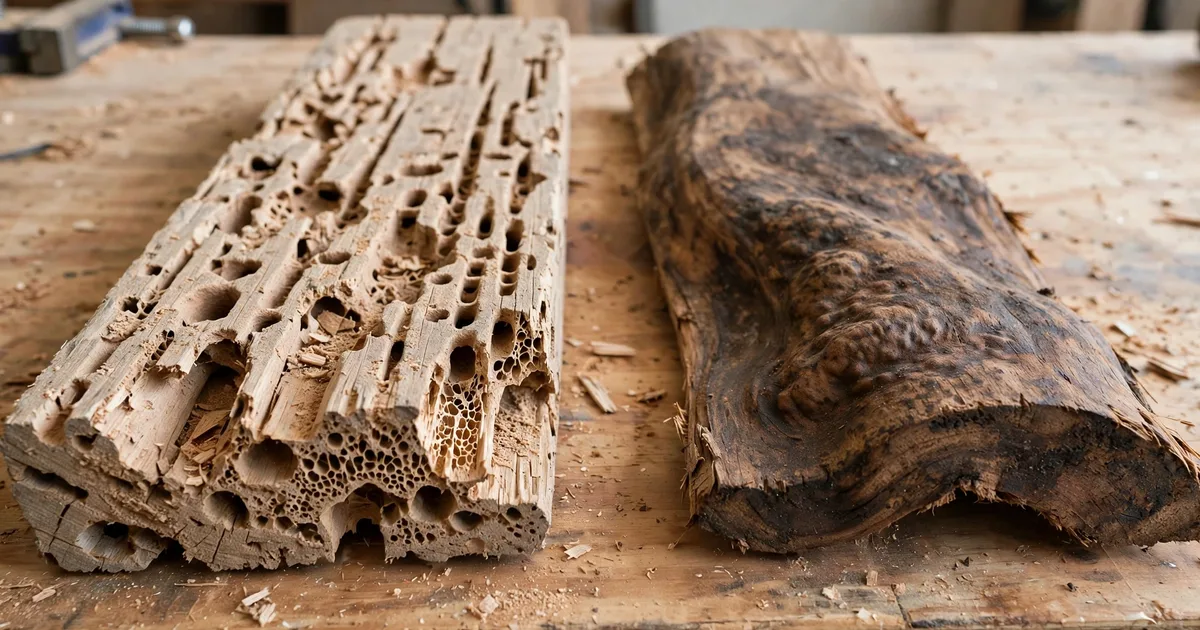
Table of Contents
- Why the Two Get Confused
- Signs That Point to Termite Damage
- Signs That Point to Water Damage
- Side-by-Side Comparison
- When Both Are Present
- What to Do With What You Find
- When to Call a Professional
- Frequently Asked Questions
Why the Two Get Confused
Most wood damage announces itself indirectly. Paint blisters or bubbles on a baseboard. A door starts sticking. A floorboard feels slightly soft, or a tap on the trim sounds hollow instead of solid — the sound clues are covered in our companion article, Hollow-Sounding Wood in Your Home: Could Termites Be the Cause? Those surface hints are shared by both problems because the underlying event is the same: the wood’s interior has lost substance, whether insects ate it or moisture and decay fungi broke it down.
The confusion costs homeowners in both directions. Termite damage mistaken for an old water stain gets painted over and left to spread. Water damage mistaken for termites gets a pest treatment while the leak keeps running and the rot continues.
Signs That Point to Termite Damage
Termite feeding has a structure to it, because it is done by insects following the wood:
- Galleries that follow the grain. Subterranean termites eat the softer springwood and leave the harder grain lines, so damaged wood shows layered, parallel tunneling along its length. Drywood termites carve smoother chambers that can cross the grain as well.
- Mud and soil inside the wood. Subterranean workings are lined or packed with dirt-like material the termites carried in. Clean-looking wood with mud inside its tunnels is a termite signature water cannot produce.
- Evidence nearby. Mud tubes on the foundation below the damage, pellet piles (frass) under drywood feeding — the sign detailed in What Do Termite Droppings Look Like? A Guide to Identifying Frass — discarded wings, or live insects in the wood all point the same direction.
- A hard, intact surface over a hollow interior. Because subterranean termites avoid breaking through to open air, the outside of a board can look and feel sound while the inside is tunneled — the damage reveals itself by sound or when the surface is pressed and gives.
- Damage in dry wood. Termite findings in wood with no leak, no staining, and no moisture history — an interior door frame, attic framing, furniture — argue for insects, since decay needs water to work.
Signs That Point to Water Damage
Water damage follows plumbing and weather, and it usually shows itself on the surface:
- Staining and discoloration. Water leaves marks: darkened wood, yellow-brown rings or streaks on ceilings and walls below a leak, and tide lines where moisture repeatedly reached. Termites do not stain wood this way.
- Soft, spongy texture. Decayed wood loses its fiber strength and feels soft or crumbly rather than tunneled. Heavily rotted wood can break apart in fibrous chunks.
- Swelling, warping, and buckling. Wood that absorbs water expands unevenly — doors and drawers swell and stick, flooring cups or buckles, trim pulls away from walls. (Doors can stick from termite-weakened frames too, which is why this sign needs company.)
- Peeling, flaking paint and surface growth. Paint over damp wood loses adhesion and peels; persistently damp surfaces can grow visible mold or mildew, with a musty odor in enclosed spaces like crawl spaces and cabinets.
- A traceable water source. A supply line, a drain, a window that leaks in wind-driven rain, a roof flashing, a slab or foundation taking on irrigation water. If the damage map matches a water map, water is the primary suspect.
Side-by-Side Comparison
| Feature | Termite Damage | Water Damage |
|---|---|---|
| Primary cause | Insects feeding inside the wood | Moisture breaking wood down, often with decay fungi |
| Pattern in the wood | Tunnels and galleries, often following the grain | Softening and breakdown spread through the wet area |
| What’s inside the wood | Hollowed chambers; mud or soil in subterranean workings; clean galleries in drywood workings | Darkened, softened, or crumbly fibers; no tunnels |
| Surface appearance | Often intact-looking until advanced; paint may blister over thinned wood | Staining, discoloration, peeling paint, warping or swelling |
| Feel and sound | Shell feels hard; sounds hollow or papery when tapped | Feels soft or spongy; sounds dull where decayed |
| Accompanying signs | Mud tubes, frass pellets, discarded wings, swarmers | Leak or moisture source, musty odor, mold or mildew |
| Typical locations | Sills, studs, joists, frames, attic wood — wet or dry | Below plumbing, windows, roof lines, and ground-contact wood |
| Moisture present? | Subterranean termites favor damp wood but also feed in dry areas; drywood termites live in dry wood | Always — no water, no water damage |
No single row settles a real case by itself; the rows work as a set. Damage with tunnels, mud, and frass on one side is termite work even if the wood is also damp.
When Both Are Present
The overlap case is common in Stanislaus and San Joaquin County homes, and it follows a simple logic. Subterranean termites are drawn to moisture: a slow plumbing leak, a poorly draining crawl space, or irrigation soaking a foundation keeps wood damp, and damp wood is easier for termites to eat. So a leak that runs for seasons can quietly convert a plumbing problem into a termite problem in the same wall framing.
Carpenter ants follow a similar pattern, excavating nests in wood already softened by water. That means “it is just water damage” and “it is just termites” are both conclusions to hold loosely when the two sets of signs appear together. The practical sequence in an overlap case is to stop the water, establish whether insects are active and where, and then repair wood — treating insects while a leak continues invites them back, and fixing a leak does nothing about a colony already feeding.
What to Do With What You Find
Observation-level steps sort most cases into a likely category:
- Map the damage. Note which boards, walls, or rooms are affected, and whether the pattern clusters around plumbing, windows, or the roof line — or sits in dry wood with no water source nearby.
- Read the accompanying signs. Look for tubes on the foundation, pellets below the wood, wings on sills, and on the water side, for staining, peeling, softness, odor, and an identifiable leak.
- Check the moisture story. Has this spot ever leaked? Is anything above or behind it carrying water? Does the area stay damp?
- Note the sound and feel without opening anything up. A hard shell that sounds papery reads differently from wood that feels spongy — and prying or poking at structural wood is where observation ends; leave that to the inspection.
- Deal with the water first if water is running. A leak is active damage on its own schedule regardless of insects, and stopping it is a plumbing or roofing matter that should not wait on the pest question.
From there, the cause decides the professional. Water findings go to the leak source and repair. Insect findings — or uncertainty, which is common — go to a pest inspection. Our termite inspection guide for California homeowners explains how inspectors sort insect damage from other damage and document each, and the complete guide to termites in Central Valley homes puts the termite side in full context. Treatments are applied according to the product label and California regulations.
When to Call a Professional
Call for an inspection when:
- You find tunneling, mud inside wood, frass, or mud tubes alongside any damaged wood
- You cannot tell which cause you are looking at — an honest and common position
- The damaged wood is structural: sills, studs, joists, beams, or porch framing
- Damage keeps appearing or spreading after a leak has been repaired
- You are buying or selling the home and damaged wood needs a documented answer
- Both sets of signs are present and you need the insect question settled before repairs are planned
Pentecost Pest Control is a family-owned company based in Modesto, at 3501 Coffee Rd, Modesto, CA 95355. We provide termite inspection, monitoring, and treatment for homes in San Joaquin and Stanislaus Counties. If the findings are insects, we explain the extent and the options; if the findings are water alone, we will tell you that too, and the repair conversation belongs with the appropriate contractor.
Frequently Asked Questions
Can termite damage and water damage really look the same?
At the surface, yes — both blister paint, weaken wood, and produce hollow or dull sounds. They separate at the pattern level: termite work is tunneled and directional, with mud or frass as evidence, while water damage is stained, softened, and mapped to a moisture source. When the surface clues will not separate them, an inspection will.
I fixed the leak. Do I still need to worry about termites?
Fixing the leak removes the condition that attracted them, and it is the right first move. It does not remove a colony that already moved in while the wood was damp, and dried-out damage looks the same whether insects left or stayed. If there were insect signs — tubes, tunnels, mud in the wood — have the area inspected after the repair so the insect question gets its own answer.
Does water damage attract termites, or is that a myth?
It is real, with a qualification: subterranean termites favor damp wood and the moist soil conditions leaks create, so chronic moisture raises a home’s termite risk around the wet area. Drywood termites are the exception — they live in dry wood and do not need a leak. Either way, keeping wood dry is one of the most useful termite-prevention habits a homeowner has.
Which problem is worse for a house?
Either one, left alone. Water damage spreads as long as water flows and can rot structural wood and feed mold; termite damage spreads as long as the colony feeds and can hollow framing behind intact surfaces. The more useful question is not which is worse but which is present, how far it has gone, and what stops it.
How much does it cost to sort out and fix damaged wood?
It breaks into pieces priced by their own factors: the pest inspection and any treatment, which depend on the cause, the extent of activity, and how accessible the areas are — the factors detailed in our guide to termite treatment cost factors — and the repair side, which depends on which members are damaged and how much of each, and is typically priced by a contractor.
Looking at damaged wood and not sure which story it is telling? Call (209) 581-5562 or request a free estimate — describe where the damage is and what came with it, and we will start with an inspection and separate the causes for you.
By the Pentecost Pest Control Editorial Team
This article is for general educational purposes only. Pest conditions, regulations, and treatment options vary by property and situation. Contact a licensed pest control professional for an inspection.