
Termite droppings from drywood termites look like tiny, hard, oval pellets — roughly the size of a grain of salt or a small seed — that collect in neat little piles below the wood where the termites are feeding. The pellets, called frass, range in color from light beige to dark brown or nearly black, and a pile is often described as looking like ground pepper, coffee grounds, or a small heap of sawdust. If you are sweeping up little piles like this under a window frame, a piece of furniture, or a baseboard in your Modesto-area home, drywood termites are a real possibility worth having checked.
One important distinction up front: pellet piles come from drywood termites, which live inside the wood they eat. Subterranean termites, the other main group in the Central Valley, do not leave pellet piles at all, so the absence of frass does not rule termites out. This guide covers what drywood frass looks like, where it shows up, how to tell it apart from similar-looking material, and what its presence does and does not tell you.
Key Takeaways
- Drywood termite droppings (frass) are hard, oval pellets about a millimeter long, pushed out of infested wood through small “kick-out” holes.
- Frass piles look like ground pepper, coffee grounds, or coarse sawdust and collect directly below the wood the colony is feeding in.
- Pellet color varies from light tan to almost black, even within one pile, because it reflects the wood the termites have eaten.
- Subterranean termites do not leave frass piles; their signs are mud tubes and damaged wood instead.
- Fresh frass appearing after you clean a spot suggests an active colony nearby, but only an inspection can confirm activity and extent.
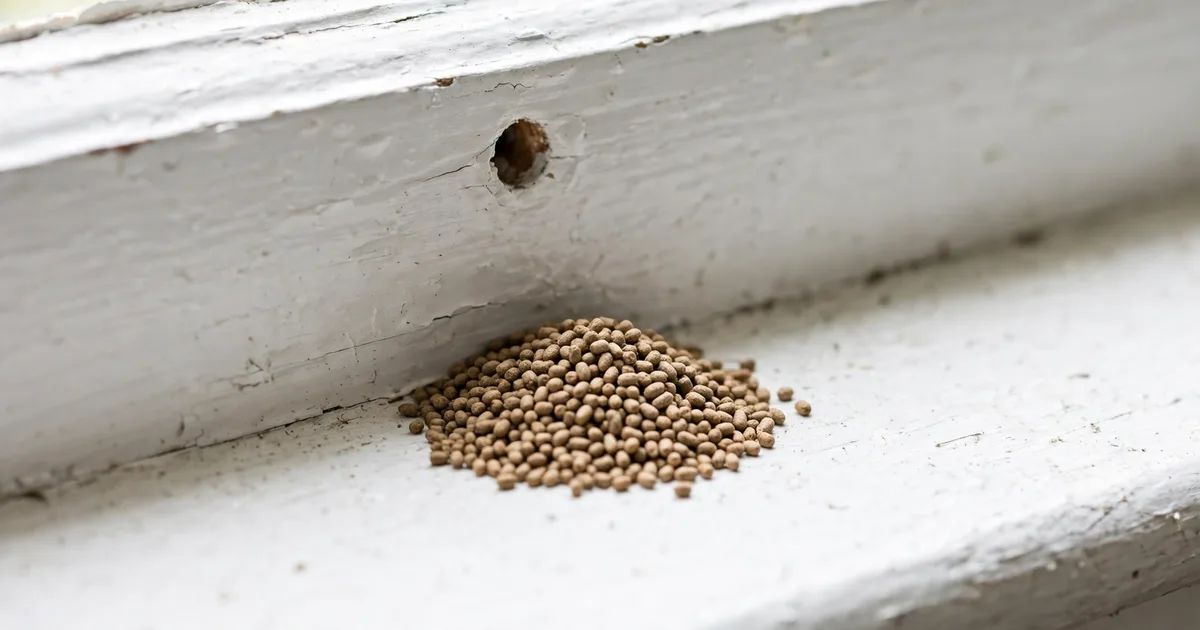
Table of Contents
- What Frass Is and Where It Comes From
- What Drywood Termite Droppings Look Like
- Where You Are Most Likely to Find Frass
- Frass vs. Sawdust and Other Look-Alikes
- What About Subterranean Termite Droppings?
- What to Do If You Find Frass
- When to Call a Professional
- Frequently Asked Questions
What Frass Is and Where It Comes From
Drywood termites spend their whole lives inside a single piece of wood — a stud, a rafter, a door frame, a piece of furniture. They eat the wood, tunnel through it, and live in the galleries they create. Because the colony lives in a dry, enclosed space, the termites push their droppings out of the wood to keep their living area clear.
They do this through tiny openings called kick-out holes. A worker termite nudges the pellets to the hole and kicks them out, and the pellets fall and collect in a cone-shaped pile on whatever surface sits below: a windowsill, the floor, a countertop, the top of a lower piece of furniture. The pile grows slowly, a few pellets at a time, which is why frass often goes unnoticed for months — it looks like a little dirt or dust that keeps coming back after cleaning.
Finding the kick-out hole matters as much as finding the pile. Look directly above the pile, in the wood overhead or on the underside of the wood itself, for a small round hole about the size of a pinhead. That hole marks the edge of the colony’s gallery system and helps an inspector zero in on where the termites actually are.
What Drywood Termite Droppings Look Like
Frass pellets have a consistent set of traits that separate them from most other debris found in a home:
- Shape: Each pellet is oval or elongated with rounded ends, and many have a slightly six-sided look when viewed up close. They resemble tiny seeds or miniature footballs.
- Size: Individual pellets are small and fairly uniform — roughly a millimeter long, similar to coarse sand or poppy seeds.
- Texture: The pellets are hard and dry. Rubbed between your fingers, they feel gritty rather than soft or powdery, and they do not smear.
- Color: Pellets range from light beige through amber and brown to nearly black. A single pile often contains several shades mixed together, because the color reflects the wood being eaten and how long ago each pellet passed through the colony.
- The pile: Because pellets fall straight down from a kick-out hole, the pile is usually a tidy little mound or scattered cone directly beneath infested wood — on a sill, a shelf, the floor, or stored items below.
The combination is what matters. One stray speck means nothing. A recurring little pile of uniform, hard, seed-like pellets under a piece of wood is the classic drywood termite signature.
Where You Are Most Likely to Find Frass
In Central Valley homes, frass turns up wherever drywood termites have found wood to live in. Common spots include:
- Window frames and sills, especially wood-framed windows that get sun and heat
- Attic framing — rafters, joists, and stored lumber, with piles landing on insulation or items stored below
- Wood furniture, including antiques and pieces with solid wood frames, where piles appear on the floor or carpet underneath
- Baseboards, door frames, and wood trim along walls
- Eaves and fascia boards, with pellets collecting on patios, porches, or the ground below
- Garage wood — stored lumber, wood shelving, and framing
Because colonies are small and slow-growing compared with subterranean termites, the damage from a drywood colony is usually localized at first. But a home can host more than one colony at a time, and piles in two different rooms deserve attention in both places.
Frass vs. Sawdust and Other Look-Alikes
Several other materials get mistaken for termite droppings, and a few features separate them:
- Carpenter ant debris: Carpenter ants also push material out of wood, but their leavings are coarser and mixed — actual wood shavings and sawdust-like fragments, sometimes with dead insect parts in the mix. It looks like rough sawdust, not uniform pellets.
- Sawdust from wood-boring beetles: Powderpost and similar beetles leave a fine, flour-like powder rather than hard pellets. If the material feels like talc or flour and piles in soft drifts below tiny holes in wood, beetles are a more likely source.
- Rodent droppings: Mouse droppings are much larger than frass pellets, shaped like small grains of rice, and turn up along walls, in cabinets, and near food — not in neat piles directly below overhead wood.
- Ordinary dirt and grit: Wind-blown dust and soil are irregular in size and shape. Frass pellets are strikingly uniform, which is the single easiest field check: uniform pellets point to termites; random grit points to dirt.
When the material is ambiguous, that is exactly the kind of question an inspection answers. Our termite inspection guide for California homeowners explains what an inspector looks for and how findings like frass get documented.
What About Subterranean Termite Droppings?
Subterranean termites — the kind that build the mud tubes covered in our companion article, Termite Mud Tubes on Your Foundation: What They Mean and What to Do Next — live in the soil and travel into a home to feed. They do not produce dry pellet piles. Their droppings stay inside their workings, mixed into the mud and soil material they build with.
So if you find a pile of pellets, you are looking at drywood evidence. If you find no pellets, termites are still possible: subterranean colonies announce themselves through mud tubes, soft or hollow-sounding wood, and swarmers rather than frass. Our complete guide to termites in Central Valley homes walks through the full set of signs for both types, and Hollow-Sounding Wood in Your Home: Could Termites Be the Cause? covers the sound-based clues in detail.
What to Do If You Find Frass
A few simple observation steps help, and none of them involve treating anything yourself:
- Note the location. Write down where the pile is and what wood sits above it. A phone photo with something for scale, like a coin, is genuinely useful.
- Look for the kick-out hole in the wood directly above the pile.
- Clean the spot once, then watch it. Sweep or vacuum the pile away, then check the same spot over the following days and weeks. New pellets appearing in a cleaned spot suggest the colony is still active; a pile that never returns may be old evidence.
- Check nearby wood for sibling piles — other frames, furniture, and stored wood in the same room or attic.
- Avoid disturbing the wood itself. Kicking, prying, or spraying into the area can scatter the evidence an inspector needs and does not reach a colony living deep in the wood anyway.
What you should not do is assume the pile tells you the whole story. Frass confirms termites have fed in that wood; it does not show how large the colony is, how far the galleries reach, or whether other colonies exist elsewhere in the house. That takes a structured inspection of the kind described on our termite control service page.
When to Call a Professional
Call for an inspection when:
- You find pellets that keep coming back after the spot is cleaned
- You find frass piles in more than one room or under more than one piece of wood
- You spot a kick-out hole, blistered or bubbling paint on wood, or wood that sounds hollow when tapped
- You are buying or selling a home and frass turns up during your own walk-through
- You found pellets months ago, set the question aside, and want a definite answer
Pentecost Pest Control is a family-owned company based in Modesto, at 3501 Coffee Rd, Modesto, CA 95355. We provide termite inspection, monitoring, and treatment for homes in Stanislaus and San Joaquin Counties, and we explain what we find — where the evidence points, what is active, and what your options are — before any work is agreed to. Treatments are applied according to the product label and California regulations.
Frequently Asked Questions
Are termite droppings always the same color?
No. Frass color runs from light beige to dark brown or nearly black, and one pile commonly mixes several shades. The color reflects the wood the colony is eating, so even pellets from a single colony vary. Color alone does not tell you the species or how active the colony is; the uniform pellet shape and the pile’s location below wood are the more useful clues.
I cleaned up a pile and it came back. Does that mean the termites are active?
It is a strong suggestion, yes. Pellets only fall when termites are feeding and pushing waste out of the wood, so frass reappearing in a cleaned spot points to a live colony in the wood above. It does not tell you how big the colony is or how much damage exists, which is why the next step is an inspection rather than a guess.
Can I tell drywood and subterranean evidence apart myself?
Often, at least as a first read. Pellet piles mean drywood termites. Mud tubes on a foundation or in a crawl space mean subterranean termites. The two types can also be present in the same home at the same time, so finding one sign does not clear the other — an inspection checks for both.
Do termite droppings mean the wood is destroyed?
Not necessarily. Drywood colonies are relatively small and grow slowly, so a colony caught from fresh frass evidence may have done limited, localized damage. But pellets can also fall for a long time before anyone notices, and the only way to know how far galleries extend is to have the wood and surrounding structure inspected.
How much does it cost to deal with drywood termites?
The cost depends on factors an inspection establishes: how many colonies are present and where, how accessible the infested wood is, how far the damage extends, and which treatment approach fits the situation. A single piece of infested furniture is a different job from colonies spread through attic framing. An honest figure follows the inspection, and a written quote should say what it covers.
Found pellets under a window frame, a door, or a piece of furniture? Call (209) 581-5562 or request a free estimate — tell us where the piles are showing up, and we will start with an inspection and explain what we find.
By the Pentecost Pest Control Editorial Team
This article is for general educational purposes only. Pest conditions, regulations, and treatment options vary by property and situation. Contact a licensed pest control professional for an inspection.