
Preparing for bed bug treatment means laundering bedding and clothing, sealing items in bags before you move them, clearing clutter so a technician can reach the places bed bugs hide, and opening up access to beds, furniture, and baseboards. Preparation is not busywork: bed bugs survive by hiding in seams, cracks, and furniture joints, and treatment can only work on the bugs it can reach. Thorough preparation is the single biggest thing a household controls in whether a treatment succeeds. One warning before the checklist itself: preparation steps vary with the treatment method being used and with the company doing the work, so treat this article as general guidance — where your treatment provider’s own instructions differ from anything below, the provider’s instructions come first.
Key Takeaways
- Preparation decides whether treatment reaches the bugs. Bed bugs hide in mattress seams, furniture joints, and cracks, and clutter and blocked access shelter them from treatment.
- Work room by room, bedrooms first: strip beds, launder bedding and clothing, declutter, and empty drawers and closets as your provider instructs.
- Bag items in sealed bags before moving them between rooms, wash and dry them on the hottest settings the fabrics can tolerate, and keep cleaned items sealed in fresh bags until your provider says they can come back out.
- Do not use bug bombs or foggers, do not carry infested items through the home unbagged, and do not throw furniture out before asking whether it can be treated.
- Plan for people and pets to be out during treatment, and follow your provider’s instructions on when it is all right to return.
- Expect follow-up visits. Eggs and deeply hidden bugs are why bed bug work is normally a process, not a single appointment.
- Pentecost Pest Control provides bed bug control for homes and businesses across Stanislaus and San Joaquin Counties.
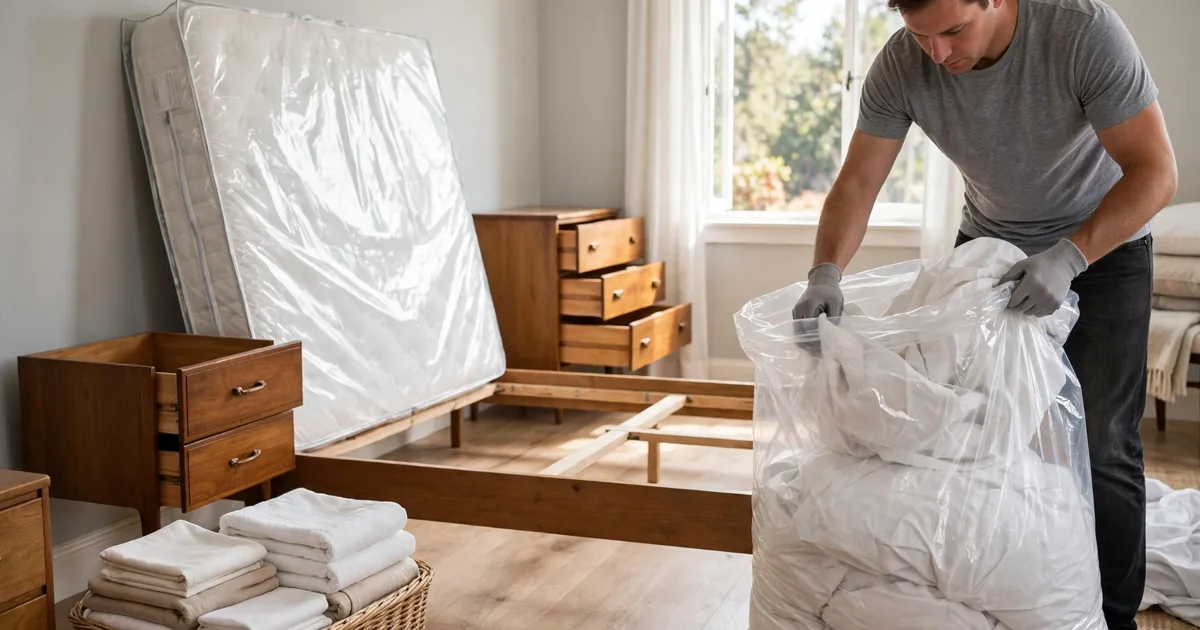
Table of Contents
- Why Preparation Matters
- The Room-by-Room Preparation Checklist
- Laundry and Bagging: The Protocol That Prevents Spreading
- What Not to Do Before Treatment
- Pets, Children, and Leaving the Home
- Treatment Day: What to Expect
- After Treatment: Re-Entry, Encasements, and Follow-Up Visits
- Preparing in Apartments and Rentals
- The Summary Checklist
- When to Call a Professional
- Frequently Asked Questions
Why Preparation Matters
Bed bugs are small, flat, and patient. During the day they tuck themselves into places that are dark, tight, and close to where people sleep or sit for long stretches: the seams and folds of mattresses, the joints of bed frames and headboards, the undersides of upholstered furniture, behind loose baseboards, inside drawer joints and screw holes, and in the cracks of nightstands and bookshelves. Eggs are laid in the same sheltered spots, glued in place and easy to overlook.
That hiding behavior is exactly why preparation matters so much:
- Access. A technician can only treat what can be reached. A bed buried under stored boxes, a closet packed to the door, or a sofa pushed tight into a corner leaves harborage untouched — and untouched harborage is where the infestation survives.
- Harborage reduction. Every item of clutter near a bed or sofa is a potential hiding place. Reducing clutter reduces the number of places bugs can wait out a treatment.
- Eggs. Eggs hidden in seams and joints are harder to reach than moving bugs, which is one reason preparation and follow-up visits work together: prep exposes what can be exposed, and follow-up deals with what hatches or emerges later.
- Containment. Bed bugs spread through a home mainly by being carried — in laundry baskets, luggage, clothing, and furniture moved from room to room. Careless preparation can scatter an infestation that was confined to one bedroom into the whole house. Careful preparation does the opposite.
The honest way to think about it: the treatment itself is the provider’s job, but the treatment happens in your home, among your belongings. The hours of preparation beforehand are what let the treatment do its work.
The Room-by-Room Preparation Checklist
Start several days before the appointment if you can, and work in the order below — the rooms where people sleep come first, because that is where bed bugs concentrate. As you go, everything that leaves a room travels in a sealed bag (the next section explains the full protocol).
Bedrooms first
The bedroom is almost always the center of a bed bug problem, so it gets the most thorough preparation.
- Strip every bed in the room. Remove sheets, pillowcases, blankets, mattress covers, and bed skirts. Bag them at the bedside — do not carry loose bedding through the house — and take the sealed bags straight to the laundry.
- Launder bedding and clothing following the laundry protocol below: hottest wash and dry settings the fabrics can tolerate, then seal the clean items in fresh bags.
- Empty nightstands, dressers, and drawers as instructed. Bed bugs hide in drawer joints and in the contents themselves. Bag the contents, launder what can be laundered, and leave emptied furniture accessible. Your provider may give specific instructions for drawers and closets — follow those where they differ.
- Declutter around and under the bed. Books, magazines, storage boxes, shoes, and anything else stored under or beside the bed should be inspected, bagged, and moved out of the treatment area as instructed. Cardboard stored under a bed is prime harborage.
- Move furniture away from the walls where you can, so baseboards and the backs of furniture can be reached. Headboards in particular need to be accessible — they are one of the most common hiding places.
- Make the mattress and box spring fully accessible. Clear everything off and around them. Do not remove the mattress from the home; it is usually treated in place and, as explained below, often fitted with an encasement afterwards.
Repeat the same steps for every bedroom where anyone sleeps — including a spare room used by guests, because a room used even occasionally can harbor bugs.
Living areas
Bed bugs are not limited to bedrooms. Anywhere people sit or rest for long periods — a sofa where someone naps or watches television in the evening — can support them.
- Clear access to upholstered furniture. Remove throw blankets and cushions (bag and launder what can be laundered), and clear items stored on, under, and behind sofas and armchairs so cushions, seams, and undersides can be reached.
- Declutter around seating. Magazines, remote controls, toys, and stored items around and under furniture should be bagged, inspected, and moved as instructed.
- Move furniture off the walls where practical, especially upholstered pieces, so the backs and the baseboards behind them are accessible.
- Check the quiet corners. Bookshelves beside a favorite chair, and any furniture where someone regularly sleeps — a daybed, a recliner, a futon — deserve the same attention as a bed.
The whole home
- Vacuum thoroughly before treatment: mattress seams, bed frames, baseboards, upholstered furniture, and the edges of carpets. Vacuuming removes live bugs, shed skins, and some eggs from the places you can reach. Immediately afterwards, empty the vacuum into a bag outdoors, seal it, and put it in an outside bin — do not carry the contents back through the house.
- Clear the floors in rooms being treated. Pick up loose items, shoes, pet toys, and anything stored on the floor so floors and baseboards can be reached.
- Open up access to closets, under-bed areas, and any place you have seen bugs or their signs — small dark spots on seams, shed skins, or the bugs themselves.
- Secure or move delicate items — fragile objects, valuables, and anything you would not want handled — out of the treatment area yourself, bagged if they come from an affected room.
- Ask your provider about anything you are unsure of — aquariums, houseplants, musical instruments, electronics, and items that cannot be washed. Different treatments treat these differently, and the provider’s answer governs.
Laundry and Bagging: The Protocol That Prevents Spreading
Laundry is where bed bug preparation is won or lost, because laundry is the main way bugs get carried around a home. The protocol is simple, and it is worth following exactly:
- Bag at the source. Put bedding, clothing, and soft items into bags in the room where they are — ideally right beside the bed or drawer they came from — and seal the bags before they leave the room. Never carry armfuls of loose bedding or clothing through the house from an affected room.
- Transport sealed. Carry the sealed bags directly to the laundry area or the washing machine. If you use a laundry basket, line it or bag items first, and do not set infested items down on beds, sofas, or clean laundry.
- Wash hot, dry hotter. Wash on the hottest setting the fabrics can tolerate, and dry on high heat for a full cycle — sustained heat is what kills bed bugs and their eggs, and the dryer does most of the work. Items that shrink or cannot tolerate heat need a different plan; ask your provider before improvising.
- Re-bag clean. Move dried items straight into new, clean bags and seal them. Do not reuse the bags the items arrived in, and do not fold clean laundry on a bed or sofa in an affected room.
- Keep cleaned items sealed and separated — ideally outside the rooms being treated, in a garage, bathroom, or other cleared area — until your provider says they can be returned. Items from an affected bedroom stay separated from the rest of the household’s belongings until they have been through the wash-and-dry cycle.
- Dispose of the used bags in an outside bin, sealed.
For items that cannot be laundered at all — some shoes, bags, books, delicate objects — do not guess. Inspect them carefully, keep them bagged and separated, and ask your provider what to do with them. The worst option is the instinctive one: carrying them to another room “to get them out of the way,” unbagged.
What Not to Do Before Treatment
Some well-intentioned moves make a bed bug problem worse. Avoid these:
- Do not use bug bombs or foggers. Total-release foggers are generally not effective against bed bugs: the insects hide deep in cracks and seams where fog does not penetrate, and the disturbance can scatter surviving bugs deeper into walls, voids, and adjoining rooms — turning a contained problem into a spread-out one. Fogger use before a professional treatment can also work against the treatment itself. Skip them entirely.
- Do not move infested items through the home unbagged. Not to another bedroom, not to the garage, not to a storage unit. Anything leaving an affected room travels sealed, per the protocol above.
- Do not throw furniture out in a panic. Many mattresses, bed frames, and sofas can be treated successfully, and discarding is often unnecessary. Hauling an infested mattress through the home — or worse, through the shared hallways and stairwells of an apartment building — unbagged can seed bugs along the whole route. If a piece genuinely cannot be treated or is not worth keeping, ask your provider how to remove it: typically sealed or wrapped before it moves, and handled so it is not picked up for reuse by someone else.
- Do not apply your own pesticides right before professional treatment unless your provider says to. Store-bought sprays applied to the wrong places can scatter bugs away from treated areas, drive them deeper into hiding, and complicate the professional’s plan. If you have already used something, tell the provider what and where — that information helps rather than hurts.
- Do not start sleeping somewhere else to escape the bites. Moving to the sofa or a spare room usually just gives the bugs a new room to colonize, because they follow their food source. If the bedroom situation feels unbearable, raise it with your provider and agree on a plan rather than improvising one.
- Do not delay preparation until the morning of the appointment. Done properly, preparation takes hours spread over days. A rushed job leaves the harborage that lets the infestation survive.
Pets, Children, and Leaving the Home
Most bed bug treatments require the household to be out of the home during the service and for a period afterwards, and the details — how long, and what has to be covered, moved, or emptied first — come from the treatment method and the product label, delivered to you as your provider’s instructions. Follow those instructions exactly where they differ from any general guidance, including anything in this article.
In general terms, plan for the following:
- People and pets out. Arrange for everyone, including dogs, cats, and other pets, to be away for the period your provider specifies. Pet bedding should be laundered following the same hot wash and hot dry protocol as household bedding, and pet items in the treatment area bagged and handled like other soft items.
- Children’s items. Bag and launder soft toys and bedding that can be washed. Ask your provider about items that cannot — crib components, play mats, and anything an infant mouths — and follow their guidance on those specifically.
- Food and kitchen items. Your provider will tell you what, if anything, needs to be covered, bagged, or removed in kitchens and pantries. Ask rather than assume.
- A place to go. Because preparation ends with a home you then have to leave for a while, plan the day in advance: work, school, a relative’s home. Just take care that the clothes and bags you leave in are not carrying passengers — leave from a cleared area, in laundered clothes, with belongings that did not come unbagged out of an affected room.
Treatment Day: What to Expect
Treatment day itself is mostly about access and absence:
- The home should be prepared as described — beds stripped, laundry done and sealed, clutter cleared, furniture pulled from walls.
- Leave for the period your provider specifies, taking pets with you, and make sure the technician can reach every room being treated, including closets and under-bed areas.
- Leave contact information where you can be reached, in case the technician finds something unexpected — a room that could not be accessed, an item that needs a decision.
- Do not re-enter early, even briefly, “just to grab something.” If something essential was left behind, call the provider and ask.
What the technician does during the visit depends on the method your provider has chosen for your home, and they will explain the plan — including what has been treated, what to expect over the following days, and the follow-up schedule — when you return or in their service notes. If anything about the plan is unclear, ask before the follow-up visit rather than after.
After Treatment: Re-Entry, Encasements, and Follow-Up Visits
What happens after treatment matters almost as much as the preparation before it.
- Re-entry timing comes from the provider and the product label. Return only when you are told it is all right to do so, and follow any instructions about ventilating rooms, and about what may or may not be wiped, washed, or vacuumed in the days that follow. Resist the urge to deep-clean treated surfaces immediately; cleaning can remove exactly the treatment that was placed to do the work, where the provider intended it to stay.
- Put beds back together as instructed. Clean bedding — from the sealed clean bags — goes back on once you are cleared to do so. Your provider may install or recommend mattress and box spring encasements: zippered covers that trap any bugs remaining inside and keep new ones from colonizing the seams. Where encasements are fitted, leave them on, intact, for as long as your provider advises — they are part of the treatment, not an accessory.
- Expect to see the follow-up on the calendar. Bed bug work normally involves more than one visit. Eggs that survive the first treatment hatch afterwards, and young bugs must be dealt with before they mature and start laying eggs of their own; follow-up visits are timed around that cycle and around what the technician finds. Keep the follow-up appointments even if you have stopped seeing bugs — that is usually the sign the plan is working, not that it is finished.
- Monitor, and report rather than react. Check mattress seams and bed frames periodically. Seeing an occasional bug in the first days after treatment is not unusual and does not by itself mean the treatment failed — but report what you see to your provider rather than reaching for a store-bought spray, which can work against the treatment in place.
- Return bagged belongings gradually, as your provider advises, and keep the laundry protocol going for bedding in the weeks after treatment.
Preparing in Apartments and Rentals
Bed bugs in a rental or apartment add a coordination problem to the preparation problem, because the bugs do not respect unit boundaries.
- Notify the property manager or landlord promptly. In multi-unit buildings, bed bugs frequently travel between adjoining units through wall voids and shared plumbing and wiring runs. A treatment confined to one unit, while an infestation next door goes unreported, often fails. Prompt notification is what allows adjacent units to be inspected, and in many buildings the property manager coordinates — and is responsible for arranging — treatment. Who pays and who prepares what is a matter of the lease and local rules; ask the property manager what the building’s process is rather than assuming.
- Coordinate your preparation with the building’s schedule. Units are often treated in sequence, and your preparation should be complete by your unit’s appointment, following the same checklist as a house.
- Protect the shared spaces on your route. Never drag an infested mattress, sofa, or bags of belongings through shared hallways, stairwells, or elevators unbagged and unwrapped — that is how one unit’s problem becomes the whole floor’s. If anything is being discarded, ask the property manager where it should go and have it sealed or wrapped first.
- Use shared laundry rooms carefully. Transport items in sealed bags, follow the same hot wash and hot dry protocol, and bring items back in fresh clean bags. Do not leave bagged items sitting open in a shared laundry room.
- For property managers and landlords: Pentecost Pest Control also provides bed bug service for commercial and multi-unit properties, and coordinating preparation across units — with clear instructions to each household — is part of making building-wide treatment work. Our residential pest control team can explain how that coordination usually runs.
The Summary Checklist
A condensed version of this article, in working order:
Days before
- Confirm your provider’s own preparation instructions; where they differ from this list, theirs govern
- Arrange where people and pets will go during treatment and the re-entry period
- Buy sturdy bags for infested items and a separate set of clean bags for laundered items
- Work through bedrooms first: strip beds, bag at the bedside, launder hot, dry on high heat, re-bag clean
- Bag and launder clothing and soft items from drawers, closets, and affected rooms as instructed
- Declutter around beds and seating; clear under-bed storage
- Empty and clear nightstands, dressers, and drawers as instructed
- Vacuum mattress seams, baseboards, and furniture; empty the vacuum outside into a sealed bag
- Move furniture away from walls; make headboards, mattresses, and box springs accessible
- Bag pet bedding for laundering; ask your provider about anything that cannot be washed
Treatment day
- Final clear of floors and access points in rooms being treated
- People and pets out for the full period specified; technician able to reach every room
- Phone contact left where you can be reached
After treatment
- Re-enter only when cleared, and follow the provider’s instructions on ventilating and cleaning
- Refit beds with clean bedding from sealed bags; fit and keep encasements as advised
- Return belongings gradually, as advised; keep up the laundry protocol for bedding
- Monitor seams and frames; report sightings to your provider instead of spraying
- Keep every follow-up appointment, even if activity seems to have stopped
When to Call a Professional
Preparation begins with a confirmed problem, and confirming bed bugs is itself a job for a professional eye in many cases — the signs (live bugs in seams, shed skins, dark spotting on mattress seams and frames) are small and easy to confuse with other evidence. Our bed bug guide for Central Valley homes walks through the signs and treatment options in full. Call for an inspection when:
- You find live bugs, shed skins, or dark spotting in mattress seams, bed frames, or upholstered furniture
- You suspect bed bugs after travel, after bringing in used furniture, or after a stay somewhere with a problem
- A property manager, tenant, or guest reports a possible problem in a rental or multi-unit property
- You have tried to deal with the problem yourself and activity continues — this is common, because the hiding places and the egg cycle defeat most one-off efforts
- You are preparing for a scheduled treatment and want the preparation instructions confirmed for your specific home and treatment method
Pentecost Pest Control is a family-owned company based at 3501 Coffee Rd, Modesto, CA 95355. We provide bed bug control and general pest control for homes and businesses across Stanislaus and San Joaquin Counties, and we explain the preparation a treatment needs — in writing, before the appointment — so the work has the best conditions to succeed.
Frequently Asked Questions
How long does it take to prepare a home for bed bug treatment?
Plan on hours, spread over several days, rather than one rushed morning. The time depends on the size of the home, how many rooms are affected, and how much laundry and decluttering there is to work through — a single affected bedroom in a tidy home is a different job from a whole house with packed closets. Starting early, bedrooms first, is what keeps preparation manageable, and your provider’s written instructions set the actual deadline: the appointment.
Do I have to throw away my mattress?
Usually not. Mattresses and box springs are commonly treated in place and then fitted with encasements, which is why discarding them in a panic is one of the mistakes listed above — it costs you a mattress and can spread bugs on the way out. Your provider will tell you if a specific piece is in a condition that makes treatment impractical; otherwise, assume the bed stays and gets prepared, treated, and encased.
Can I just sleep in another room until treatment day?
It is better not to. Bed bugs follow the people they feed on, and moving your sleeping spot to a sofa or spare room commonly spreads the infestation into that room, widening the treatment area. Staying put is unpleasant but keeps the problem contained; if it truly is not possible, tell your provider so the plan can account for it.
What do I do with items that cannot be washed or dried on high heat?
Do not improvise and do not quietly relocate them. Inspect them carefully, keep them bagged and separated from cleaned items, and ask your provider — the right handling depends on the item and the treatment method, and providers plan for this question on nearly every job. The one firm rule is the bagging rule: anything that leaves an affected room, leaves it sealed.
Why are follow-up visits part of bed bug treatment?
Because of eggs and hiding places. Eggs sheltered in seams and joints can hatch after the first treatment, and young bed bugs need to be dealt with before they mature and begin laying eggs of their own. Follow-up visits are timed to that cycle and to what the technician finds at each visit, which is why skipping one — even when you have stopped seeing bugs — can let a surviving pocket rebuild the infestation.
How much does bed bug treatment cost?
It depends on factors assessed at the property: how many rooms are affected and how established the infestation is, the size of the home, how much furniture and clutter is involved, the treatment method the inspection calls for, and how many follow-up visits the situation requires. Preparation affects it too, in both directions — a well-prepared home lets the treatment cover everything the first time. Honest pricing follows an inspection rather than a phone guess.
Ready to schedule treatment, or want the preparation steps confirmed for your home? Call (209) 581-5562 or request a free estimate. Tell us what you have found — bugs in a seam, spotting on a frame, a problem in a rental unit — and we will start with an inspection and walk you through what preparation your treatment will need.
By the Pentecost Pest Control Editorial Team
This article is for general educational purposes only. Pest conditions, regulations, and treatment options vary by property and situation. Contact a licensed pest control professional for an inspection.