
Rodent exclusion is the work of finding every opening rats and mice use to enter a home and sealing those openings with materials rodents cannot gnaw through. It matters because trapping or removing the animals already inside only solves half the problem: if the entry points stay open, new rodents follow the same routes in, often within weeks. Exclusion is the step that makes other control work last. This guide explains how rodents get in, how to audit a home area by area, which materials hold up, and when proofing is a reasonable do-it-yourself project versus a job for a professional.
Key Takeaways
- Exclusion means sealing the entry points rodents use — gaps at rooflines, vents, utility penetrations, doors, and foundations — so animals cannot get in or return.
- Removal without exclusion rarely lasts. New rodents find open entry points quickly, because the routes and scent trails are already established.
- Mice can use gaps as small as a dime, so proofing has to account for openings that look too small to matter.
- A thorough audit works area by area: exterior perimeter, roof and attic, kitchen and pantry, garage, and crawl space, in that order from outside in.
- Materials matter. Metal flashing, hardware cloth, and copper mesh resist gnawing; soft foam on its own does not, because rodents chew straight through it.
- Never seal a home up with rodents still inside. The animals present need to be removed first or at the same time, or they will die in voids or chew new openings.
- Exclusion works best alongside habitat steps: trimming vegetation off the house, storing food properly, fixing leaks, and clearing harbourage.
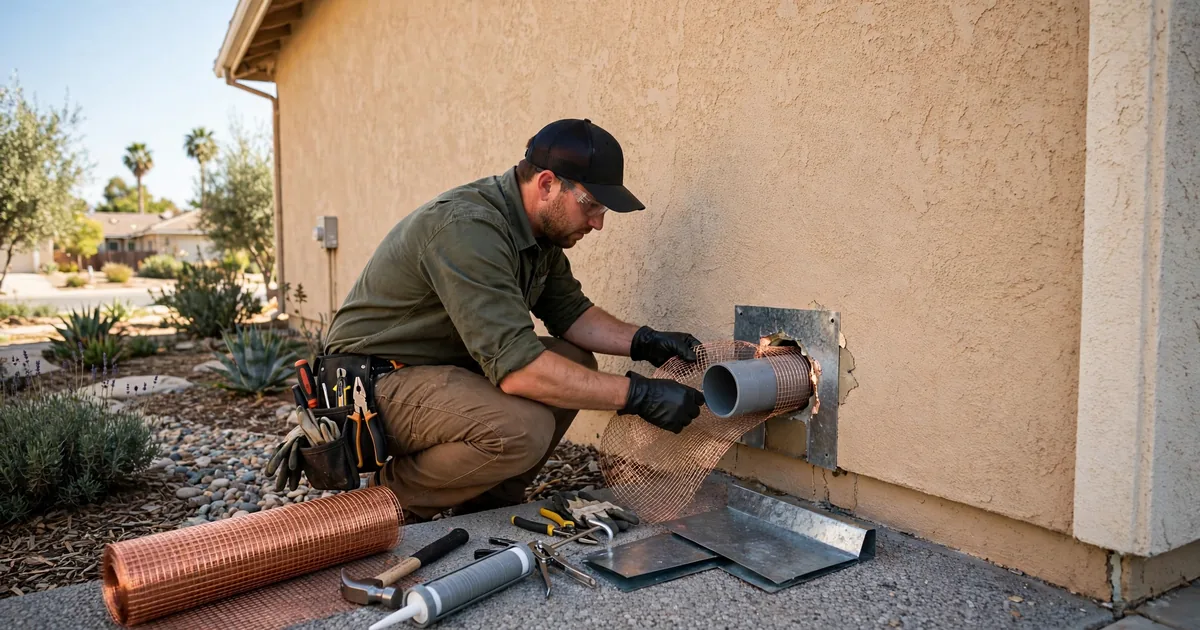
Table of Contents
- Why Exclusion Matters More Than Trapping Alone
- How Rats and Mice Get In
- The Area-by-Area Exclusion Audit
- Materials That Hold Up — and One That Does Not
- Entry Points at a Glance
- Rodents Already Inside: Seal-Out Timing
- Habitat Steps That Support Exclusion
- DIY Proofing vs. Calling a Professional
- When to Call a Professional
- Frequently Asked Questions
Why Exclusion Matters More Than Trapping Alone
Trapping answers the question of which rodents are inside today. Exclusion answers the question of whether any rodent can be inside next month. Both matter, but only one of them changes the house itself.
A home with open entry points is, from a rodent’s perspective, a standing offer: shelter, warmth, and usually food and water, available to any animal that finds the way in. Removing the animals that accepted the offer does nothing to withdraw it. Rats and mice travel established routes marked by scent and grease marks, and an opening used by one animal is easy for the next to find. This is why homeowners often describe a frustrating cycle — traps catch animals for a while, activity seems to stop, and then droppings and scratching return. The population was never really the root problem. The openings were.
Exclusion breaks the cycle by changing the structure. Once every entry point is sealed with gnaw-resistant material, the routes rodents relied on simply end at a wall they cannot pass. Animals outside stay outside, and control work done inside — removal, sanitation, monitoring — is no longer undone by new arrivals. Exclusion is also the part of rodent control that keeps working between service visits: a properly sealed vent or roofline gap protects the home every hour of every day, without anything needing to be reset, replaced, or reapplied.
That is why a complete rodent plan, like the one described in our complete guide to rodent control for Central Valley homes, treats exclusion as a core step rather than an optional extra. Removal handles the present. Exclusion handles the future.
How Rats and Mice Get In
Rodents rarely force their way into a house. They use openings that already exist — the gaps every home has where materials meet, where services pass through walls, and where weather and age have worn things loose. Knowing the usual routes tells you where an audit needs to look.
Rooflines and eaves. The junction where the roof meets the wall is one of the most common entry zones, especially for roof rats. Gaps at eaves, lifted or damaged tiles and shingles, openings around roof vents, and gaps in fascia boards all give climbers a way into the attic. Anything that reaches the roof — tree branches, vines, fences, utility lines — is a route to those openings.
Vents. Attic vents, gable vents, crawl space vents, and dryer vents are necessary openings, which makes them permanent weak points. A vent with a damaged, rusted, or missing screen is an open door. Screens also loosen over time, and a screen that looks intact from the ground may be pushed in at one corner.
Utility penetrations. Every pipe, cable, conduit, and line that passes through an exterior wall leaves a gap around itself: plumbing lines, electrical conduit, air-conditioning lines, gas lines, and cable entries. The hole drilled for the service is often slightly larger than the service itself, and whatever sealed it originally can shrink, crack, or fall away.
Garage doors and entry doors. The gap under a garage door — especially at the corners, where the seal often wears first — is a ground-level entry that mice and rats both use. Entry doors with worn or missing weather stripping, and door sweeps that no longer meet the threshold, leave the same kind of gap at a smaller scale.
Foundations. Cracks in foundation walls, gaps where the framing meets the foundation, and openings around crawl space access points let ground-dwelling rodents, particularly Norway rats and mice, move from outside to the subarea and from there into wall voids and the house above.
Sewer and drain lines. In general terms, rodents can also reach a home through plumbing: damaged or uncapped drain lines, broken sewer connections, and dry or damaged traps can give rats a route in from below. This is less common than the openings above, but it explains the occasional case where a home seems fully sealed at ground level and roofline and rats still appear — usually in bathrooms or near drains. Plumbing routes are one reason a persistent problem deserves a professional look rather than more sealing of the obvious places.
For species-specific detail on how these routes are used, see our pages on rat control and mouse control.
The Area-by-Area Exclusion Audit
An exclusion audit is a slow, systematic walk of the whole structure, looking for gaps and judging each one by a simple standard: could a rodent use this? Mice can use gaps as small as a dime, so the standard is stricter than most people expect. Work from the outside in, and note every opening before sealing any of them — a map of all the entry points is what makes the proofing complete rather than partial.
Exterior perimeter
Start at ground level and walk the full perimeter. Check where the siding meets the foundation, look for cracks and gaps in the foundation itself, and inspect every utility penetration as it passes through the wall. Check crawl space vents and the crawl space access for damaged screens and ill-fitting covers. Look at door thresholds and the full run of the garage door seal, corners included. Note gaps around outdoor faucets and hose bibs. While you walk, also note the routes: vegetation against the wall, stored items, and woodpiles all hide openings and give rodents covered approaches to them.
Roof and attic
The roofline deserves its own pass because roof rats enter from above. From the ground, look for lifted tiles, damaged shingles, gaps at eaves and fascia, and openings around roof and plumbing vents. Note every branch, vine, or line that touches or overhangs the roof. Inside the attic, look for daylight at the eaves and around vents — visible light means a gap — and check for droppings, grease marks along beams, and nests, which point to the openings being used most. The attic check also tells you whether animals are currently living above you, which changes the order of work, as described below.
Kitchen and pantry
Indoors, rodents follow food. Check where plumbing passes through the cabinet floor and wall under the sink — those holes are often oversized. Look at gaps behind the stove and refrigerator, around dishwasher lines, and where the pantry meets pipes or conduit. Droppings in cabinets or along the back of counters confirm which of these gaps are in active use. Kitchen openings often connect to wall voids, which connect to everywhere else, so a gap under a sink is rarely just a kitchen problem.
Garage
Garages combine entry points, shelter, and stored food, which is why they are so often the first place rodents establish. Check the garage door seal along its full width, with attention to the corners. Check the pedestrian door into the house and the gaps around stored items against walls. Pet food and birdseed stored in the garage in bags or thin containers are both an attractant and a signpost — gnawed packaging tells you the garage is on an active route.
Crawl space
If the home has a crawl space or subarea, check it last but do not skip it. Look for damaged vent screens, gaps around plumbing and ducting as they pass into the floor above, burrows or droppings, and openings around the access hatch itself. Ground-level rodents often enter here first and move upward through plumbing and wall voids, so a crawl space with open vents undermines proofing done everywhere else.
Materials That Hold Up — and One That Does Not
Proofing fails most often at the material, not the effort. A gap filled with something a rodent can chew through is not sealed; it is just temporarily plugged, and gnawing through a plug also enlarges the opening for next time. In general terms, the materials used for exclusion are chosen for one property above all: rodents cannot easily gnaw through them.
Metal flashing and sheet metal are used for larger gaps at rooflines, eaves, and around vents, where a flat, rigid barrier is needed. Properly fitted metal closes the opening and presents a surface teeth cannot work on.
Hardware cloth — woven or welded wire mesh — is the standard for covering vents and larger openings that still need to let air move. It is fitted over or into the opening and fixed firmly, so the vent keeps doing its job without leaving a way through.
Copper mesh is packed into gaps around pipes, conduit, and other penetrations, then finished with sealant. The mesh fills the void with a gnaw-resistant core so the seal does not depend on the sealant alone.
Sealants and mortar close small cracks and finish the edges of mesh and flashing. On their own they suit only the smallest gaps; anywhere a rodent can get its teeth into a purchase, sealant needs mesh or metal behind it.
Door sweeps and garage door seals close the moving gaps. A rigid sweep that meets the threshold, and a garage door bottom seal that is intact along its whole width including the corners, remove two of the easiest ground-level entries.
The material that does not hold up on its own is soft expanding foam. Foam is useful as a backing or filler in some repairs, but as the only barrier in a rodent gap it fails, because rodents chew through it quickly — sometimes within days of it being applied. A hole sprayed full of foam looks sealed, and that appearance is the problem: the homeowner stops looking at the spot while the rodents reopen it. Where foam is used at all in an exclusion repair, it needs a gnaw-resistant layer — mesh or metal — as the actual barrier.
Vent covers and screens follow the same principle: a cover is only proofing if it is rigid, intact, and fixed so it cannot be pushed in at an edge. A loose screen is a gap with a decoration on it.
Entry Points at a Glance
| Entry point | Common signs | Proofing approach, in general terms |
|---|---|---|
| Roofline, eaves, and fascia gaps | Droppings and grease marks in the attic, scratching in ceilings | Seal gaps with metal flashing or mesh; repair lifted tiles and damaged fascia |
| Roof, gable, and attic vents | Damaged or pushed-in screens, droppings below the vent | Fit hardware cloth or a rigid vent cover over the opening |
| Utility penetrations (pipes, conduit, lines) | Droppings near the penetration, gaps visible around the line | Pack with copper mesh and finish with sealant |
| Garage door | Gap visible at the corners, droppings and gnawed packaging inside | Replace the bottom seal; fit corner seals; adjust the door so it closes evenly |
| Entry doors | Daylight under the door, worn weather stripping | Fit a door sweep and replace worn stripping |
| Foundation cracks and crawl space vents | Burrows near the foundation, droppings in the subarea | Seal cracks; screen vents with hardware cloth; secure the access cover |
| Crawl space and plumbing openings | Activity in bathrooms or near drains, signs low in the structure | Seal around pipes where they enter the floor; damaged drain or sewer lines are a plumbing referral |
| Trees, vines, and lines reaching the roof | Roof rat droppings in the attic, runways along fences | Trim branches and vines back from the roof; treat as part of the surrounding proofing, not a seal |
Rodents Already Inside: Seal-Out Timing
The one mistake that turns exclusion from a solution into a problem is sealing a home completely while rodents are still living in it. An animal sealed into an attic or wall void will try to get out — by chewing, sometimes through interior materials it would never normally touch — and an animal that cannot get out may die in a void, which creates an odour problem that is far harder to fix than the original entry point.
So the order of work matters. The audit comes first: it establishes whether animals are currently inside, where they are living, and which openings they are using. Removal of the animals present then happens before final sealing, or alongside it, with the main entry points left open until activity inside has stopped. Where a professional is managing the job, the usual sequence is inspection, removal, a check that activity has ended, and then full sealing, followed by a check that the seals are holding.
For a homeowner doing their own proofing, the practical version is this: if you are hearing scratching in the attic or walls, or finding fresh droppings, do not seal the openings those animals are using until the animals are dealt with. Seal the unused openings — the spare routes — while removal is underway, and close the active routes last. If you cannot tell which openings are active, that uncertainty is itself a good reason to have the audit done professionally, as part of residential pest control service.
Habitat Steps That Support Exclusion
Sealing is structural, but rodents choose houses for reasons. A home with sealed entry points and strong attractions around it will be tested constantly — every new crack and worn seal found quickly — while a home that offers little food, water, or cover is tested far less. Habitat steps lower the pressure on your proofing.
Vegetation. Trim tree branches back from the roof so climbers lose their bridge to the eaves. Keep shrubs and ground cover from pressing against exterior walls, where they hide entry points and give rodents covered travel routes. Keep vines off the house; a vine on a wall is a ladder to the roofline.
Food. Store pet food, birdseed, and animal feed in sealed, hard containers, indoors or in the garage, rather than in bags. Clean up fallen fruit from trees promptly. Keep trash and compost in closed containers, and avoid leaving pet food out overnight where that is practical.
Water. Fix plumbing and irrigation leaks, and avoid standing water near the foundation. Rodents need water as reliably as they need food, and a dripping outdoor faucet or a leaking irrigation line supplies it at ground level, close to foundation entry points.
Harborage. Stack firewood away from the house and off the ground. Clear clutter, debris, and stored items from against exterior and garage walls — stored cardboard in particular gives rodents both nesting material and cover. Keeping the perimeter clear has a second benefit: it makes the next audit faster, because the openings are visible.
DIY Proofing vs. Calling a Professional
Some exclusion work is well within a homeowner’s reach, and some is not. Being honest about the line saves money in both directions — paying for work you could have done, or doing work that has to be redone.
Proofing is usually reasonable as a do-it-yourself project when the openings are at ground level and easy to reach, the gaps are simple — a vent screen to replace, a pipe penetration to pack and seal, a door sweep to fit — and there is no sign of rodents currently living in the attic or walls. A ground-level audit with a flashlight, followed by sealing what you find with mesh, flashing, and sealant, is realistic weekend work for many homeowners. This guide’s audit section is written for exactly that.
Professional help makes more sense when entry points are at the roofline or anywhere that needs a ladder and roof work; when signs show animals currently living in the attic, walls, or crawl space; when the problem keeps returning after gaps have been sealed, which usually means an opening was missed — often at the roof or in the plumbing; when the structure is complex, with additions and multiple rooflines; or when the rodents may be using sewer or drain lines, which is a diagnosis before it is a repair. A professional audit also has a practical advantage: it is done by someone who has seen where rodents enter hundreds of other homes, and who checks the places experience says to check. Exclusion involves no chemical decisions for a homeowner to get wrong — it is mechanical work — so the question is purely about access, thoroughness, and correctly reading the signs.
When to Call a Professional
Call for an inspection if you find droppings, gnaw marks, or nests and cannot identify every entry point; if you hear scratching or scurrying in the attic, walls, or ceilings; if activity returns after you have sealed the openings you could find; if the entry points are on the roof or in a crawl space you cannot safely work in; if wiring or insulation has been gnawed; or before a remodel that opens walls or changes a roofline, when entry points can be sealed while access is open. Rodent problems also tend to be one part of a wider picture, and homeowners comparing options may find our upcoming guide on how to choose a pest control company useful reading before they book anyone.
Call (209) 581-5562 or request a free estimate to schedule an inspection.
Pentecost Pest Control is a family-owned company based at 3501 Coffee Rd, Modesto, CA 95355. We serve residential and commercial customers in San Joaquin and Stanislaus Counties. Call (209) 581-5562 or email info@pentecostpestcontrol.com to request a free estimate.
Frequently Asked Questions
What is the difference between exclusion and proofing?
They describe the same work. Exclusion is the term the pest control industry uses; proofing is the term builders and homeowners often use. Both mean finding the openings rodents use and sealing them with materials rodents cannot gnaw through, so animals outside stay outside.
How much does rodent exclusion cost?
It depends on factors that can only be assessed at the property: how many entry points there are and where they are, how accessible they are — a ground-level vent and a roofline gap are very different jobs — how much material and ladder or roof work is involved, whether rodents are currently inside and need removal first, and the size and complexity of the structure. An honest figure follows an inspection of the actual openings rather than a guess made over the phone.
Can I just use expanding foam to seal rodent holes?
Not on its own. Rodents chew through soft foam quickly, so a foam-only fill tends to be reopened and the gap can end up larger than before. Foam can serve as a backing in some repairs, but the barrier itself should be gnaw-resistant — copper mesh or hardware cloth finished with sealant for small gaps, metal flashing for larger ones.
Should I seal entry points if I still hear rodents in the attic?
No — not the openings those animals are using. Sealing animals into an attic or wall void leads them to chew new routes, sometimes into living areas, and animals that die in a void create a serious odour problem. Remove the animals first, confirm activity has stopped, and then seal, closing the active entry points last.
Does exclusion work for both rats and mice?
Yes, because both enter through gaps in the structure — they differ mainly in which gaps. Rats use larger openings and often enter at the roofline or ground level; mice use smaller gaps, as small as a dime, anywhere from foundation to eaves. A complete audit looks for both, which is why proofing done for one species usually protects against the other as well.
How do I know if I’ve missed an entry point?
Continued or returning activity is the clearest sign: fresh droppings, new gnaw marks, or scratching after the work is done. Grease marks around a sealed opening show it was in use, and a similar opening nearby is worth a second look. If activity continues after careful sealing, an inspection can usually find the missed route — commonly at the roofline, in a vent, or around plumbing.
This article is for general educational purposes only. Pest conditions, regulations, and treatment options vary by property and situation. Contact a licensed pest control professional for an inspection.