
Mosquitoes and flies feel like weather — something that shows up in summer and cannot be helped — but around a house, both are almost always source problems. Mosquitoes breed in standing water on or near your property: a plant saucer, a clogged gutter, a neglected pool. Nearly every fly problem in a home traces back to one specific material an inspection can find: drain flies breeding in the film inside a drain, fruit flies in a forgotten piece of fruit or a recycling bin, house flies in waste that sits too long. Find the source and remove it, and the pressure drops. Skip the source and treat only the insects you can see, and the next generation is already on its way. This guide walks through where mosquitoes and each common fly actually breed in and around Central Valley homes, how to remove those sources, and when the problem calls for a professional.
Key Takeaways
- Mosquitoes around a home are usually home-grown: they breed in standing water on the property, including very small amounts in saucers, buckets, toys, and clogged gutters.
- A weekly walk-through — dump and scrub containers, check gutters and drainage, maintain pools and fountains — breaks the mosquito life cycle before new adults emerge.
- Some biting pressure comes from beyond your fence line: neighboring properties, canals, and agricultural water. You control your own sources, not the whole neighborhood, and an honest plan accounts for both.
- House flies breed outdoors in waste and decaying matter and come inside through open doors, torn screens, and gaps. Waste habits and door discipline do most of the work.
- Tiny flies indoors are a different problem from house flies: drain flies point to the organic film inside a drain or floor sink, and fruit flies point to something fermenting. Each is solved by removing its specific source.
- A sudden burst of large flies indoors often means something has died in a wall void, attic, or crawl space — a hidden source that has to be found, not just waited out.
- If you cannot find the source, or the problem keeps returning, an inspection is the step that finds it. Pentecost Pest Control provides residential pest control for homes across Stanislaus and San Joaquin Counties.
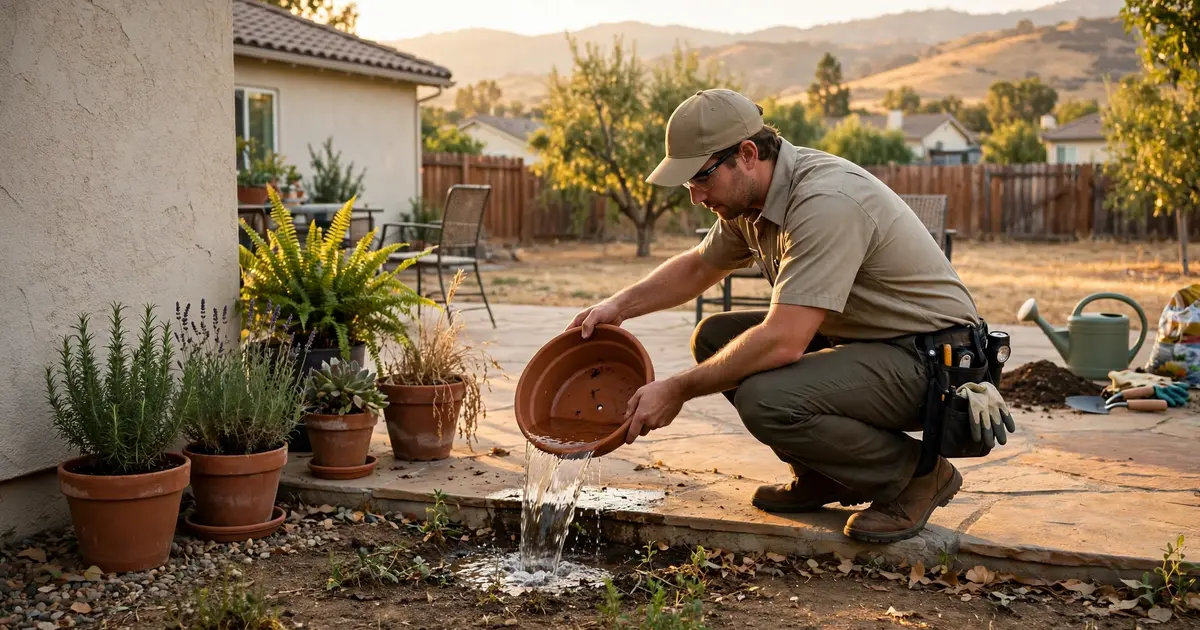
Table of Contents
- Mosquitoes in the Central Valley: It Starts With Standing Water
- Mosquito Source Reduction: A Weekly Yard Walk-Through
- When the Biting Pressure Is Not Coming From Your Yard
- House Flies: The Outdoor Breeders That Come Inside
- Drain Flies: The Small Flies Around Sinks and Floor Drains
- Fruit Flies: The Fermentation Specialists
- Blow Flies and Other Large Flies Indoors
- What Professional Mosquito and Fly Service Does
- Mosquitoes, Flies, and Health: A Measured Look
- A Seasonal Calendar for the Central Valley
- When to Call a Professional
- Frequently Asked Questions
Mosquitoes in the Central Valley: It Starts With Standing Water
Every mosquito biting in your yard began life in water. Female mosquitoes lay eggs in or just above standing water, and the young stages — the wriggling larvae and pupae you may have seen in a neglected bucket — live entirely in that water until the adult emerges and flies away. This is the fact that makes mosquito prevention possible: no standing water, no new mosquitoes. The adults you see on a given evening may have flown in, but a yard that produces mosquitoes of its own is a yard with water standing somewhere.
In the Central Valley, that water hides in more places than most homeowners expect:
- Plant saucers and pots. The saucer under a patio plant is the classic backyard source. It holds water for days after watering, it sits in shade, and nobody thinks of it as a body of water.
- Buckets, watering cans, wheelbarrows, and tools left outdoors catch rain and sprinkler water and hold it undisturbed.
- Clogged gutters and low spots in roofing drainage. A gutter full of leaves holds a long, shallow ribbon of water above your head, out of sight. It is one of the most commonly missed sources in a home inspection.
- Neglected pools, spas, and ponds. A maintained pool is not a mosquito source. A pool, spa, or ornamental pond that has stopped circulating and being treated becomes one of the largest sources on a property — thousands of mosquitoes can come out of green, still water.
- Irrigation puddles and drainage problems. Overspray, broken lines, and low spots where watering collects keep soil and hollows wet for days. In an irrigated landscape like ours, this is a year-round habit to check, not just a rainy-season one.
- Children’s toys, play equipment, tarps, and tire swings. Anything with a cup, fold, or hollow that can hold water after the sprinklers run.
- Pet water bowls, birdbaths, and livestock water that is not refreshed often enough.
- Cans, bottles, and yard debris that catch and hold small amounts of water in out-of-the-way corners.
Two things about this list are worth understanding. First, the amount of water can be very small. Mosquitoes do not need a pond; a bottle cap’s worth of sheltered water that stands undisturbed long enough can produce adults, which is why a serious walk-through looks at small containers and not just obvious ones. Second, mosquito development is fast in Central Valley heat. In warm weather the trip from egg to biting adult can take little more than a week, so water that stands for a week at a time — a saucer that refills with every watering, a gutter that never dries — is a continuous production line.
Adult mosquito behavior shapes when you notice them. Many of the species around homes are most active at dawn and dusk, resting in shaded, sheltered spots during the day — in dense shrubs, under decks and eaves, in garages and sheds. Others bite during the day as well, particularly the container-breeding species that live close to houses. Either way, the pattern to remember is that a yard heavy with mosquitoes at the hours you use it usually has its own sources, and those sources are findable.
One more piece of the picture: your property is not the only line of defense, and it is not supposed to be. Counties and local mosquito and vector control districts monitor mosquito populations across the region and treat public and large-scale sources — things like neglected public water, agricultural and wetland areas, and storm drainage that no homeowner controls. Their work lowers the background pressure for everyone. What it cannot do is empty the saucer on your patio or clear your gutter. The division of labor is simple: districts handle the landscape, homeowners handle the lot — and most of the biting in a given backyard comes from the lot.
For the broader picture of how mosquitoes fit among the region’s house-invading pests, our General Household Pest Guide for Central Valley Homes is a useful companion to this guide.
Mosquito Source Reduction: A Weekly Yard Walk-Through
Source reduction is the whole strategy, and it works on a simple schedule: because mosquitoes can complete their development in about a week in warm weather, a weekly walk-through that interrupts standing water everywhere it sits keeps your property from producing adults. Think of it as a route, not a chore list — the same lap of the yard, the same checks, once a week during mosquito season.
Dump and scrub containers. Tip out saucers, buckets, cans, toys, and anything else holding water. Scrubbing matters, not just dumping: mosquito eggs are laid at the waterline and can cling to the sides of a container through a dry spell, hatching when it fills again. A quick scrub of the inside surface removes them. Items that must hold water — a pet bowl, a birdbath — should be emptied, scrubbed, and refilled on the same weekly rhythm.
Turn over, cover, or store what you can. Wheelbarrows, wading pools, and empty pots stored upside down or under cover cannot collect water. Tarps stretched tight, without sagging folds, shed water instead of holding it. Rain barrels and water storage should be tightly covered or screened so mosquitoes cannot reach the surface to lay eggs.
Maintain pools, spas, and water features. A pool or spa that is circulating and maintained on schedule does not breed mosquitoes. One that is broken, unused, or waiting for attention does. If a pool will sit unused for a while, it still needs to be kept up or properly closed down — and an ornamental pond or fountain should keep its water moving or be maintained so it does not become a still, green source. This is the single largest source on the properties that have one, and it is worth a direct conversation with whoever maintains your pool if you are seeing heavy pressure.
Clear gutters and check drainage. Gutters and downspouts clogged with leaves hold water against the roofline all season, and low areas where downspouts discharge can puddle against the foundation. Keeping gutters clear and drainage moving is ordinary home maintenance with a direct mosquito payoff — and it is one reason our home maintenance bundles pair pest control with roof inspection and downspout maintenance: the conditions above the walls and the pests around them are the same conversation. While you are looking at drainage, check for irrigation leaks, broken sprinkler heads, and low spots that stay wet days after watering, and correct what you find.
Mind the less obvious water. Air conditioner condensate that drips into a pan or puddle, refrigerator and cooler drainage outdoors, boat covers and grills with water pooled in their folds, hollow fence posts and tree holes near seating areas — a careful lap of the property once, with mosquitoes in mind, usually turns up two or three sources the owner did not know about.
Reduce adult resting places near where you sit. You cannot eliminate resting habitat, and there is no need to strip a yard. But dense, shaded vegetation right against a patio, and clutter stored under decks and eaves, give daytime-resting mosquitoes a home base next to your chairs. Thinning and tidiness near seating areas, good air movement — a simple outdoor fan on a patio genuinely discourages weak-flying mosquitoes — and screens in good repair on doors and windows all lower the biting you experience without pretending to remove mosquitoes from the neighborhood.
A note on what this routine is not: it is not a chemical routine. Everything above is inspection, water management, and maintenance. Where professional treatment fits in is covered below — but a property whose sources are handled weekly is one where any treatment has a chance to hold, and a property whose sources are ignored is one where nothing holds for long.
When the Biting Pressure Is Not Coming From Your Yard
An honest guide has to say this plainly: you can do everything in the section above correctly and still get bitten. Adult mosquitoes fly. Some species travel only a short distance from where they emerged; others range much farther. Biting pressure at a Central Valley home can come from:
- A neighboring property with a neglected pool, standing water, or unmanaged containers. You cannot inspect or correct someone else’s lot. A friendly conversation solves some of these; where a neglected pool is involved, local mosquito and vector control districts generally have a process for reports of neglected pools and similar public-health sources, and your county health department can point you to it.
- Canals, drains, and agricultural water. Much of the Valley lives near irrigation infrastructure, orchards, fields, and low ground that holds water. Those sources are part of the regional landscape. District monitoring and treatment address the worst of them, but homes near water and agriculture will usually see more mosquito pressure than homes in the middle of a dry subdivision, no matter how tidy their own yards are.
- Weather and season. A wet spring, an irrigation change, or a stretch of hot weather can raise pressure across a whole neighborhood at once. When every yard on the street is complaining in the same week, the source is rarely one house.
What a homeowner can control is real but bounded: your own sources, your screens and doors, your seating-area habits, and whether your yard offers resting shelter next to where you spend time. What you cannot control is the population produced by the wider landscape. That is why any promise that a yard can be made permanently free of bites should be treated with suspicion, whoever makes it. The reasonable goal — and it is a genuinely achievable one — is a property that produces no mosquitoes of its own and offers them little reason to stay, so the pressure you feel is the neighborhood background and not your own production line running on top of it.
House Flies: The Outdoor Breeders That Come Inside
The common house fly is the fly most people mean by “flies in the house,” and its story is different from the mosquito’s in one important way: house flies almost never breed indoors. They breed outdoors, in moist, decaying organic matter, and the adults come inside looking for food and shelter. Prevention therefore has two fronts — reduce breeding around the property, and make the house harder to wander into.
Where house flies breed. The female lays eggs in material that is moist, warm, and decaying: household garbage that sits too long, especially in heat; pet waste left in the yard; compost that is wet and unbalanced; manure and soiled animal bedding where animals are kept; fallen, rotting fruit under trees; and spilled feed or organic debris in outbuildings. In Central Valley summer heat, development from egg to adult fly is quick — on the order of a week or so in favorable conditions — which means waste that sits for a week in a hot garage or an uncovered bin is not just stored waste; it is a fly nursery at full production. The pattern homeowners notice — a sudden increase in flies around the house every garbage cycle, or a hatch of flies after a hot spell — is usually this arithmetic at work.
Waste practices that do the work. Because breeding is in the waste itself, the habits that matter are about time and containment:
- Bag garbage, keep bin lids closed, and rinse bins out when residue builds up — the film in the bottom of a bin is breeding material even after the bags are gone.
- Do not let garbage sit in a hot garage or side yard longer than the pickup cycle requires, and keep the bin area itself clean of spills.
- Pick up pet waste in the yard regularly, on a schedule measured in days, not weeks.
- Harvest fruit as it ripens and pick up fallen fruit; a layer of rotting fruit under a backyard tree is one of the most productive fly sources a home can have.
- Keep compost covered and balanced rather than wet and exposed, and clean up spilled pet food and feed outdoors.
Keeping them out. House flies are persistent wanderers, and they enter the way anything else does: open doors, doors without sweeps, torn or missing window screens, and gaps around utility lines and vents. In homes where doors stand open to a patio all summer, some fly entry is simply the cost of the habit — door discipline, self-closing screen doors, and screens kept in repair decide how much. Outdoors, keeping eating areas clean, covering food, and placing waste bins away from doors and patios lowers the number of flies congregating where you live.
What about traps and zappers? Baited fly traps placed outdoors, away from doors and seating, can reduce the number of flies in an area, and many homeowners use them around animal areas. Light traps and zappers kill flies that reach them but do not address breeding, and a zapper placed beside a patio table can draw flies toward the very place you are trying to keep them from. None of these devices substitutes for the waste habits above. If flies keep appearing indoors in numbers despite clean waste and sound screens, the breeding source is probably one you have not found yet — a dead animal in an enclosed space, covered in the blow fly section below, is a common one — and that is an inspection question.
Drain Flies: The Small Flies Around Sinks and Floor Drains
If the flies in your home are tiny, slow, and fuzzy-looking, and they cluster around sinks, showers, or floor drains, you are probably not dealing with house flies at all. Drain flies — also called moth flies, for their fuzzy wings and bodies — breed in the soft organic film that builds up inside drains, overflow channels, and floor sinks. The adults are weak fliers that stay near the drain they came from, which is why they turn up resting on the wall beside a shower or walking on a bathroom counter rather than orbiting the kitchen light.
The source here is neither garbage nor fruit; it is the drain itself. The gelatinous film that lines a drain — soap residue, hair, food particles, and the microbes that live on them — is both the food and the nursery for drain fly larvae. This is true of little-used drains as much as busy ones: a guest bathroom, a laundry floor drain, a floor sink in a garage or commercial-style kitchen, or a drain in a vacant part of the house can produce drain flies quietly for a long time. A simple check helps confirm the diagnosis: tape a clear cup or a piece of clear tape over a suspect drain overnight, sticky side down for tape. Adults emerging from that drain will be caught on it by morning, and you will know which drain is producing them.
The fix is mechanical, and it is homeowner work. Because the larvae live inside the film, treating the air in the room does nothing; the film has to be physically removed:
- Scrub the inside of the drain with a stiff drain brush, working the brush down the walls of the pipe and around the trap area, so the film is scoured off rather than just rinsed.
- Flush with hot water after scrubbing to carry the loosened material away.
- Repeat over several days if the buildup was heavy, and clean the drain’s overflow channel and stopper as well — the same film collects there.
- For floor drains and floor sinks that see little use, keep the trap from drying out and include the drain in regular cleaning; a dry trap invites problems of its own.
- Where a drain fly problem traces to a broken line, a cracked sewer pipe, or buildup in an inaccessible section, the fix is a plumbing repair — a pest inspection can tell you when the evidence points that way.
Done properly, drain cleaning ends the problem because it ends the breeding site; the adults present live out their short lives and no new generation replaces them. If small flies persist after every drain in the area has been genuinely scrubbed, the source is somewhere else — a hidden leak keeping a wall void or subfloor wet and growing film where you cannot see it is the usual alternative — and finding it is a reason to call for an inspection rather than to keep treating the room.
Fruit Flies: The Fermentation Specialists
Fruit flies are the other tiny fly of the kitchen, and they are easy to tell from drain flies once you look: fruit flies are smooth-bodied rather than fuzzy, often with noticeably red eyes, and they hover over the fruit bowl, the recycling, and the sink rather than resting on walls near drains. They breed in fermenting material — and fermentation, in a kitchen, is everywhere once you start looking.
The sources are usually mundane: fruit ripening past its prime on the counter or in a bowl; a banana peel or melon rind in an open bin; cans and bottles waiting for recycling with sweet residue inside; a mop or sponge holding sour moisture; the drip tray and drain of a refrigerator or a kegerator-style tap; a forgotten potato or onion softening in the back of a pantry cabinet. Fruit fly development in warm conditions is fast, so a single overlooked source can produce a visible cloud in days, and the cloud seems to come from nowhere because the source is small.
Prevention is source hunting, done thoroughly once:
- Move ripe fruit to the refrigerator, and throw out anything past ripe rather than letting it sit.
- Rinse cans and bottles before they go into recycling, store recycling in a container with a lid, and take it out on a short cycle.
- Empty kitchen waste daily while a problem is active, and wipe up sweet spills — juice, soda, wine — the day they happen, including under appliances where drips collect unnoticed.
- Check the pantry for softening produce, and look under the sink for leaks and damp, sour-smelling material.
- Rinse mops and sponges and let them dry; a permanently wet mop is a small fermentation tank.
Baited vinegar-style traps catch adults and can confirm where the flies are concentrated, which helps the hunt — but a trap next to an active source is a scoreboard, not a solution. Remove the source and the problem collapses within days as the remaining adults die off without anywhere to breed. A fruit fly problem that survives a genuinely thorough clean-out usually means one source was missed — the recycling stored in the garage, the drain of a wet bar, the fruit delivery in a break room — rather than a failure of the approach.
Blow Flies and Other Large Flies Indoors
Sometimes the fly problem is neither tiny nor ordinary: a sudden appearance of large, metallic green or blue flies, or big dark flies, inside the house — often at windows, often over a few days, and often in numbers that make no sense for an open door. That pattern has a specific and common cause: something has died somewhere in the structure. Blow flies specialize in carrion. A rodent that died in a wall void, attic, chimney, or crawl space will draw them, the eggs are laid on the remains, and the adults that emerge inside the structure head for light — which is why they collect at windows, looking trapped and out of place.
A related group, cluster flies, behaves differently: these are outdoor flies that enter structures in the cooler months to spend the winter sheltered in wall voids and attics, emerging sluggishly on warm days. They do not breed indoors and are not drawn by anything dead, but they are another case where the answer lies in how the insects are getting in, not in what is attracting them.
The practical points:
- A burst of large flies indoors is information. It usually means a hidden carcass — rodent, bird, or other animal — in a void or enclosed space. The flies will stop once the remains dry out or are removed, but the underlying event matters: a rodent dying inside a wall often means rodents had access to the structure, and access that let one in will let others in. Our rodent exclusion and proofing guide covers how entry points are found and sealed so the void stays empty.
- Do not seal an active void shut in a hurry. Trapping a source inside can prolong odor and insect activity in the living space. Where the remains are accessible — an attic, a crawl space — removal is the cleaner fix, followed by checking how the animal got in.
- Entry points are the cluster fly answer. Sealing gaps in siding, eaves, and around windows, and keeping attic vents screened, reduces both cluster fly entry and the rodent and wildlife access that produces carcass problems in the first place.
Flies of this kind are one of the clearest cases where the insects are the symptom. Treating the windowsills while a source sits in the wall misses the point; finding and addressing the source is the whole job.
What Professional Mosquito and Fly Service Does
Homeowner prevention handles most mosquito and fly pressure at most homes, and the sections above are written so you can do that work yourself. Professional service adds two things: an inspection practiced at finding the sources homeowners walk past, and treatment directed at the places pests rest and breed when sources alone do not explain the pressure.
In general terms, a professional visit for mosquitoes and flies involves:
- A source inspection of the whole property — gutters and roof drainage, containers and stored items, pools and water features, irrigation and drainage low spots, waste areas, drains indoors, and the enclosed spaces where a hidden source could sit. For flies especially, this inspection is the service: the breeding material identified and removed or corrected is what changes the count next week.
- Recommendations you carry out — the specific dump-and-scrub list, waste corrections, screen and door repairs, and drainage fixes for your property, in writing, so the work between visits continues.
- Treatment directed at resting and breeding areas where findings call for it — for mosquitoes, the shaded, sheltered vegetation and surfaces near the home where adults rest during the day; for flies, the specific areas where inspection found activity concentrated. Treatments are applied according to the product label and California regulations.
- Monitoring and adjustment — what the counts do after sources are corrected tells both you and the technician whether the diagnosis was complete, and seasonal visits can be timed to the pressure your property actually experiences.
What professional service is not: it is not a treatment that makes a property immune to insects flying in from the surrounding landscape, and it does not replace the weekly water routine or the waste habits that keep sources from rebuilding. The homeowners who get the most from mosquito and fly service are the ones whose own prevention is already running — the professional work then handles the sources that could not be found and the pressure that prevention alone does not fully answer. Our residential pest control service is built that way for general pests as well: findings first, treatment aimed at the findings, and a homeowner who knows what to watch for between visits.
Mosquitoes, Flies, and Health: A Measured Look
Health questions come up with both of these pests, and they deserve a straight answer without exaggeration in either direction.
Mosquitoes are not only a nuisance. In California, mosquitoes can carry West Nile virus, and state and local public health agencies track the virus’s activity each season and report it publicly. That is the main mosquito-borne illness concern for Central Valley residents in most years. The sensible response is proportionate: take the source reduction in this guide seriously, use personal protection sensibly at the hours mosquitoes are active — covering clothing and repellents used as their labels direct are personal choices a health source can advise on better than a pest guide — and pay attention to your county health department’s seasonal announcements, which are the authority on current local risk. No pest control article can tell you your personal risk, and anyone who uses frightening numbers to sell a service is not being straight with you.
Flies are a different and quieter concern. House flies and blow flies move constantly between waste, animal matter, and the surfaces where food is prepared and served, and they carry material from the first to the second on their bodies and feet. That is why flies in a kitchen — at home, and even more so in a food business — are a sanitation finding and not just an annoyance, and why the waste and breeding-source habits in this guide matter beyond comfort. Drain and fruit flies are mostly a sign of a specific source to correct rather than a health concern in themselves.
The through-line of this section is the same as the rest of the guide: the health-conscious move is not a stronger treatment, it is removing the conditions — standing water for mosquitoes, breeding material for flies — that put these insects in daily contact with your household in the first place.
A Seasonal Calendar for the Central Valley
Mosquito and fly pressure in Stanislaus and San Joaquin Counties follows the Valley year. Knowing the rhythm lets you time the habits above instead of reacting to the first bad evening.
- Spring. As temperatures warm, mosquitoes become active and the first generations establish in whatever water winter left behind. Early spring is the highest-value moment for the walk-through: empty what winter filled, clear gutters of the season’s debris, and bring pools and water features back into maintained condition before they produce a season’s first surge. House flies build as waste warms.
- Summer. Peak season for both pests. Heat speeds up mosquito and fly development alike, irrigation keeps incidental water standing, and fruit ripens — and falls — fast. The weekly water routine matters most now; so do waste cycles, fallen fruit pickup, and screens and doors in repair. Drain and fruit fly problems surface in kitchens as produce moves through the house quickly.
- Fall. Pressure eases as nights cool, but mosquitoes stay active on warm afternoons well into the season, and harvest-time activity in the surrounding agricultural landscape can keep background pressure up. Cluster flies begin looking for sheltered entry into structures — a good moment for the sealing checks — and rodents moving toward shelter raise the odds of the hidden-carcass fly events described above.
- Winter. Mosquito activity drops sharply, though sheltered water that never freezes can still produce on mild stretches, and some species overwinter as adults in garages, sheds, and crawl spaces. Winter is the planning season: repair screens, correct drainage, clear the yard of the containers and debris that would otherwise hold the first spring water, and put the property in a state where the spring walk-through starts from clean.
None of this requires a calendar appointment with a pest company to be useful. It is a homeowner’s rhythm. But homeowners who fold these checks into a standing residential pest control routine tend to keep them — the visit reminds the household what season is coming and what it brings.
When to Call a Professional
The weekly walk-through and the source hunts in this guide solve most mosquito and fly problems. Call for an inspection when:
- Mosquitoes are heavy around your home and your own walk-through has not found the water — especially if a pool, pond, gutter line, or drainage problem on the property is hard to assess from the ground
- Small flies persist after you have genuinely scrubbed the drains and cleared the kitchen — the source is likely hidden, such as a leak wetting a wall void or subfloor
- Large flies appear indoors in a burst, which usually means a carcass in a wall void, attic, or chimney and rodents or wildlife with access to the structure
- Flies keep appearing in a food business, rental, or other setting where the count has consequences beyond annoyance, or where employees report them in food areas
- You are moving into a home with a neglected pool or an unknown yard history and want the sources found before the season starts
- Biting pressure is severe enough that you cannot use your yard, and you want an honest assessment of how much of it is coming from your property versus the surrounding landscape
Pentecost Pest Control is a family-owned company based in Modesto, at 3501 Coffee Rd, Modesto, CA 95355. We serve residential and commercial customers in San Joaquin and Stanislaus Counties, inspect before we recommend, and explain what we find in plain language. With mosquitoes and flies, that honesty matters: we will tell you which sources are yours to fix, which ones treatment can address, and which part of the pressure is the neighborhood’s — so you spend effort where it actually changes the count.
Frequently Asked Questions
Why are mosquitoes so bad in my yard when my neighbor’s yard seems fine?
Usually because the sources are unevenly distributed, and mosquitoes do not travel far when everything they need is close. A property producing its own mosquitoes — standing water in containers, gutters, or a neglected pool — experiences that production as its baseline, on top of whatever drifts in. A neighbor without sources feels only the drift. The walk-through in this guide is the test: if your yard has water standing week to week, your yard is likely breeding its own. Where two adjoining yards both do the work, pressure usually falls for both.
Can mosquitoes breed in my pool?
In a maintained pool, no — circulating, properly kept pool water is not a breeding site. In a neglected pool, absolutely: a pool or spa that has gone green and still, with its equipment off and its upkeep stopped, is one of the largest mosquito sources a property can hold. If a pool will sit unused, it still needs to be kept up or formally closed down, and a neighbor’s neglected pool is one of the problems local mosquito and vector control districts generally accept reports about, since no homeowner can correct it from their own side of the fence.
I keep seeing tiny flies around my kitchen sink. What are they?
One of two likely answers. If they are fuzzy, slow, and rest on the wall near the sink or shower, they are drain flies breeding in the film inside a drain — scrub the drain thoroughly, as the drain fly section describes, and use the overnight tape test to confirm which drain. If they are smooth-bodied, hover over fruit and recycling, and seem to gather wherever something sweet sits, they are fruit flies, and the answer is a source hunt: ripening fruit, recycling residue, a sour sponge or mop, or produce softening somewhere out of sight. Size and behavior separate them, and the fixes are entirely different, which is why identifying the fly comes first.
Do bug zappers and traps solve a fly problem?
They reduce the number of adult flies at the spot where they are placed, and outdoor baited traps can help around animal and waste areas when they are kept away from doors and seating. What they cannot do is reach the breeding source — the waste that sat too long, the film in the drain, the carcass in the wall — and a breeding source produces adults faster than a device at the patio removes them. Treat traps as a supplement and a monitoring aid. When the adults keep coming, the question is never a bigger device; it is an unfound source.
How much does mosquito and fly service cost?
It depends on factors an inspection establishes: the size of the property and how much standing-water and resting habitat it holds, whether a pool, pond, or drainage problem is involved, which flies are present and where their breeding sources are, how much of the correction is homeowner work versus treatment, and whether the service is a single visit or a seasonal program timed to pressure. A home whose sources are easy to find and fix is a different job from a property with a neglected pool and a hidden carcass source. Honest pricing follows an inspection rather than a guess over the phone, and a written quote should say what it covers.
Will treatment keep mosquitoes out of my yard for the rest of the summer?
No single visit does that, and a company that promises a season without bites is promising something the surrounding landscape will not let it keep. What treatment and source reduction together do is remove your property’s own production and reduce the number of mosquitoes resting and biting around the home — for most families, the difference between a yard they avoid and a yard they use. Pressure from canals, fields, and neighboring sources continues in the background. A seasonal program, revisited as conditions change, manages that honestly rather than promising it away.
Ready to find the source at your home? Call (209) 581-5562 or request a free estimate. Tell us what you are seeing — mosquitoes at dusk, tiny flies at the sink, a burst of big flies at the window — and we will start with an inspection and explain the next steps.
By the Pentecost Pest Control Editorial Team
This article is for general educational purposes only. Pest conditions, regulations, and treatment options vary by property and situation. Contact a licensed pest control professional for an inspection.