
A stinging insect around your house is not one problem — it is several, and they are not handled the same way. The slender wasps under your eaves, the yellowjackets pouring out of a hole in the lawn, and a cluster of honey bees resting on a fence are three different situations, with different risks and different responses. What decides the response is the species and where its nest is: a small open nest over a back door is one kind of job, a colony inside a wall is another entirely, and a honey bee swarm may need nothing but a day or two of patience. This guide walks through the stinging insects Central Valley homeowners actually meet, how to tell them apart by body, nest, and behavior, and when a nest is a do-it-yourself observation project and when it is a professional’s job.
Key Takeaways
- Paper wasps build open, umbrella-shaped nests under eaves and are usually calm away from the nest. Yellowjackets nest in the ground and in wall voids, grow defensive by late summer, and cause most picnic problems.
- There are no established true hornets in California. The “hornet” most people see here is the bald-faced hornet — actually a large aerial-nesting relative of the yellowjacket, black with white markings.
- Mud daubers and carpenter bees are solitary and rarely sting. Carpenter bees bore into exposed wood, which matters for fascia, eaves, and decks over time.
- A honey bee swarm is temporary and usually moves on within a day or two. A colony established inside a wall is a different problem: removal has to include the hive material, not just the bees.
- Never seal stinging insects inside a structure. A wall-void nest is not a spray-and-seal job — trapped wasps find another way out, often into the house.
- If a nest is over a doorway, in a wall, in the ground along a walkway, or too high to reach without a ladder, get an inspection. Pentecost Pest Control handles stinging insects as part of general pest control for Central Valley homes across Stanislaus and San Joaquin Counties.
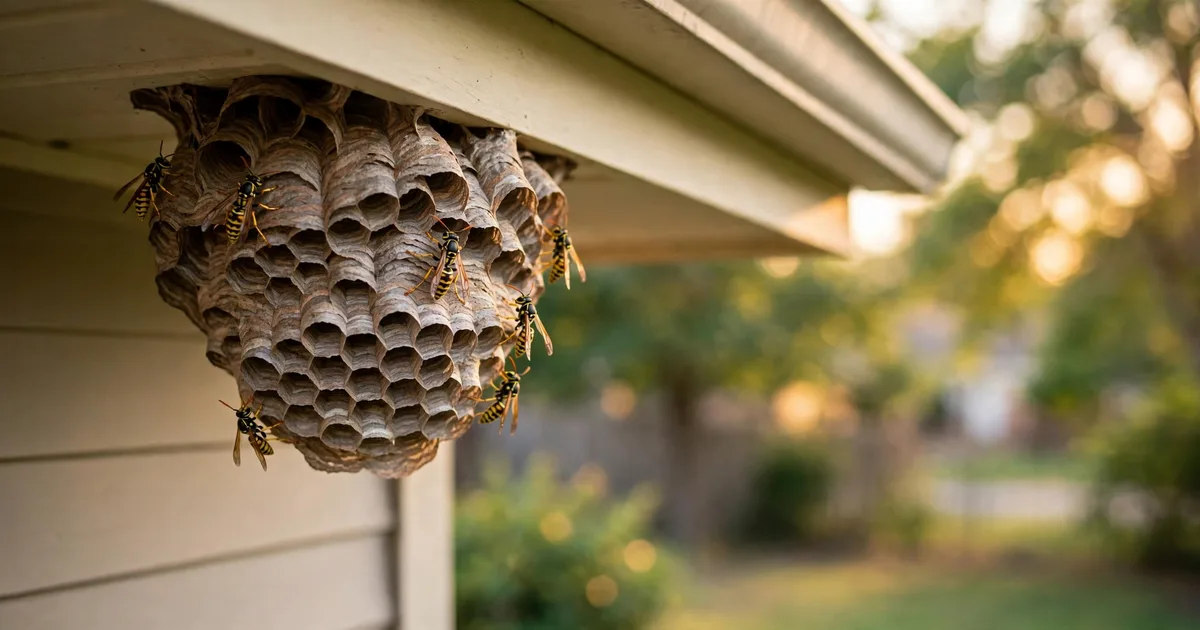
Table of Contents
- Paper Wasps: The Nests Under Your Eaves
- Yellowjackets: Ground Nests, Wall Voids, and Late-Summer Tempers
- “Hornets” in California: What You Are Probably Seeing
- Mud Daubers and Carpenter Bees: The Solitary Species
- Honey Bees: A Swarm Is Not a Colony
- How to Tell Them Apart
- What to Do When Wasps or Bees Come at You
- What Control Involves, in General Terms
- How to Prevent Stinging Insect Problems
- When to Call a Professional
- Frequently Asked Questions
Paper Wasps: The Nests Under Your Eaves
Paper wasps are the wasps most Central Valley homeowners know by sight: slender, long-legged wasps, reddish-brown or brown with yellow markings, whose legs dangle below them in flight. They build the open nests everyone recognizes — a single layer of gray, papery cells hanging upside down from a short stalk, like a tiny open umbrella. You will find them under eaves, porch ceilings, deck railings, window frames, and inside open mailboxes and stored equipment.
The colony follows a yearly cycle. A single queen starts the nest in spring, building the first few cells and raising the first workers herself. Through summer the nest grows as more workers hatch, and the colony spends its days hunting caterpillars and other soft insects to feed the young, visiting flowers along the way. A nest found in April may hold a handful of wasps; the same spot in August can hold dozens. By late fall the colony winds down — workers and the old queen die off, and newly mated queens leave to overwinter in sheltered spots such as bark crevices, attics, and wall voids, each one a potential founder of next spring’s nest. Paper wasps do not reuse an old nest, though a sheltered eave that suited one colony often suits another the following year.
Temperament is the paper wasp’s saving grace. Away from the nest, foraging paper wasps are focused on hunting and generally ignore people entirely. At the nest they will defend it if it is bumped, vibrated, or swatted at — a nest over a doorway gets disturbed every time the door slams, which is why location matters more than the wasp’s intentions. A small nest under a far eave of the garage is a reasonable thing to leave alone and watch. A growing nest directly over the front door, where delivery drivers, guests, and children pass within inches of it all day, is a different calculation, and it is the placement — not aggression — that usually drives the call.
Yellowjackets: Ground Nests, Wall Voids, and Late-Summer Tempers
Yellowjackets are the stocky, boldly banded black-and-yellow wasps that show up at barbecues, and they account for most of the stinging-insect trouble in the Central Valley. In California, the western yellowjacket is the usual ground-nesting species. Unlike paper wasps, yellowjackets build enclosed paper nests out of sight: most often underground, in abandoned rodent burrows and other ready-made holes in the ground, and regularly inside wall voids, hollow fence posts, and similar cavities in and around structures.
That hidden placement drives everything about this species. A ground nest gives no warning until a footstep lands near the entrance or a lawn mower passes over it — the vibration reads as an attack, and the colony responds with numbers. A wall-void nest announces itself differently: a steady stream of wasps entering and leaving one crack in the siding all day, sometimes with faint scratching or buzzing sounds in the wall. It is easy to walk past either nest for weeks without knowing it is there.
Colonies also grow large and change character over the season. A spring yellowjacket colony is a queen and a few workers. By late summer the same colony can hold thousands of workers, natural prey is getting scarcer, and the colony’s appetite shifts toward scavenging — which is when yellowjackets start working picnic tables, trash cans, fallen fruit, pet food, and the rim of every soda can and sweet drink outdoors. This late-summer peak, when colonies are biggest, hungriest, and most defensive of the nest, is when most stings happen and when most calls come in.
Two situations deserve special mention. First, a ground nest along a walkway, in a play area, or anywhere a mower or gardener must pass is a genuine hazard even if nobody has been stung yet, because the trigger is ordinary foot traffic. Second, a nest in a wall void is a structural problem, not just an insect problem, for reasons covered in the control section below. Neither is a good candidate for a wait-and-see approach once it is confirmed.
“Hornets” in California: What You Are Probably Seeing
Here is a fact that surprises many homeowners: there are no established true hornets in California. True hornets — the group that includes the large hornets of Europe and Asia — have never established populations here. When a Central Valley homeowner reports a hornet, they are almost always looking at something else, and the usual answer is the bald-faced hornet.
The bald-faced hornet, despite the name, is not a true hornet at all. It is a large member of the yellowjacket family that nests in the open air. It is bigger and heavier-bodied than a common yellowjacket, and strikingly marked — mostly black, with white markings on its face and body instead of yellow. It builds the enclosed, gray, papery nest people picture when they think of a hornet’s nest: a rounded, football-shaped structure hanging in a tree or shrub, attached under an eave, or set on another sheltered part of a structure. The nest starts small in spring and can grow large by late summer, wrapped in layered paper with a single entrance near the bottom.
Bald-faced hornets earn their keep by hunting — they catch flies and other insects, including yellowjackets, on the wing. Away from the nest they are not interested in your lunch. Near the nest it is another story: the colony defends the space around the nest, and a nest hanging low in an ornamental tree over a sidewalk, or built onto a structure beside a walkway, can make that route a problem by August. Because the nest is fully enclosed and usually elevated, homeowners sometimes do not realize how large the colony inside has become until the season is well along.
The practical point is that the name does not change the work. Whether the caller says hornet, wasp, or bee, the inspection starts the same way: identify what the insect actually is, find where the nest is, and let those two facts set the plan.
Mud Daubers and Carpenter Bees: The Solitary Species
Two common stinging insects around Central Valley homes are neither social nor defensive, and both are frequently mistaken for bigger problems.
Mud daubers are solitary wasps — long, slender, dark wasps with an extremely thin, thread-like waist. Instead of paper, the female builds her nest from mud: a row or cluster of mud tubes and cells plastered to a wall, under an eave, inside a garage or shed, or behind shutters. She stocks each cell with paralyzed spiders, lays an egg, and seals it up. Mud daubers are about as unaggressive as a wasp gets — they essentially never sting people, even when handled carelessly, and each nest is one female’s project rather than a colony. The nests themselves are mostly a cosmetic nuisance, though old, abandoned mud nests are sometimes reused by other solitary wasps and bees. A mud nest on an out-of-the-way wall can simply be left alone; nests in doorways or on finished surfaces are commonly removed once activity has ended.
Carpenter bees are the big, slow bees that hover around eaves, fences, and deck rails in spring. They look like bumble bees, and the easiest way to tell them apart is the abdomen: a carpenter bee’s is smooth and shiny, while a bumble bee’s is fuzzy. The males do the hovering — they stake out territory near nest sites and dart at anything that passes, which alarms people, but male carpenter bees cannot sting at all. Females can sting but rarely do; they are busy with the nest. The real issue with carpenter bees is wood. A female bores a neat, round entrance hole — about a half inch across — into exposed, weathered, or unpainted wood, then tunnels along the grain to build a series of brood cells. Favorite targets in the Valley are fascia boards, eaves, porch posts, deck and fence rails, and wooden siding. One season’s boring is usually minor and mostly cosmetic, but the holes are reused and extended year after year, and a piece of wood that hosts bees every spring can accumulate real damage over time. Sawdust below a hole, and staining under it, are the signs that a gallery is active.
Neither insect calls for alarm. Carpenter bee activity is worth addressing mainly to protect the wood, and mud dauber nests are worth addressing mainly when they are somewhere you do not want them.
Honey Bees: A Swarm Is Not a Colony
Honey bees are the fuzzy, amber-and-brown-banded bees that work flowers in every Central Valley garden, and they are the one insect in this guide where the first advice is often to do nothing — for a specific, limited situation.
A swarm is a colony on the move. When a healthy colony outgrows its home, it divides: the old queen leaves with a large share of the workers, and that traveling group clusters temporarily — on a tree branch, a fence post, a mailbox, the side of a structure — while scout bees search for a new home. A swarm looks dramatic: thousands of bees in a hanging cluster, with more circling nearby. But a swarm has no nest, no stored food, and no young to defend, and swarming bees are generally about as calm as honey bees get. In most cases the scouts find a cavity and the whole cluster is gone within a day or two, occasionally a few days longer. The right response to a swarm on your property is distance and patience: keep people and pets away from the cluster, do not spray it, do not try to knock it down, and let it leave on its own schedule. If a swarm is still in place after several days, or it parks somewhere genuinely in the way, that is the time to call and talk through the options.
An established colony is a completely different situation. When scouts choose a hollow in a tree, a chimney, or the void inside a wall, floor, or soffit, the bees build wax comb, raise young, and store honey — a permanent household that grows over the season. A colony inside a structure is not a wait-it-out problem. The colony will not leave on its own, and the longer it stays, the more comb and honey accumulate inside the wall.
How colonies in structures are handled matters more than homeowners expect:
- The hive material has to come out, not just the bees. If bees are removed or die in a wall but the comb and honey stay, the problem continues: honey melts and seeps, comb ferments, and the residue attracts ants, cockroaches, rodents, and other bees — and can draw a new colony to the same void later. Complete removal means opening the structure enough to take out the bees and the comb, which is planned work, sometimes involving a contractor for the repair afterward.
- Never seal bees inside. Closing the entrance of an active colony traps thousands of bees that will look for another way out — frequently into the living space — and a colony that dies sealed in a wall leaves the same comb problem behind, plus odor and a draw for other pests.
- Options depend on access. For a colony in an accessible spot — a removable structure, an irrigation box, a hollow that can be opened without dismantling the building — a beekeeper may be able to remove the bees live and re-establish the colony elsewhere. A colony deep inside a wall or floor usually takes a planned approach that weighs the structure, the colony’s location, and how the void will be opened and closed again. This is a conversation to have before anything is treated, not after.
Honey bees also carry a weight the other insects in this guide do not: they are the pollinators behind a large share of Central Valley agriculture, and beekeeping and bee colonies are treated deliberately under California rules. That value is one more reason the goal with bees is a planned removal matched to the situation — and the reason a swarm, which will solve itself in a day or two, should simply be left alone.
How to Tell Them Apart
Species identification is the whole ballgame with stinging insects, because the response that fits a paper wasp nest is pointless for a wall-void yellowjacket colony and wrong for a honey bee swarm. Three things tell them apart: body shape, nest type and location, and behavior around food.
| Feature | Paper Wasps | Yellowjackets | Bald-Faced Hornets | Honey Bees |
|---|---|---|---|---|
| Body | Slender, long legs dangle in flight | Stocky, bold yellow-and-black bands | Black with white markings, heavier build | Fuzzy, amber and brown bands |
| Nest | Open comb of exposed cells, under eaves and porches | Enclosed paper nest in ground holes or wall voids | Enclosed gray paper nest in trees or on structures | Wax comb inside a cavity; swarms cluster in the open |
| At your food | Not interested — hunting insects instead | Meat, sweet drinks, trash, and ripe fruit, worst in late summer | Not interested — hunting flies and other insects | Flowers and water; a resting swarm ignores food entirely |
| Temperament | Calm away from the nest; defends a nest that is bumped | Little interest away from the nest; strongly defends it | Calm on the hunt; defends the area around the nest | A colony defends its home; a swarm has none to defend |
Mud daubers (thin-waisted, dark, mud tube nests) and carpenter bees (big, shiny-abdomen bees boring into wood) are covered in their own section above — both are solitary, and both are far down the list of things to worry about. If the insects at your house do not match anything in this table, or a nest is somewhere you cannot see clearly enough to judge, a photo from a reasonable distance is a useful thing to have before you call.
What to Do When Wasps or Bees Come at You
Most stings happen in a few predictable moments: a nest is stepped on or mowed over, a wasp is swatted at a table, or someone pokes at a nest to see what lives in it. The general guidance is simple.
- Move away, calmly and quickly. If wasps start coming out of the ground or a wall, leave the area and keep going until they stop following. Do not stop to swat at them — swinging at the insects makes the encounter worse, not shorter — and get people and pets indoors or well away from the spot.
- Leave nests strictly alone once you know they are there. No poking, tapping, spraying water, or knocking a nest down to “check.” Disturbance at the nest entrance is the classic trigger for a colony’s defense, and it is when multiple stings happen.
- Give a honey bee swarm space rather than attention. A cluster on a branch is not attacking anyone; watching it from a distance for a day or two while it moves on is the whole job.
- Know the one situation that is urgent. Anyone who knows they are allergic to stings, or who develops signs of a serious reaction after a sting — such as trouble breathing, swelling of the face or throat, or dizziness — should get medical care immediately; do not wait to see whether it passes. A nest near the home of someone with a known sting allergy is also not a candidate for waiting out the season.
What Control Involves, in General Terms
Professional control of stinging insects starts with identification and ends with the nest, and the middle depends on both. In general terms, the work looks like this:
Identify the species first. As the sections above show, the same-looking problem can be a hanging colony of a few dozen paper wasps or a hidden colony of thousands of yellowjackets. Species decides where the colony actually lives, how it will react, and what removing it involves. No sound plan starts before this step.
Find the nest — all of it. For visible nests (paper wasps under an eave, a bald-faced hornet nest in a tree) the location is obvious. For ground and wall-void nests, the visible entrance is only the front door: the colony extends into the burrow or the void, and work is planned around the colony’s actual size and position, which an inspection estimates from the traffic pattern and the structure. Work is also timed with the colony in mind — scheduled for when activity at the nest is at its lowest — rather than in the middle of the day’s foraging.
Match the approach to the placement. A hanging nest can often be treated and removed in one visit. A ground nest means reaching a colony below the surface and confirming activity has ended. A wall-void nest is the involved case: it is not a spray-and-seal job. Spraying into a void and closing the entrance can drive surviving wasps inward to chew through into living space, and nest material and dead insects left sealed in a wall attract other pests. Proper handling of a void nest accounts for the colony and, where the situation calls for it, the nest material inside the wall.
Treatments follow the label. Where a treatment product is part of the plan, it is chosen and applied for the species and placement involved. Treatments are applied according to the product label and California regulations. Your technician should be able to explain what is being done and why it fits the nest you have.
After the colony is dealt with, the nest of paper wasps and bald-faced hornets is typically removed so the site does not attract attention from scavenging insects, and the homeowner gets the prevention picture: which gaps to seal, which spots to watch in spring, and whether follow-up is part of the plan for that placement. For honey bee colonies, control follows the path laid out in the honey bee section — removal planned around the bees and the comb together.
How to Prevent Stinging Insect Problems
You cannot make a yard uninteresting to every wasp and bee in the Central Valley, and for pollinators you would not want to. Prevention here is about steering nests away from the parts of the property you live in, and removing the late-summer attractions that bring yellowjackets to your table.
- Walk the eaves in spring. Paper wasps and bald-faced hornets found their nests early, when a starter nest is a queen and a few cells. A spring check of eaves, porch ceilings, shutters, and railings catches nests while they are small, and removing old, abandoned paper nests over the winter makes the usual spots less established-looking for the next season’s queens.
- Seal the structure. Caulk and repair gaps in siding, soffits, and fascia; screen attic and crawl space vents and keep the screens intact; and close off hollow fence posts, open pipes, and unused cavities that read as nest sites. Most of our residential pest control customers fold this into the same seasonal maintenance they do for ants and rodents: the openings insects use are usually the same openings.
- Manage outdoor food and drink. Cover food at outdoor meals, keep sweet drinks covered or in closed containers, clean up spills promptly, and rinse cans and bottles before they go into the recycling. Keep trash containers lidded and set away from seating and play areas where the layout allows, and pick up fallen fruit under trees — fruit and sugar are the two magnets for late-summer yellowjackets.
- Protect exposed wood. Carpenter bees prefer bare, weathered wood, so keeping fascia, rails, and other exposed wood painted or finished on a normal maintenance cycle discourages boring. Plug abandoned carpenter bee holes during fall and winter maintenance, since old holes are reused.
- Watch the ground and the walls. A stream of wasps at one spot in the siding, or traffic in and out of one hole in the lawn, is worth noticing early — the colonies behind those entrances are much smaller in June than in September.
When to Call a Professional
A small paper wasp nest on a far corner of the property, bothering no one, is a reasonable thing to observe from a distance. The situations below are the ones where an inspection earns its keep:
- A nest over a doorway, along a walkway, or anywhere people and pets must pass close by every day
- Wasps streaming in and out of a hole in the ground — especially near play areas, garden beds, or mowing routes
- A steady stream of wasps entering a crack in the siding, or buzzing and scratching sounds inside a wall
- A nest in a tree, chimney, or high on the structure that cannot be reached without a ladder
- A honey bee colony established inside a wall, floor, chimney, or other part of the structure
- Repeated stings, or a nest you cannot identify from a comfortable distance
- Anyone in the household has a known allergy to stings and a nest is anywhere near living areas
A word about doing it yourself: the common failure pattern with stinging insects is reaching the visible part of the problem and missing the colony. A visible entrance hole is rarely where the colony ends, hardware-store sprays aimed at a wall void can push wasps into the house, and disturbing a defensive colony without protective equipment is how homeowners get stung — often several times, retreating. Identification, reach, and the material left behind are the three things a professional visit is actually for. Pentecost Pest Control is a family-owned company based in Modesto, at 3501 Coffee Rd, Modesto, CA 95355. We serve residential and commercial customers in San Joaquin and Stanislaus Counties, inspect before we recommend, and explain what we find in plain language. If something in this guide sounds familiar — a buzzing wall, a hole in the lawn with traffic, a nest over the door — start with the inspection.
Frequently Asked Questions
A cluster of bees is hanging on my fence. Should I call right away?
Probably not yet. A tight cluster of bees with more circling nearby is almost always a swarm — a colony in transit that has stopped to rest while its scouts look for a home. Swarms have no nest to defend and usually leave within a day or two. Keep people and pets away from it, do not spray or disturb it, and give it time. Call if it is still there after several days, if it is somewhere that cannot be avoided, or if the bees start disappearing into a wall, chimney, or other part of the structure — that means the scouts chose your house, and it has become the established-colony situation described above.
How much does wasp or bee nest removal cost?
It depends on factors an inspection establishes: the species, where the nest is (an open nest under an eave is a different job from a colony inside a wall void or deep in the ground), how large the colony has grown, how the site is reached, and whether structure has to be opened and hive or nest material removed and the opening closed again. Honey bee colony removal in a structure is priced on that fuller scope for the same reason. Honest pricing follows an inspection rather than a guess over the phone, and a written quote should say what it covers.
Can I just knock down a wasp nest or spray it myself?
It is not a step we recommend. Most stings happen exactly then — disturbing a nest is the trigger for its defense — and a colony in the ground or a wall extends well beyond the spot you can see or reach from outside. Sprays aimed into a wall void can drive wasps deeper into the structure and into living areas, and any nest material left behind continues to attract other pests. If a nest is anywhere near where people live and pass, the inspection is the step that changes the outcome.
Will wasps use the same nest again next year?
Paper wasp and yellowjacket colonies are annual: the colony dies off over the winter, and last year’s paper nest — open comb or enclosed — is not reused. What does recur is the spot. A sheltered eave, a protected fence post, and a burrow-friendly patch of ground stay attractive to next spring’s queens, which is why removing old nests in winter and sealing gaps are on the prevention list. Honey bees are the exception: an established colony is perennial and stays in its cavity year-round until it is removed.
Are carpenter bees damaging my house?
Usually a little, over a long time. A single season of boring is generally cosmetic — entrance holes and surface staining on fascia, rails, or siding. The concern is accumulation: holes are reused and galleries extended year after year, and a board that hosts bees every spring can develop real damage over time. Bees boring into a piece of wood you care about — a fascia board, a porch post, a deck rail — are worth an inspection, and keeping exposed wood painted or finished is the main habit that discourages them.
How do I keep yellowjackets away from a barbecue?
Work on the attractions rather than the insects. Cover food until the moment it is served, keep sweet drinks covered or in closed bottles and cans you can close again, wipe up spills as they happen, set trash and recycling a few steps away from the table with lids on, and clear plates promptly. None of that empties a nearby colony — if yellowjackets are working your yard hard by late summer, there is usually a ground or void nest in the neighborhood producing them — but it lowers the draw considerably. If the traffic is heavy and constant, an inspection to find the colony is the real fix.
Ready to have a nest identified? Call (209) 581-5562 or request a free estimate. Tell us what you are seeing — a nest over the door, wasps at a hole in the lawn, bees in a wall — and we will start with an inspection and explain the next steps.
By the Pentecost Pest Control Editorial Team
This article is for general educational purposes only. Pest conditions, regulations, and treatment options vary by property and situation. Contact a licensed pest control professional for an inspection.