
“Cockroach” covers two problems so different that treating one like the other is the most common reason cockroach work fails. The German cockroach is a small insect — about 1/2 to 5/8 inch long, light brown, with two dark stripes behind its head — and it lives and breeds indoors, in the cracks around your kitchen and bathroom appliances, building a population that never goes outside. The American cockroach is one of the largest roaches you will ever see indoors — about 1 1/2 to 2 inches long, reddish-brown, with a pale edge behind its head — and it does not really live in your house at all. It lives outdoors, in sewers and drains, crawl spaces, and irrigated landscaping, and wanders in looking for food and moisture.
Homeowners confuse the two because both are “roaches in the house,” but the confusion matters. A German cockroach problem is a breeding-population problem: the colony is inside the structure, hidden in harborage near heat, water, and food, and control means finding those harborages and breaking a fast reproductive cycle. An American cockroach problem is a perimeter problem: the population is outside or in the drainage system, and control means reducing that outdoor pressure and closing the routes in. The identification comes first, because the right response to one roach is close to useless against the other. This guide explains how to tell them apart, what each one can do in a home, and what control looks like in general terms.
Key Takeaways
- Size is the fastest separator: German cockroach adults are about 1/2 to 5/8 inch long; American cockroach adults are about 1 1/2 to 2 inches — roughly three times as long.
- Color and markings confirm it: German cockroaches are light brown with two dark parallel stripes behind the head. American cockroaches are reddish-brown with a pale, yellowish margin on the shield behind the head.
- German cockroaches live and breed indoors year-round and are almost never an outdoor insect. American cockroaches live outdoors, in sewers, drains, and crawl spaces, and come inside as wanderers.
- Where you find them tells the story: groups of small roaches clustered in kitchen cabinets, behind the refrigerator, or under the sink point to German cockroaches. One or two very large roaches near a drain, in a garage, or in a basement point to American cockroaches.
- A female German cockroach carries her egg case until just before it hatches, which shelters the eggs from almost everything — and is a main reason German cockroach plans include follow-up visits.
- Spraying a kitchen for an outdoor roach problem, or setting out a perimeter treatment for roaches breeding inside the cabinets, wastes the effort in opposite directions. Identification decides which problem you are actually solving.
- If you are not sure which cockroach you have, an inspection settles it before any treatment is chosen. Pentecost Pest Control provides cockroach control for homes across Stanislaus and San Joaquin Counties.
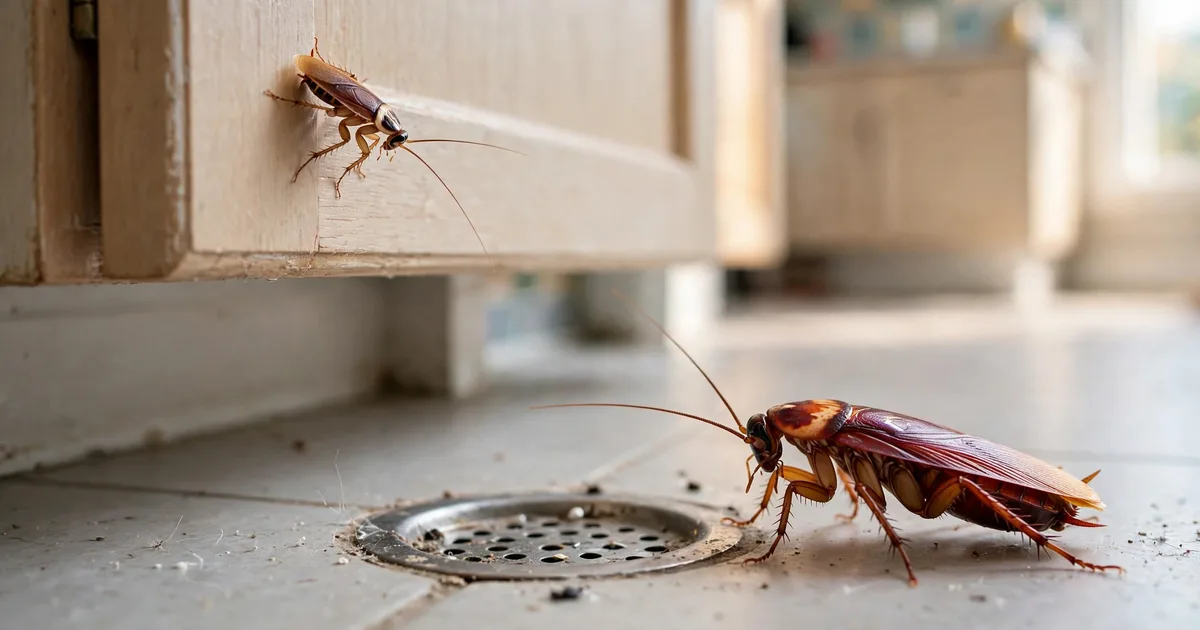
Table of Contents
- German Cockroaches: Appearance and Behavior
- American Cockroaches: Appearance and Behavior
- German vs. American Cockroaches at a Glance
- How to Tell Them Apart in Practice
- Risks of German Cockroaches
- Risks of American Cockroaches
- Other Large Outdoor Cockroaches in the Central Valley
- Control in General Terms
- How to Prevent Both Cockroaches
- When to Call a Professional
- Frequently Asked Questions
German Cockroaches: Appearance and Behavior
The German cockroach (Blattella germanica) is the cockroach that actually infests homes. Despite the name, it has nothing to do with Germany in any way that matters to a homeowner — what matters is that of all the cockroach species in the Central Valley, this is the one that has adapted completely to living indoors with people, and it essentially never survives as an outdoor population here.
What they look like. Adults are about 1/2 to 5/8 inch long — small enough that several could line up along a quarter. They are light brown to tan, and the marking that settles the identification is on the pronotum, the shield-like plate behind the head: two dark, parallel stripes running front to back. No other common household roach has those two stripes. Adults have wings folded over their backs but almost never fly. The young stages — nymphs — are smaller, darker, and wingless, with the same stripe pattern showing as they grow. A cluster of roaches in several sizes, from specks up to 5/8 inch, all in the same kitchen, is characteristic: you are looking at a breeding population at every stage of its life cycle.
Where they live. German cockroaches live in harborage — tight cracks and voids close to food, water, and warmth. The classic locations are the hinge areas and motor housings of refrigerators and dishwashers, under sinks, inside cabinet framing, behind drawers, around plumbing penetrations, in the folds of cardboard boxes stored nearby, and inside small appliances that sit warm on the counter. They prefer to be wedged in with surfaces touching their backs, which is why a kitchen can hold a substantial population in spaces a homeowner rarely sees. They stay close to their harborage, usually moving only a short distance to feed, so where you find droppings and shed skins is close to where they live.
How they reproduce. This is the trait that drives everything about German cockroach control. The female produces an egg case — an ootheca — that holds dozens of eggs, and unlike most cockroaches she carries that case protruding from the end of her abdomen for the entire incubation, setting it down only shortly before the eggs hatch. Carrying the case protects it: the eggs are sheltered from predators, from drying out, and from many treatments that would reach a case left sitting in a crack. Under warm indoor conditions, a new generation can mature in a matter of months, and because females produce cases repeatedly through their lives, a small introduced group becomes a large population on a timescale homeowners consistently underestimate. It also means that even a thorough first treatment can be followed, weeks later, by a hatch from cases that were already in place — which is why follow-up is built into the plan rather than treated as a sign the plan failed.
How they get in. German cockroaches almost never walk in from the yard. They are carried in: in grocery bags and delivery boxes, in used appliances and furniture, in the belongings of someone moving from an infested unit, and between adjoining apartments through shared walls, plumbing runs, and utility chases. A single egg case in a box of stored items can start a problem in a clean home, which is why this species turns up in well-kept kitchens — it is a hitchhiking problem, not a housekeeping verdict, though the sanitation points below shape how fast it grows.
When and where you see them. German cockroaches are nocturnal and stay hidden while numbers are low, so the early signs are indirect: droppings that look like black pepper or coffee grounds speckled in cabinet corners and along the tops of door hinges, shed skins in drawers and under appliances, and a stale, musty odor in heavy infestations. Seeing live roaches in the daytime, out on counters or inside cabinets when the light comes on, usually means the harborages are crowded — the population has outgrown its hiding places. That is a later-stage sign, and it means the problem has been building for a while.
American Cockroaches: Appearance and Behavior
The American cockroach (Periplaneta americana) is the big roach of drains, crawl spaces, and summer evenings — the one many people call a waterbug. It is a peridomestic insect: it lives around buildings rather than in them, and its whole biology points outward.
What they look like. Adults are about 1 1/2 to 2 inches long, large enough that one crossing a garage floor gets your full attention. They are reddish-brown to mahogany in color, and the identifying mark is on the pronotum, the shield behind the head: a pale, yellowish margin or band around its edge. There are no dark paired stripes. Adults of both sexes have fully developed wings that cover the abdomen. Nymphs are smaller, wingless, and more uniformly brown, but even the young look like scaled-down versions of the adults and are mostly found in the same outdoor and utility places.
Where they live. Outdoors and in the wet infrastructure of a property: sewers and storm drains, crawl spaces, basements, boiler and utility rooms, tree holes, woodpiles, compost, and the damp soil and mulch of irrigated landscaping. In the Central Valley, summer irrigation keeps the ground around homes moist through the hottest months, and American cockroaches thrive in that perimeter zone — under leaf litter, in meter boxes and drainage structures, and along the shaded foundation line. Indoors is not where they breed; a heated, dry kitchen does not suit them the way it suits the German cockroach.
How they reproduce. The female forms an egg case holding a smaller number of eggs than the German cockroach’s case, carries it only briefly, and then deposits or glues it in a sheltered crevice near food and moisture — in a crawl space, behind stored material, in a drain structure. The whole life cycle is slower: development from egg to adult takes many months, and the population builds gradually outdoors rather than exploding inside a wall void. That slower cycle is why the American cockroach problem is about pressure — a large, established outdoor population sending wanderers in — rather than about a hidden indoor colony racing ahead of you.
Flight. American cockroaches have wings and use them more than German cockroaches do. Most of the time they glide — launching from a height and descending at an angle, often toward light or warmth. In genuinely warm weather they can manage short, clumsy flights. A big roach that “flew at me” on a summer night is almost always this species, and the flight is startling without changing what the insect is or what should be done about it.
When and where you see them. Activity peaks in the warm months. Indoors, they appear one or two at a time: in a bathtub or sink (having come up around plumbing or fallen in and been unable to climb the smooth sides), in a garage, near a floor drain, or along a basement or crawl space entry. Sightings often follow irrigation, heavy watering, or rain that floods outdoor harborage and pushes them to move, and they frequently enter through gaps around doors, vents, and utility penetrations or around drain lines. A pattern of single large roaches, spread over weeks, with none of the clustered small-roach signs described above, is the outdoor species visiting — not breeding in your walls.
German vs. American Cockroaches at a Glance
| Feature | German Cockroaches | American Cockroaches |
|---|---|---|
| Adult size | About 1/2 to 5/8 inch | About 1 1/2 to 2 inches |
| Color and markings | Light brown to tan; two dark parallel stripes on the shield behind the head | Reddish-brown; pale yellowish margin around the shield behind the head |
| Habitat | Indoors only — kitchen and bathroom harborage near heat, water, and food | Outdoors and in sewers, drains, crawl spaces, basements, and irrigated landscaping |
| Where you find them | Clustered in cabinets, appliance hinges and motors, under sinks, behind drawers | One or two at a time near drains, in garages, tubs, and utility areas |
| Reproduction pattern | Female carries the egg case until just before hatching; dozens of eggs per case; new generations in a matter of months | Female deposits the egg case in a sheltered spot; slower cycle, many months from egg to adult |
| What attracts them | Food residue, grease, water, warmth, and tight harborage close to all three | Moisture, decaying organic matter, warmth, and open routes in from outside |
| Typical signs | Pepper-like droppings in cabinet corners, shed skins, roaches scattering when cabinet doors open, musty odor when numbers are high | Occasional large roaches indoors, activity around drains and crawl space access, sightings after irrigation or rain |
| Risk to the home | A breeding indoor population: ongoing contamination of food and surfaces, allergen buildup in the home | Contamination carried in from drains and sewers; steady outdoor pressure at entry points |
| What control has to solve | Locating indoor harborage, breaking a protected egg cycle, and sanitation — with follow-up visits | Reducing the outdoor and drain population, and closing the entry routes into the structure |
How to Tell Them Apart in Practice
Most identifications take less than a minute once you know what to look at:
- Measure it against a coin. An adult German cockroach is about the length of a dime’s diameter or less. An adult American cockroach is longer than a quarter is wide — unmistakably big. There is almost no overlap between the adults of these two species, so size alone settles most sightings.
- Look at the shield behind the head. Two dark stripes running parallel on a light brown background: German. A pale, light-colored edge framing a reddish-brown shield: American. This marking is visible in a clear phone photo, which is worth taking before the insect disappears — a photo of the back, with a coin beside it for scale, tells an inspector most of what is needed.
- Count, and note the sizes. Many roaches, in a range of sizes down to tiny dark nymphs, all in the kitchen or bathroom: that is a German cockroach population living on site. One large roach, alone, in a tub or garage: that is an American cockroach that wandered in. The pattern is as diagnostic as the insect.
- Read the droppings. German cockroach droppings look like coarse black pepper or coffee grounds, speckled and smeared in the corners of cabinets, along hinge lines, and under appliances near harborage. American cockroach droppings are larger — blunt-ended pellets, more like a mouse’s in shape though smaller — and turn up near crawl space entries, in garages, and around drain areas rather than inside food cabinets.
- Consider the season and the trigger. Small roaches in the kitchen in January are German cockroaches; indoor conditions are their habitat all year. Big roaches appearing after the irrigation runs, during a hot spell, or right after rain are American cockroaches being pushed around outdoors. Winter indoor sightings of the big species do happen around drains and heated utility spaces, but the small clustered kitchen problem is the German species in every season.
One caution: finding one species says nothing about the other, and a home can have American cockroaches around its perimeter while a German cockroach introduction gets started in the kitchen. Restaurants and apartment buildings see this often. Identifying the roach in front of you, each time, is the step that matters — the same identification-first logic that applies to the ants in our guide to Argentine ants vs carpenter ants.
Risks of German Cockroaches
The German cockroach is the more serious household problem of the two, precisely because it lives where you do.
A breeding population, not a visitor. Every other trait flows from this one. A German cockroach infestation grows in place, month over month, in the structure of the kitchen and bathroom. It does not die off in winter, does not move out when the weather changes, and does not resolve because a few visible roaches were killed. Left alone, the trajectory is always upward — more harborage occupied, more rooms involved, until roaches are being seen in daylight and in areas away from the kitchen.
Contamination of food and surfaces. Cockroaches move between the least clean places in a room — drain areas, the voids behind appliances, the inside of trash storage — and the surfaces where food is prepared and stored, and they can carry bacteria on their bodies and legs as they go. They also leave droppings, regurgitated material, and shed skins in the cabinets and drawers where dishes and food are kept. The point is not any single dramatic exposure; it is the steady, daily contact between an insect population and the places a household eats from.
Allergens in the home. Cockroach droppings, shed skins, and body fragments accumulate in harborage areas and become part of household dust, and cockroach material is a recognized indoor allergen: for people who are sensitive to it, ongoing exposure can aggravate allergy and asthma symptoms. This is described in general terms on purpose — the severity varies from person to person, and questions about a specific person’s symptoms belong with a medical professional. The practical point for this guide is simple: allergen load tracks population size and how long the infestation has run, which is one more reason an indoor breeding problem should not be left to grow.
Spread through buildings and businesses. In apartments and condominiums, German cockroaches move between units along plumbing and wiring runs, so one untreated unit can keep supplying the units around it — a building problem, not a single-tenant problem. In restaurants, grocery and food-storage settings, and other food businesses, this species is the central cockroach concern, because it breeds right where food is handled; our commercial pest control work deals with it in exactly those settings. A problem found early — in one unit, one kitchen — is a smaller job than one found after it has had a year to spread.
Risks of American Cockroaches
The American cockroach’s risks are real but different in shape: they come from where the insect has been, and from pressure, not from an indoor colony.
Contamination carried in. This species moves through sewers, drains, crawl spaces, and decaying organic matter outdoors, then walks across a garage floor, a laundry room, or occasionally a kitchen. Like other cockroaches it can carry bacteria on its body from those environments. A home does not get the accumulating, in-the-cabinets contamination of a German cockroach infestation from occasional wanderers — but a steady stream of large roaches coming up around drains and plumbing deserves a response, and stored food and food-preparation surfaces should not be sharing space with insects arriving from a sewer system.
What their presence is telling you. A pattern of American cockroach sightings is often a building report in disguise. Roaches appearing from a particular bathroom may point to a dry drain trap, a cracked drain line, or an unsealed plumbing penetration. Roaches in a crawl space in numbers point to moisture and harborage down there. Roaches under a door point to a failed sweep. The insect is the symptom; the entry route and the outdoor conditions are the findings an inspection should produce.
Outdoor pressure that does not quit. The population in the yard, the drains, and the neighborhood’s wet infrastructure renews itself every warm season, and Central Valley summers are long. Individual wanderers will keep testing the structure as long as harborage sits against the house and gaps stay open. That is why American cockroach work is measured by reduced sightings over a season rather than by a single visit’s body count, and why the harborage and sealing work in the prevention section does so much of the long-term lifting.
Other Large Outdoor Cockroaches in the Central Valley
Two other large species turn up around Central Valley homes, and both are frequently mistaken for the American cockroach. Both follow the American pattern — outdoor insects, not indoor breeders — so the control logic is the outdoor one.
Oriental cockroach. About an inch long, dark brown to nearly black, and shiny, as if polished. The females have very short wing pads and the males have wings that cover only part of the abdomen; neither can fly. They favor cool, damp places: basements, crawl spaces, drains, and outdoors under mulch, leaf litter, and debris. This is one of the species most often called a “waterbug.” Indoors, it tends to stay low — ground floors, basements, and around plumbing — and it moves more slowly than the American cockroach.
Turkestan cockroach. Also about an inch long, and increasingly common in the Southwest and the Central Valley. The males are light brown with full wings and will fly toward outdoor lights; the females are darker brown with short wings and a pattern of pale markings along the edges. They live outdoors in water meter boxes, irrigation control boxes, compost, and leaf litter, and around homes in the same irrigated perimeter zone as the American cockroach. Males drawn to porch lights at night are the ones most often noticed.
If the large roach at your door is glossy black, or about an inch long rather than two, it is probably one of these two — and the identification still matters less than the category: outdoor species, perimeter problem, entry points and harborage to address.
Control in General Terms
Control follows identification, and these two species need nearly opposite plans. What follows is a general description of how each problem is approached — not a set of instructions for doing it yourself, because the details depend on the species, the property, and the products a professional chooses. Treatments are applied according to the product label and California regulations. The label is the authority on how any product may be used.
Controlling German cockroaches
With German cockroaches, the harborage is the problem, and control is built around finding it and breaking the egg cycle:
- Inspect and map first. The technician checks the known harborage points — appliance hinges and motors, under-sink voids, cabinet framing, plumbing runs — and uses what the droppings and skins reveal to map where the population actually lives. Treating a kitchen without that map treats the room, not the roaches.
- Treat the harborage directly. Professional treatment is placed into and around the cracks and voids where the roaches spend their days, rather than broadcast across open surfaces they cross only briefly. Baits are a common part of the approach for this species, placed in the harborage zones where foraging roaches feed and share food with the ones that never come out — described here as an approach only, since product choice and placement are professional decisions for the specific kitchen.
- Understand why spraying alone disappoints. General sprays applied openly in a kitchen mostly reach roaches that are already exposed, and many spray treatments flush roaches out of treated harborage and scatter them into new ones — deeper into appliance voids, into adjoining rooms, in apartments into adjoining units. A population can look smaller for a week and be more spread out than before. This is the classic way a German cockroach problem gets worse while appearing to be treated.
- Sanitation as part of the plan. Grease films around the stove, food residue under appliances, standing water under the sink, and cardboard stored on the kitchen floor all sustain the population and compete with treatment. Degreasing, drying out the under-sink cabinet, and removing cluttered harborage are not cosmetic steps; they change how well the professional work performs.
- Follow up, because of the egg cases. Females already carrying cases will produce a hatch after the first treatment, on the case’s schedule, not the treatment’s. Follow-up visits are timed to catch that next generation before it matures and starts producing cases of its own. A German cockroach plan quoted as a single visit, with no follow-up, should prompt the question of how the eggs are being handled.
Controlling American cockroaches
With American cockroaches, the structure’s perimeter and its plumbing are the problem, and control is built around pressure and access:
- Work the exterior and the entry points. Treatment is directed at the places the population lives and travels — the foundation line, crawl space, drain surrounds, meter boxes, and the harborage against the house — rather than at the indoor rooms where wanderers are spotted.
- Close the routes in. Door sweeps, sealed plumbing and utility penetrations, screened vents, and repaired gaps at the foundation remove the openings wanderers use. A big roach needs a bigger gap than a German cockroach does, so sealing for this species is genuinely effective when it is thorough.
- Deal with drains and plumbing. Floor drains with dry traps, cracked drain lines, and open cleanouts are highways from the sewer population to the interior. Keeping traps filled with water, and repairing damaged drain components — sometimes with a plumber, since drain repair can sit outside a pest control company’s scope — cuts off the route the sightings keep using.
- Reduce outdoor harborage. Mulch and leaf litter pulled back from the foundation, woodpiles moved away from the house, compost and debris managed, and irrigation that is not soaking the foundation line all reduce the population living within a few feet of the walls.
- Expect seasonal follow-up. Because the source population is outdoors and renews itself, service for this species is usually about keeping pressure down across the warm season rather than ending a colony on a single date.
How to Prevent Both Cockroaches
Prevention overlaps even though control does not, because both species are drawn by food, water, and harborage. Our General Household Pest Guide for Central Valley Homes covers the full range of house-invading pests; for these two roaches, the habits that matter are:
- Keep the kitchen degreased — stove sides, the gap behind the range, under the refrigerator — and wipe up food residue the day it lands. Grease is German cockroach food at a scale most people underestimate.
- Fix plumbing leaks and dry out under-sink cabinets; in a dry Valley summer, a slow drip is a water source insects will build around.
- Store food, including pet food, in sealed containers, and avoid leaving pet food out overnight.
- Reduce cardboard and clutter stored on floors, especially in kitchens, garages, and near appliances — cardboard is shelter, harborage, and an egg-laying surface in one.
- Inspect incoming boxes, used appliances, and secondhand furniture before they settle into the home; the German cockroach arrives as cargo, and a few minutes at the door is the cheapest intervention in this entire article.
- Seal gaps around doors, pipes, and utility penetrations, fit door sweeps, and keep attic and crawl space vents screened and intact.
- Keep floor drain traps filled with water, and have damaged drain lines repaired rather than capped and forgotten.
- Pull mulch, leaf litter, and stored items back from the foundation, stack firewood away from the house, and aim irrigation at the yard rather than the walls.
- Do a seasonal walk-around — foundation line, meter boxes, crawl space access, under sinks — the same way you would for ants or termites. Most of our residential pest control customers fold roach awareness into exactly this routine: most problems are spotted first by the person who lives in the house.
When to Call a Professional
Identification and the occasional outdoor wanderer are homeowner territory. Call for an inspection when:
- You see small roaches in a kitchen or bathroom, in any season, at any hour — the indoor species does not resolve on its own
- Roaches appear in the daytime, or scatter from cabinets and drawers when doors open
- You find pepper-like droppings in cabinet corners or shed skins under appliances
- Large roaches appear indoors repeatedly, or keep coming from one drain, room, or crawl space entry
- You are moving into or out of a rental, or a neighboring unit in your building has a known problem
- You run a food business and have seen any roach activity in food areas
- You cannot tell which roach you have — a clear photo with a coin for scale is a fine start, and an inspection settles it
A word about doing it yourself: for German cockroaches, the failure pattern is spraying open surfaces while the population sits protected in harborage and the egg cases ride out the treatment on the females carrying them. For American cockroaches, it is treating the bathroom where one was seen while the population in the drains and the yard carries on untouched. In both cases the visible roaches disappear for a while and the problem does not, which is why the inspection and the identification are not formalities. They are the work.
Pentecost Pest Control is a family-owned company based in Modesto, at 3501 Coffee Rd, Modesto, CA 95355. We serve residential and commercial customers in San Joaquin and Stanislaus Counties, inspect before we recommend, and explain what we find in plain language. If the roach in your kitchen is the small kind in the cabinets or the big kind by the drain, start with the inspection.
Frequently Asked Questions
I found one big cockroach in the bathtub. Do I have an infestation?
Probably not an indoor one. A single large roach — an American cockroach, or one of the other outdoor species — usually wandered or was washed in from the drain and plumbing area, or came through a gap looking for moisture, and smooth tub sides trap it where you find it. What would change the answer is a pattern: big roaches appearing repeatedly, from the same drain or room, or any small roaches at all in the kitchen. One wanderer calls for checking door sweeps and drain traps; a pattern calls for an inspection.
Why are the cockroaches in my kitchen so small?
Because they are German cockroaches, most likely — the adults of that species are only about 1/2 to 5/8 inch, and a kitchen population includes nymphs at every smaller size down to specks. Small size here is not a sign of a young, minor problem; it is the signature of the species that breeds indoors. Confirm with the two dark stripes behind the head, and treat the sighting as the start of an inspection rather than a cleaning project alone.
Can American cockroaches fly?
They have full wings and can glide, and in warm weather they can make short flights — usually downward launches that look more dramatic than they are. German cockroaches have wings too but almost never fly. So a roach that flew on a summer night is the outdoor species, and a roach’s ability to fly does not change the plan: the outdoor population, the harborage, and the entry points are still the problem to solve.
Will cleaning alone get rid of German cockroaches?
Cleaning matters, and it is part of every sound plan — grease, food residue, water, and clutter all sustain the population and interfere with treatment. But cleaning alone rarely ends an established infestation, because the roaches themselves live in harborage cleaning does not reach: inside appliance voids, cabinet framing, and hinge gaps, with egg cases sheltered on the females. Sanitation removes their support; it does not remove them. If small roaches keep appearing after the kitchen is genuinely clean, the remaining step is an inspection and a treatment plan aimed at the harborage.
How much does cockroach treatment cost?
It depends on factors an inspection establishes: which species is involved, how large and spread out the population is, how much harborage has to be treated, whether the job is an indoor breeding problem or an outdoor pressure problem, the size and construction of the home or building, and how many follow-up visits the plan includes. German cockroach work usually involves a series of visits tied to the egg cycle, while American cockroach work centers on the exterior, drains, and entry points. Honest pricing follows an inspection rather than a guess over the phone, and a written quote should say what it covers.
Can I get rid of either roach on my own?
Homeowners can do real work on both: sanitation, degreasing, fixing leaks, sealing entry points, keeping drain traps filled, and clearing harborage all reduce what attracts roaches and how easily they get in. Where do-it-yourself efforts usually stall is at the hidden part — the German cockroach population inside appliance voids and cabinet framing, or the American cockroach population in the drains and the yard. If roaches keep appearing after the housekeeping is done, or if the roaches are the small indoor species at all, a professional inspection is the step that changes the outcome.
Ready to have your cockroaches identified? Call (209) 581-5562 or request a free estimate. Tell us what you are seeing — small roaches clustered under the sink, or one big roach near a drain — and we will start with an inspection and explain the next steps.
By the Pentecost Pest Control Editorial Team
This article is for general educational purposes only. Pest conditions, regulations, and treatment options vary by property and situation. Contact a licensed pest control professional for an inspection.