
If ants have shown up in a Central Valley home, they are usually one of two species, and they could hardly be more different. Argentine ants are tiny — about 1/16 inch long, all the same size, dull brown — and they arrive in long trails of hundreds or thousands, looking for sweets and water. Carpenter ants are among the largest ants you will ever see indoors: workers vary noticeably in size, up to about 1/2 inch, and they are usually black or red-and-black. They do not pour across the counter in a trail; they wander in smaller numbers, often at night, and the colony may be nesting inside damp wood in the structure itself.
Homeowners confuse the two because both are “ants in the house,” but the confusion matters. An Argentine ant problem is a nuisance problem driven by an enormous colony living mostly outdoors, and control is about cutting off food, water, and access while the colony itself is addressed. A carpenter ant problem is a wood problem: the ants excavate galleries in wood to make room for their nests, so finding the nest — and the moisture that usually invited it — is the whole job. The identification comes first, because the right response to one ant is close to useless against the other. This guide explains how to tell them apart, what each one can do to a home, and what control looks like in general terms.
Key Takeaways
- Size is the fastest separator: Argentine ant workers are all about 1/16 inch long; carpenter ant workers in a single colony range from about 1/4 inch up to about 1/2 inch.
- Argentine ants travel in obvious trails and go after sweets and water. Carpenter ants forage in loose, scattered patterns, mostly after dark.
- Argentine ants nest outdoors in soil and under objects, in colonies with many queens that can extend across whole neighborhoods. Carpenter ants nest in wood — usually damp or previously damaged wood — with a main colony and smaller satellite colonies.
- Argentine ants do not damage wood. Their risks are food contamination and sheer persistence. Carpenter ants do not eat wood, but they hollow it out to nest, and over time that excavation can weaken structural members.
- Sawdust-like debris (frass) containing bits of insects points to carpenter ants. A trail of tiny ants running to a spill or a pet bowl points to Argentine ants.
- Spraying a visible Argentine ant trail kills only foragers — a small share of the colony — and the trail usually returns. Carpenter ant control fails when it treats the ants you see and never finds the nest.
- If you are not sure which ant you have, an inspection settles it before any treatment is chosen. Pentecost Pest Control provides ant control for homes across Stanislaus and San Joaquin Counties.
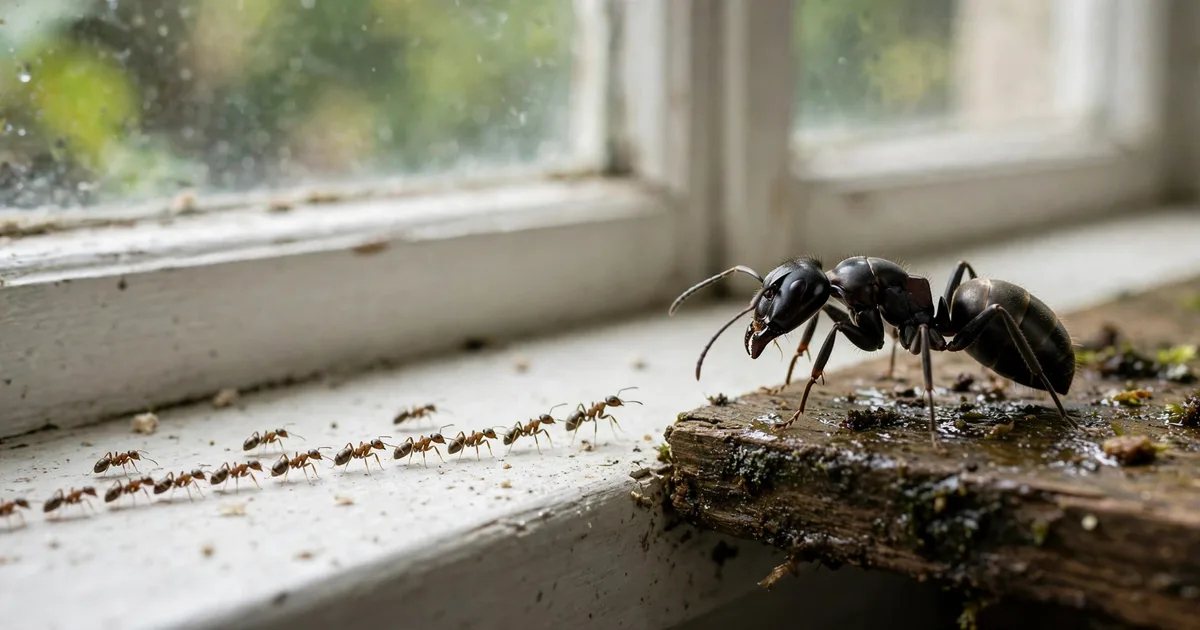
Table of Contents
- Argentine Ants: Appearance and Behavior
- Carpenter Ants: Appearance and Behavior
- Argentine Ants vs. Carpenter Ants at a Glance
- How to Tell Them Apart in Practice
- Risks of Argentine Ants
- Risks of Carpenter Ants
- Carpenter Ants or Termites?
- Control in General Terms
- How to Prevent Both Ants
- When to Call a Professional
- Frequently Asked Questions
Argentine Ants: Appearance and Behavior
The Argentine ant (Linepithema humile) is the ant most Californians picture when they think of a kitchen invasion, and it is the dominant house-invading ant in much of the state. It is a small, unremarkable-looking insect, which is part of why it gets underestimated.
What they look like. Workers are about 1/16 inch long and all essentially the same size — there are no big soldiers mixed in. They are a dull light to dark brown, with no stripes, spines, or shiny finish, and they give off a faint musty odor when crushed. Under a magnifier they have the narrow, pinched waist all ants have, with a single small segment in it. In practice, most people identify them by numbers and behavior before they ever look at one closely: a tight, busy trail of tiny, uniform, brown ants running along a baseboard, a counter edge, or up the side of the house.
How the colony works. Argentine ants do not live in one nest with one queen. Their colonies have many queens, and neighboring colonies do not fight the way most ant species do — they merge into interconnected supercolonies that can stretch across entire neighborhoods. A colony expands by budding: a queen and a group of workers simply walk off and start a new nest nearby. This structure explains almost everything about dealing with them. There is no single nest to find and destroy, and killing the ants in one trail does not reduce the colony in any lasting way, because thousands more workers and plenty of queens remain in the ground, under pavement, in mulch, and in wall voids around the property.
Where they nest and what they eat. Nests are shallow — in soil, under stones, boards, and planters, in leaf litter and mulch, and sometimes in wall voids or insulation near a moisture source. Argentine ants are drawn to water as much as to food, and they favor sweets above almost everything: spilled juice, honey, syrup, ripe fruit, and the pet food bowl all draw trails. Outdoors, their main food is honeydew, the sugary liquid produced by aphids and scale insects on trees and shrubs, and Argentine ants actively protect those insects from predators. A citrus tree or rose bush against the house can support the colony that is raiding your kitchen.
When they come indoors. In the Central Valley, Argentine ants pour indoors when outdoor conditions turn against them: after heavy rain floods their shallow nests, during summer heat and drought when they hunt for water, and when honeydew supplies drop. A line of ants at a bathroom sink, a tub, or a potted plant is usually a water run, not a food run. They enter through cracks in the foundation, gaps around pipes and wires, torn window screens, and the space under doors — openings so small that most homes have many.
Carpenter Ants: Appearance and Behavior
Carpenter ants (Camponotus species) are a different scale of insect entirely, and a different kind of problem. Several species live in California; the ones homeowners meet are large, dark ants that nest in wood — a habit that makes them easy to confuse with termites, and important to identify correctly.
What they look like. Workers from the same colony vary in size, from about 1/4 inch for smaller workers up to about 1/2 inch for the largest — a difference you can see at a glance when two of them stand side by side. Queens are bigger still. Color depends on the species: some Central Valley carpenter ants are solid black or dark brown, while a common western species has a reddish thorax and a dark abdomen, giving it a red-and-black look. Up close, a carpenter ant has the pinched ant waist, elbowed antennae, and a smooth, evenly rounded thorax when viewed from the side. Winged carpenter ants — the reproductives that fly out in spring — are sometimes mistaken for termites, a confusion covered below.
How the colony works. A carpenter ant colony has one queen, usually in a main (parent) colony located outdoors in a tree, a stump, a log, or landscape wood where moisture is steady. As the colony grows, it establishes satellite colonies — nests without the queen, holding workers, older larvae, and pupae — and those satellites are frequently inside structures: in wall voids, under attic insulation, in hollow doors, in foam insulation, and in wood that has been softened by water. The ants you see foraging indoors may belong to a satellite colony in the wall or may be commuting from the parent colony outside. Either way, there is a nest, it is in or near wood, and finding it is the central task.
They excavate wood; they do not eat it. This is the fact that separates carpenter ants from termites. Carpenter ants cannot digest wood. They chew it to hollow out smooth galleries and tunnels where the colony lives, and they carry the chewed material out and dump it. That debris — called frass — is one of the most useful signs a homeowner can find: coarse, shredded, sawdust-like piles, often mixed with bits of dead insects the colony has discarded. A pile of frass under a window frame, in a crawl space, or below attic framing deserves a close look. The ants prefer wood that is damp, softened, or already decayed, because it is easier to excavate, which is why a carpenter ant nest so often points to a leak or a drainage problem that came first.
When and where you see them. Carpenter ants are mainly nocturnal. Foragers leave the nest around dusk and work through the night, which is why homeowners tend to spot them one or two at a time in the evening — a large ant crossing a bathroom, turning up near a dishwasher or a sink, or trailing along the top of a fence or a tree branch toward the house. Outdoors they travel along edges and lines: branches touching the roof, utility wires, vines, and fence rails are all highways. Inside, they are drawn to the same places moisture collects — under sinks, around tubs and showers, near water heaters, in window frames where condensation forms, and around roof leaks.
Argentine Ants vs. Carpenter Ants at a Glance
| Feature | Argentine Ants | Carpenter Ants |
|---|---|---|
| Worker size | All about 1/16 inch, uniform | Varies within the colony, about 1/4 inch up to about 1/2 inch |
| Color | Dull light to dark brown | Black, dark brown, or red-and-black depending on species |
| Colony structure | Many queens; interconnected supercolonies spanning whole properties or neighborhoods | One queen in a main colony, plus satellite colonies without queens |
| Nesting sites | Shallow nests in soil, under stones, boards, mulch, and planters; sometimes wall voids near moisture | Inside wood — damp or decaying wood, wall voids, insulation, hollow doors; main colony often outdoors in a tree or stump |
| Food | Sweets first: honeydew, syrup, juice, fruit; also pet food and grease | Insects and honeydew outdoors; a wide range of household foods; drawn to moisture |
| Movement pattern | Dense, organized trails of many ants, day or night | Loose, scattered foragers, mostly dusk through night |
| Typical signs | Trails along counters, baseboards, and foundations; ants at sinks and pet bowls | Frass piles (coarse sawdust with dead insect bits); large ants appearing one or two at a time; faint rustling in walls |
| Risk to the home | Nuisance and food contamination; persistent re-invasion | Galleries excavated in wood; over time, damage to the wood members they occupy |
| What control has to solve | Food, water, and access around the whole property, plus the outdoor colony pressure | Locating the main and satellite nests and correcting the moisture that attracted them |
How to Tell Them Apart in Practice
You rarely need a hand lens. Four quick observations settle the identification in most homes:
- Look at the size — and whether it varies. Measure against a coin or a ruler if the ants hold still. A stream of ants that are all the same tiny size, around 1/16 inch, is Argentine ants. Ants that range from modest to startlingly large — some twice the length of others — are carpenter ants. No Argentine ant will ever be 1/2 inch long.
- Watch how they move. Argentine ants form organized, two-way trails, following edges, grout lines, pipes, and the base of walls. Carpenter ants wander more loosely, often alone, and most activity happens after dark. A flashlight check around 10 or 11 at night, near sinks and along exterior walls, often reveals carpenter ant traffic that is invisible at noon.
- Follow the trail to what it wants. A trail that ends at a drip of syrup, a fruit bowl, or a honeydew-covered shrub is Argentine ants at work. Ants appearing near a shower, a leaking window frame, or a stack of damp firewood — with no clear food target — suggest carpenter ants working around a nest.
- Look for debris. Argentine ants leave no debris; their sign is themselves. Carpenter ants push out frass: coarse, irregular, sawdust-like shreds, often mixed with insect legs and wings, collecting in a cone beneath a crack, a frame, or an attic area. If you find that pile, save a photo of it and of any ants nearby — it tells an inspector a great deal. Termite droppings look different again: dry, uniform pellets, covered in the termite section below.
One caution: finding Argentine ants says nothing about carpenter ants, and the two can be present at the same address at the same time — one raiding the pantry while the other nests in a wet window frame. Identifying the ant in front of you is the step that matters, each time.
Risks of Argentine Ants
Argentine ants do not bite people in any meaningful way, they do not damage wood, and they do not go after the structure of a house. Their risks are about contamination, persistence, and how thoroughly they take over a property.
Food contamination. A trail that finds an open cereal box, a sugar canister, or food left on a counter has walked across floors, soil, and outdoor surfaces to get there. Food that ants have been running through should be discarded, and the trail’s presence in a pantry is a standing reminder that storage has to be sealed. In commercial kitchens, food storage areas, and healthcare settings, Argentine ant activity is a genuine sanitation problem, not just an annoyance.
Relentless re-invasion. Because the colony is spread across the property and beyond it, Argentine ants return after almost any partial effort. Seal one crack and they use another; clear the kitchen and they appear in the bathroom. This persistence is not a failure of effort — it is the arithmetic of a supercolony with many queens. It is also why the strategy for this ant is management of the whole property: food, water, harborages, vegetation, and access points, together with professional treatment aimed at the colony pressure outdoors rather than only the ants visible indoors.
Displacing other ants and upsetting the yard. Argentine ants aggressively push out native ant species wherever they establish, and native ants are part of how a yard’s ecology works — they aerate soil, move seeds, and prey on other insects. The Argentine ants that replace them farm aphids and scale on citrus, roses, and garden plants, protecting those pests from predators, so plant damage and sticky honeydew on leaves often increase where Argentine ants dominate. A yard full of Argentine ants is frequently a yard with worsening aphid problems, and the two issues have to be handled together.
Moisture problems they reveal. Indoors, Argentine ant trails to a sink or a tub sometimes trace a plumbing leak or a damp crawl space you did not know about. The ants are not the damage there — but following where they gather can point at water that should not be where it is.
Risks of Carpenter Ants
Carpenter ant risk is slower and more serious, and it is aimed at the house itself.
Structural damage over time. A carpenter ant colony removes wood to make room for itself, and the colony grows. Galleries that start in a windowsill or a door frame can extend into wall studs, beams, and floor joists if the colony is left alone for years. Carpenter ants are usually slower and more localized than termites — they do not consume the wood, and damage tends to concentrate where the nest is — but wood that has been hollowed into galleries has lost strength, and in load-bearing members that matters. Damage is worst in wood that stays damp, which is unfortunately the same wood a house can least afford to lose: sill plates, the ends of joists, framing around plumbing, and wood under leaking roofs.
A moisture problem made visible. In most indoor cases, carpenter ants are a symptom as much as a problem. They chose that wall or frame because the wood was wet — from a plumbing leak, a failed shower pan, roof flashing, condensation, or wood sitting against wet soil. Treating the ants without fixing the moisture leaves the invitation open, and replacing the wood without treating the ants invites the colony to move into the repair. The two repairs belong in the same plan.
Spread within the structure. Satellite colonies let the colony occupy several areas at once — a bathroom wall here, an attic void there, a hollow door somewhere else — all connected to a parent colony that may be in a tree in the yard. That spread is why a few ants in one room, dismissed for a season or two, can become ants in three rooms. It is also why carpenter ant work hinges on inspection: the foragers you see are the smallest part of the problem.
The swarm surprise. In spring, mature colonies release winged reproductives, and a swarm emerging indoors — from a wall, a window frame, or a baseboard — can be alarming and is often the first unmistakable sign of a satellite colony inside the structure. Winged ants indoors in spring, especially large ones, are a reason to call for an inspection promptly rather than a reason to vacuum them up and wait.
Carpenter Ants or Termites?
Because carpenter ants nest in wood and produce debris, they are constantly confused with termites, and the two problems call for different responses. The distinctions that matter most:
- The insect itself. An ant — carpenter or otherwise — has a narrow, pinched waist, elbowed antennae, and, when winged, two pairs of wings of unequal length. A termite has a broad body with no pinched waist, straight beaded antennae, and two pairs of wings that are nearly equal and longer than its body. If you find a winged insect indoors, a photo of the waist and antennae usually settles it.
- What happens to the wood. Termites eat wood and digest it; their galleries are packed with soil-like material and follow the grain. Carpenter ants excavate and remove the wood, leaving galleries that look clean and sanded inside, with the debris pushed outside. One pest consumes the house; the other remodels it for housing.
- The debris. Drywood termite frass is made of hard, uniform, seed-like pellets. Subterranean termites leave mud tubes rather than piles. Carpenter ant frass is coarse and mixed — wood shreds of different sizes tangled with dead insects and other debris the colony throws out. Of the three, only carpenter ant frass looks like a tiny junk pile.
- The damage pattern. Termites feed continuously and can compromise wood across wide areas over time. Carpenter ant damage is usually centered on the nest area and grows as the colony grows.
Both problems deserve a professional identification, and it is common for an inspector to find one while checking for the other. Our guide to termites in Central Valley homes explains termite signs, inspection, and treatment in the same general terms used here, and it is the right next read if the insect you found has a broad waist and straight antennae.
Control in General Terms
Control follows identification, and the two ants need opposite strategies. What follows is a general description of how each problem is approached — not a set of instructions for doing it yourself, because the details depend on the species, the property, and the products a professional chooses. Treatments are applied according to the product label and California regulations, and the label is the authority on how any product may be used.
Controlling Argentine ants
The goal with Argentine ants is to reduce the colony pressure around the property and make the interior not worth raiding, at the same time. In general terms, that means:
- Sanitation first. Wipe up spills promptly, store sugar, syrups, honey, and pet food in sealed containers, rinse recyclables, and keep counters and floors free of the sweet films ants follow trails to. A kitchen that stops rewarding scouts sees its trails thin out.
- Remove the water. Fix dripping faucets and plumbing leaks, address irrigation that soaks the foundation, and dry out the damp spots under sinks and in crawl spaces. Water is often the real reason for an indoor trail.
- Manage the outdoor engine. Because honeydew-producing aphids and scale feed the colony, heavy infestations on shrubs and trees against the house matter. Trim vegetation back off the structure so branches do not bridge ants onto the roof and walls, and keep mulch and leaf litter from piling against the foundation.
- Seal entry points. Caulk cracks around windows, doors, and pipe penetrations, repair screens, and fit door sweeps. Sealing does not defeat a supercolony, but it raises the cost of getting in and channels ants to fewer openings.
- Treat the colony, not the trail. This is the step most DIY efforts miss. Spraying a visible trail kills the foragers in it — a small fraction of the colony — and the queens simply replace them, often within days. Worse, some spray treatments applied around a budding species can split the colony into more nests, spreading the problem. Professional approaches for Argentine ants often involve slow-acting baits placed where trails run, which workers carry back and share through the colony, together with targeted exterior treatment — chosen and placed by the technician based on where the trails and nests actually are. Baiting is described here as an approach only; product choice, placement, and timing are professional decisions that depend on the property.
Homeowners genuinely help on sanitation, water, vegetation, and sealing. The colony-level work — reaching queens spread across a yard and beyond it — is what professional service is for, and it is normally an ongoing effort across the season rather than a single visit.
Controlling carpenter ants
With carpenter ants, the nest is the problem, and control is built around finding and eliminating it:
- Locate the nests. An inspection follows foragers, checks the places frass collects, and examines damp wood, wall voids, attics, and the trees, stumps, and landscape timbers around the home to find the satellite colonies and, where possible, the parent colony. Treating without this step treats the symptom.
- Treat the nest directly. A colony nesting in a wall void or a frame is treated where it lives, with products and methods selected for that location. Because a satellite colony has no queen, eliminating satellites stops the indoor damage, while the parent colony outdoors is dealt with so it cannot simply send out replacements.
- Fix the moisture and the wood. The leak, the drainage failure, or the condensation that softened the wood has to be corrected, and excavated wood that has lost strength should be evaluated for repair or replacement — in some cases by a contractor, since repair work can be outside a pest control company’s scope. New, dry wood in a dry wall is not attractive nesting material.
- Cut the highways. Prune branches touching the roof, move firewood off the ground and away from the house, and remove stumps and buried landscape wood that can host a parent colony near the structure.
Why the nest location matters so much: foraging carpenter ants may travel considerable distances along their highways, so an ant seen in a kitchen may belong to a nest in a bathroom wall, an attic, or a tree outside. Any plan that only addresses where the ants were spotted will keep missing the colony. That is the difference between carpenter ant control and ant spraying, and it is why inspection comes before treatment in every case.
How to Prevent Both Ants
Prevention overlaps more than control does, because both ants are drawn in by the same household conditions. Our General Household Pest Guide for Central Valley Homes covers the full range of house-invading pests; for these two ants, the habits that matter are:
- Fix leaks quickly — under sinks, at water heaters, around tubs and showers — and correct drainage so soil and wood near the foundation stay dry.
- Seal cracks and gaps in the foundation and around doors, windows, and utility penetrations, and keep screens and door sweeps in repair.
- Trim trees and shrubs off the house and roofline so vegetation does not form a bridge, and avoid planting beds piled high with mulch against the foundation.
- Store food, including pet food, in sealed containers; wipe up sweet spills the day they happen; and avoid leaving pet food out overnight.
- Store firewood off the ground and away from the house, and bring in only what you are about to burn.
- Replace water-damaged, spongy wood rather than painting over it, and pay attention to window frames, door thresholds, and deck connections where water collects.
- Do a seasonal walk-around — foundation line, window frames, under sinks, attic hatch — the same way you would for termites. Most of our residential pest control customers fold ant awareness into exactly this routine: most invasions are spotted first by the person who lives in the house.
When to Call a Professional
Identification and the occasional outdoor ant are homeowner territory. Call for an inspection when:
- Large ants — 1/4 inch or bigger — appear indoors, especially in several rooms or near damp wood
- You find frass piles, or hear faint rustling in a wall
- Winged ants emerge indoors in spring
- Argentine ant trails keep returning through sealing and sanitation efforts, or are present in multiple rooms
- Ants are getting into stored food, a pantry, or food preparation areas
- You are buying or selling a home and want wood-nesting insects checked along with the rest of the inspection
- You cannot tell which ant you have — a photo or a captured specimen is a fine start, and an inspection settles it
A word about doing it yourself: for Argentine ants, the failure pattern is spraying trails while the supercolony carries on untouched outdoors. For carpenter ants, it is treating the room where ants were seen while the nest — in a wall, an attic, or a tree — carries on untouched too. In both cases the visible ants disappear for a while and the problem does not, which is why the inspection and the identification are not formalities. They are the work.
Pentecost Pest Control is a family-owned company based in Modesto, at 3501 Coffee Rd, Modesto, CA 95355. We serve residential and commercial customers in San Joaquin and Stanislaus Counties, inspect before we recommend, and explain what we find in plain language. If the ant in your kitchen is the tiny kind in a trail or the large kind near a damp window frame, start with the inspection.
Frequently Asked Questions
I keep seeing big black ants in my kitchen. Are they carpenter ants?
Probably, but confirm it before assuming. Carpenter ants are large by ant standards — workers of noticeably different sizes, up to about 1/2 inch — and they are usually most active in the evening and overnight, often near water: sinks, dishwashers, bathrooms. Big ants seen one or two at a time, especially in spring, fit the pattern. Size alone is not proof, though, and other large ants exist. Catch one in a jar or take a clear photo against a coin for scale, and an inspector can confirm the species and start looking for the nest.
Will Argentine ants damage my house?
No. Argentine ants do not eat or excavate wood and do not damage the structure. Their harm is contamination of food they trail through, the sheer persistence of a colony that seems to refill every trail you clear, and their effect outdoors, where they displace native ants and protect the aphids and scale that damage garden plants. They are a management problem, not a structural one — which is exactly why telling them apart from carpenter ants matters.
Why do Argentine ants come back after I spray the trail?
Because the trail is not the colony. The ants you sprayed are foragers — a small share of a colony with many queens and nests spread through the soil, mulch, and wall voids of your property and your neighbors’ properties. The queens replace lost workers quickly, and a new trail forms, sometimes within days, sometimes through a different crack. In a budding species, spray pressure around a nest can even split the colony into additional nests. Lasting reduction means addressing food, water, and access around the whole property together with treatment aimed at the colony itself.
Do carpenter ants eat wood the way termites do?
No. Carpenter ants cannot digest wood at all. They chew it to hollow out nesting galleries and push the debris out as frass. The practical differences are that carpenter ant damage is usually slower and concentrated around the nest, and the frass looks like coarse mixed sawdust rather than termite pellets. That does not make it harmless — galleries in a sill plate or a beam still weaken the wood — but it means the inspection looks for a nest and a moisture source, not the soil contact and mud tubes that point to subterranean termites.
How much does ant treatment cost?
It depends on factors an inspection establishes: which species is involved, how many areas are active, whether carpenter ant nests are inside the structure and how accessible they are, the size and construction of the home, and whether follow-up visits are part of the plan. Argentine ant work often involves treating pressure around the whole property and is commonly part of an ongoing service, while carpenter ant work centers on locating and treating specific nests. Honest pricing follows an inspection rather than a guess over the phone, and a written quote should say what it covers.
Can I get rid of either ant on my own?
Homeowners can do real work on both: sanitation, fixing leaks, sealing entry points, trimming vegetation off the house, and drying out damp wood all reduce what attracts ants and how easily they get in. Where do-it-yourself efforts usually stall is at the colony — the Argentine ant supercolony spread across the property, or the carpenter ant nest hidden in a wall void or a tree. If trails keep returning after the housekeeping is done, or if there is any sign of ants nesting in wood, a professional inspection is the step that changes the outcome.
Ready to have your ants identified? Call (209) 581-5562 or request a free estimate. Tell us what you are seeing — tiny ants in a trail along the counter, or large ants near a damp window frame — and we will start with an inspection and explain the next steps.
By the Pentecost Pest Control Editorial Team
This article is for general educational purposes only. Pest conditions, regulations, and treatment options vary by property and situation. Contact a licensed pest control professional for an inspection.