
Termites are a year-round concern for Central Valley homeowners because both drywood and subterranean termites live in California, and both feed on the wood in and around a house quietly, often for a long time before anyone notices. The good news is that most infestations leave clues — mud tubes, droppings that look like tiny pellets, discarded wings, and wood that sounds hollow — and a professional inspection can confirm which type you have and how far it has spread. This guide walks through the signs, the inspection process, and the treatment options in general terms, so you know what to expect and when to call for help.
Key Takeaways
- Central Valley homes can host two very different termites: subterranean termites, which live in the soil and travel through mud tubes, and drywood termites, which live inside the wood itself.
- The most common early signs are mud tubes on a foundation, pellet-like droppings called frass, piles of discarded wings, and wood that sounds hollow or feels soft.
- Flying termites (swarmers) are often confused with flying ants. Wing size and body shape are the easiest ways to tell them apart.
- A termite inspection looks at the exterior, interior, attic, and any crawl space or subarea, and ends with written findings and recommendations.
- Treatment is chosen by species, location, and how widespread the activity is. Options include localized treatment, fumigation, and monitoring — there is no single method that fits every home.
- Prevention is mostly moisture control and common sense: fix leaks, keep wood off the ground, store firewood away from the house, and seal gaps.
- If you find any of the signs below, skip the guesswork and get an inspection. Pentecost Pest Control provides termite control and inspections for homes across Stanislaus and San Joaquin Counties.
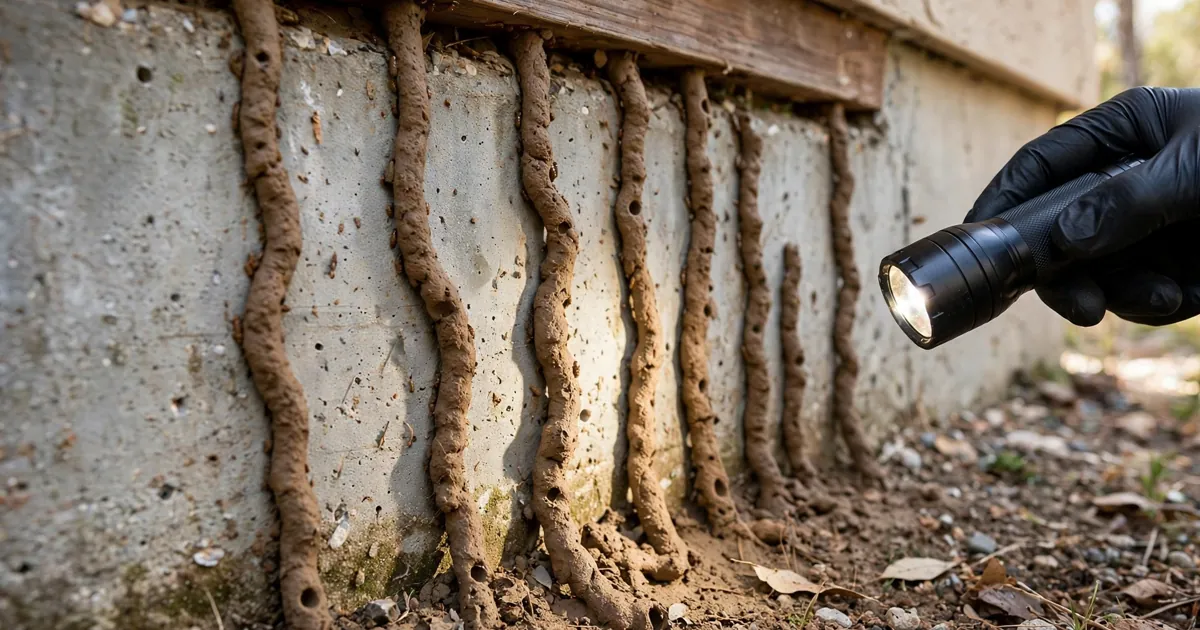
Table of Contents
- The Two Termites That Matter in California
- Drywood vs. Subterranean Termites
- Signs of Termites in a Central Valley Home
- Termite Swarmers vs. Flying Ants
- Why Central Valley Conditions Suit Termites
- What a Termite Inspection Includes
- Treatment Options in General Terms
- Termite Damage and Repairs
- How to Prevent Termites
- When to Call a Professional
- Frequently Asked Questions
The Two Termites That Matter in California
Many kinds of termites exist, but for a homeowner in Modesto, Turlock, Stockton, or anywhere else in the Central Valley, two groups account for nearly every call: subterranean termites and drywood termites. They behave so differently that identifying the species is the first job of any inspection, because the right treatment for one can be the wrong treatment for the other.
Subterranean termites live in colonies in the soil. They need moisture and contact with the ground, and they travel back and forth between their colony and the wood they are eating through protected tunnels. In a house, they usually enter at foundation cracks, plumbing penetrations, expansion joints, or anywhere wood sits close to soil. They tend to attack structural wood from the ground up — sill plates, floor joists, subflooring, and the bottom of wall studs — which is why inspectors spend so much time in crawl spaces and along foundation walls.
Drywood termites need no contact with soil at all. A pair of flying drywood termites can land on exposed wood, slip into a crack or seam, and start a colony inside the wood itself. Attic framing, fascia boards, window and door frames, eaves, and wooden furniture are common targets in California homes. Because the colony lives inside the piece of wood it is eating, a drywood infestation can be limited to one board or spread through connected framing — and because they do not need ground moisture, they can be active in dry, hot attic spaces where subterranean termites could not survive.
A third group, dampwood termites, also occurs in California, mostly in wet, decaying wood outdoors. They rarely matter inside a maintained home, and an inspector who finds them will usually point to the moisture problem that attracted them. For the rest of this guide, the focus stays on the two types that damage Central Valley houses.
Drywood vs. Subterranean Termites
If you only remember one section of this guide, make it this one. Telling these two apart explains almost everything else: the signs you will see, where the inspector will look, and which treatments are even on the table.
| Feature | Drywood Termites | Subterranean Termites |
|---|---|---|
| Where the colony lives | Inside the wood it is eating | In the soil, outside the wood |
| Needs soil contact? | No | Yes — moisture and ground contact |
| Typical entry | Flying termites enter cracks and seams in exposed wood | Through foundation cracks, joints, and plumbing openings |
| Droppings | Dry pellets (frass) pushed out of the wood, often in small piles | No visible pellets; waste stays in the colony |
| Tunnels | Galleries inside wood, clean and smooth | Mud tubes on foundations and walls for travel |
| Common locations | Attics, eaves, fascia, window frames, furniture | Crawl spaces, sill plates, subflooring, lower walls |
| Spread pattern | Often one area or connected wood members | Can spread through a structure from entry points upward |
| Treatment direction | Localized treatment, or fumigation if widespread | Soil and foundation-focused treatment, plus monitoring |
For a deeper side-by-side, read our article on drywood vs. subterranean termites. The practical point is simple: pellets under a window frame point one way, mud tubes on a foundation point the other, and the treatment plan follows from that diagnosis.
Signs of Termites in a Central Valley Home
Termites are quiet, and a home can look perfectly fine from the sidewalk while feeding is going on inside a wall. Homeowners usually discover them through indirect evidence rather than by seeing the insects themselves. Here are the signs professionals take seriously, roughly in the order people tend to find them.
Mud tubes
Subterranean termites build pencil-width tubes of soil and saliva to travel between the ground and wood without drying out. Look for them on foundation walls, on piers in a crawl space, running up the inside of a garage wall, or around plumbing that passes through a slab. A tube does not automatically mean termites are active inside it today — old tubes remain after activity ends — but a tube is always a reason to have the area inspected. Do not just knock tubes down and move on; their location tells an inspector where termites were entering.
Frass (termite droppings)
Drywood termites push their droppings out of small kick-out holes in the wood, and the pellets collect in piles below — under attic framing, on windowsills, below baseboards, or on furniture. Frass looks like coarse pepper, sawdust, or tiny seeds, and its color ranges from light tan to dark brown depending on the wood being eaten. Piles that reappear a few days after you sweep them up suggest an active colony above. Our room-by-room article on the signs of termites in your home walks through where to look in each space, and a companion piece explains what termite droppings look like in more detail.
Discarded wings
After a swarm, reproductive termites shed their wings. Finding a neat little pile of similar, translucent wings on a windowsill, in a spider web, or near a door is one of the clearest signs that termites swarmed in or near your home — sometimes from a colony inside the structure itself. Wings drifting in from outdoors are possible too, which is why an inspection, not the wings alone, settles the question.
Damaged or hollow-sounding wood
Tap on baseboards, door frames, and exposed beams with a screwdriver handle. Wood with termite galleries inside often sounds hollow or papery, and a gentle probe can push through a surface that looks painted and sound but has almost nothing behind it. Other damage clues include:
- Paint that bubbles or looks uneven for no obvious reason
- Floors or ceilings that sag or feel spongy
- Doors and windows that suddenly stick in their frames
- Maze-like galleries visible in broken or exposed wood
- Small, round kick-out holes in drywall, trim, or attic wood
Swarmers indoors
Seeing winged termites inside the house — especially coming from a wall, window frame, or light fixture rather than an open door — usually means there is a mature colony in or very near the structure. Outdoor swarms in the yard can come from a colony in a stump, fence, or landscape wood, which is still worth checking but is a different situation from swarmers emerging indoors.
None of these signs confirms the species or the size of the problem on its own. What they confirm is that it is time for a closer look.
Termite Swarmers vs. Flying Ants
Every year, Central Valley pest companies get the same phone calls: “There are flying bugs all over my porch — are they termites or ants?” The two insects swarm at similar times, and from a distance they look alike. Up close, three features separate them:
- Wings: A termite swarmer has two pairs of wings that are nearly equal in length, and the wings are noticeably longer than its body. A flying ant has two pairs of unequal wings — the front pair is much longer than the back pair.
- Body shape: A termite’s body is one broad segment, with no pinched waist. An ant has a narrow, pinched waist between its thorax and abdomen.
- Antennae: Termite antennae are straight and look like a string of tiny beads. Ant antennae are bent, like elbows.
Timing offers a hint as well. Subterranean termites in the Central Valley commonly swarm in spring, often on warm days following rain, when the soil is moist. Drywood termites tend to swarm later, in late summer and fall, often on warm, still days, and they frequently fly toward light in the evening. Flying ants swarm at various times depending on the species, so timing alone never settles it — get a close look at a captured insect, or a photo of one, and the wings and waist will usually tell the story. If the insects came from inside the house, treat it as a termite sign until an inspection says otherwise. Our dedicated comparison, termite swarmers vs. flying ants, includes a step-by-step identification checklist.
Why Central Valley Conditions Suit Termites
Termites are not a coastal problem that the Valley escaped. Local conditions give both species what they need:
- Warm summers. Long, hot Central Valley summers keep colonies active and feeding through much of the year, and warm attic spaces suit drywood termites particularly well.
- Irrigation and landscaping. Lawns, drip lines, and irrigated planting beds keep soil moist along foundations — exactly the moisture subterranean termites depend on, even when the surface looks dry.
- Slab and raised foundations. Older Valley homes on raised foundations often have crawl spaces where plumbing leaks and poor ventilation raise moisture under the house. Newer slab homes are not exempt: termites enter through slab cracks, joints, and the openings where pipes come through.
- Wood close to soil. Fence posts, planter boxes, deck supports, tree stumps, and firewood stacked against a wall all give subterranean termites food and shelter right next to the structure. Agriculture around our towns means orchards, vineyards, and rural properties often have outbuildings, posts, and stored wood that deserve the same attention as the house itself.
- Mild winters. The Valley does not get the hard, sustained freezes that slow termites in colder regions, so colonies stay established year after year.
None of this means an infestation is inevitable. It means prevention and periodic inspection are a normal part of owning a home here, the same way roof maintenance is.
What a Termite Inspection Includes
A professional termite inspection is a careful visual examination of the accessible areas of a home by a licensed inspector, looking for live termites, evidence of past or current activity, damage, and conditions that invite termites in. In general terms, an inspection covers:
- The exterior. The inspector walks the perimeter looking at the foundation, siding, eaves, fascia, door and window frames, wood-to-ground contact, stucco that runs below grade, fence connections, stumps, and stored wood. Mud tubes, damaged wood, and conducive conditions such as earth-to-wood contact are noted.
- The interior. Accessible walls, baseboards, window frames, door frames, and closets are checked for frass, kick-out holes, bubbling paint, and hollow-sounding wood. Bathrooms, kitchens, and laundry areas get extra attention because plumbing leaks create the moisture termites and other wood-destroying organisms thrive on.
- The attic. For drywood termites especially, the attic is prime territory. The inspector looks for frass, galleries in exposed framing, and swarm evidence, moving as far as safe access allows.
- The crawl space or subarea, if the home has one. This is where subterranean activity often shows first — mud tubes on piers and foundation walls, damaged sill plates and joists, plumbing leaks, and debris or form boards left in the soil.
- The garage and any attached structures, which share walls and framing with the house.
Inspectors work only in areas that are accessible without moving furniture or opening walls, and a good report says so. After the inspection you receive written findings. In California, wood-destroying pest inspection reports are a familiar part of buying and selling a home — lenders, buyers, and sellers commonly request them during real estate transactions — and the report typically separates findings about actual infestation or damage from notes about conditions that could lead to problems if they are not corrected. Your inspector will explain what each finding means, what treatment (if any) is being recommended, and what the options are before any work is agreed to. If you are preparing for a home purchase or sale, our termite inspection guide for California homeowners explains reports and next steps in more detail.
You can help an inspection go well with simple preparation: clear access to the attic hatch and crawl space opening, move stored items away from garage and foundation walls where you can, unlock gates and outbuildings, and keep pets somewhere safe and out of the way during the visit.
Treatment Options in General Terms
There is no honest one-size-fits-all termite treatment, because the right approach depends on the species, where the activity is, and how much of the structure is involved. What follows describes the main categories in general terms. In California, structural pest control work of this kind is done by licensed companies, and any treatment product is applied by licensed professionals according to its product label — the label is the authority on how a product may be used, and your technician should be able to explain what is being applied and why.
Localized (spot) treatment
When drywood activity is confined to a limited, accessible area — one section of attic framing, a window frame, an eave — a localized treatment may be an option. The idea is to treat the infested wood directly rather than the whole structure. It is less disruptive and the household usually does not need to leave. Its limit is built into the name: it addresses the activity that can be found and reached. If an inspection shows activity in several separate areas, or in wood that cannot be accessed, a localized approach may not be enough on its own.
Fumigation (tenting)
Fumigation is the option most people picture: the structure is covered with tarps (the “tent”), sealed, and a fumigant is applied inside to reach termites throughout the building, including in wood that no one can see or reach. It is generally considered when drywood activity is widespread or spread across multiple inaccessible areas. Fumigation requires real preparation — the household leaves for a period, food and medications must be prepared or removed following the fumigation company’s instructions, plants and other items may need attention, and a licensed fumigator manages the process, including the clearance steps before anyone re-enters. Because it is a whole-structure treatment, it does not leave a residual product behind, which is one reason prevention afterward still matters. Your company will walk you through preparation well ahead of time; nothing about a fumigation should be improvised.
Monitoring
Monitoring stations placed around a structure are checked on a schedule to detect subterranean termite activity near the home. Monitoring is used to catch activity early, to confirm whether activity near a home is ongoing, and as part of an ongoing service relationship after treatment. It is a detection and management tool — a way of keeping eyes on a property in a region where termites are common — rather than a one-time cure.
Soil and foundation-focused treatment for subterranean termites
For subterranean termites, treatment in general terms focuses on the relationship between the colony in the soil and the structure: addressing the soil and entry areas around and under the home and eliminating the routes termites use to reach wood. The details depend on construction type — slab, raised foundation, or a mix — and on where activity was found. Correcting the moisture and wood-to-ground conditions that invited them is part of the same conversation, because treatment works best when the property stops offering termites an easy living.
What treatment decisions depend on
- The species — drywood and subterranean treatments are fundamentally different
- How widespread the activity is — one area versus several
- Whether the infested wood can be accessed directly
- The construction of the home and what is practical for the household
- Findings about damage that may need repair regardless of treatment choice
A trustworthy proposal explains the findings first and the treatment second, and it should be clear about what a treatment does and does not do. Be cautious with anyone who recommends a whole-house treatment without inspecting, or who cannot tell you which species they found. Pricing, when you compare proposals, depends on factors such as the size and construction of the home, the species, how much activity there is, accessibility, and the method recommended — which is why a real figure only makes sense after an inspection, not over the phone.
Termite Damage and Repairs
Termite damage ranges from cosmetic to structural, and the only way to know which you are dealing with is to look. Drywood colonies tend to damage the specific wood members they live in — trim, framing, fascia, sometimes furniture — and the damage is often limited until a colony has been active a long time or several colonies are present. Subterranean termites feeding from the ground up can affect the wood closest to the soil first, including sill plates, the ends of joists, and subflooring, which are parts of the home that matter structurally.
A few principles help homeowners keep this in perspective:
- Damage accumulates slowly. Termites do not eat a house in a month. Damage that sounds alarming on a report usually reflects activity over a long period, which is exactly why catching it at the inspection stage matters.
- Treatment and repair are separate steps. Treatment addresses the termites. Repair addresses the wood. A pest control company will tell you what its findings mean for repairs and, where the work is outside its scope, that a licensed contractor or other qualified professional should evaluate and repair damaged members.
- Not every damaged board is an emergency, but none of it repairs itself. Once termites are dealt with, a plan for replacing or reinforcing damaged wood — prioritized with professional advice — protects the value of the home.
- Reports during a home sale spell this out. In California transactions, inspection reports identify infestation and damage findings and the conditions that contribute to them, so buyers and sellers can negotiate treatment and repairs with the facts on paper.
Avoid covering up suspect wood with paint or patching before an inspection. Fresh paint over galleries hides evidence your inspector needs, and it does nothing about activity inside the wood.
How to Prevent Termites
No prevention plan can promise termites will never find a house — anyone who guarantees that is overselling — but most of what attracts termites to a Central Valley home is within the owner’s control. Prevention is mostly about removing moisture, food, and easy access.
Control moisture
- Fix plumbing leaks promptly, including slow ones under sinks, at water heaters, and in crawl spaces. Check irrigation lines and sprinkler heads so they do not spray or soak the foundation.
- Keep gutters and downspouts clear and draining away from the house, and make sure soil and landscaping slope away from the foundation rather than toward it.
- Address standing water in the subarea and improve crawl space ventilation where it is lacking.
- Indoors, use exhaust fans and fix the small, chronic drips — a damp subfloor or wall cavity is an open invitation.
Our article on moisture and termites explains why leaks and poor drainage matter so much if you want to go deeper on this one topic.
Keep wood off the ground and away from the house
- Maintain a clear gap between soil and any wood on the structure where construction allows; where siding, stucco, or wood already touches soil, ask your inspector about it — earth-to-wood contact is a classic finding on California reports.
- Store firewood off the ground and away from the house — not stacked against an exterior wall or under an eave. Bring in only what you are about to burn, and check pieces for pellets or galleries. Our piece on firewood, mulch, and landscaping covers storage and plantings in more detail.
- Keep mulch and dense plantings pulled back from the foundation so you can see the slab or foundation wall and it can stay dry.
- Remove stumps, dead roots, scrap lumber, and old form boards from the yard and crawl space. Buried or forgotten wood near a home is termite food with no benefit to anyone.
- Repair or replace water-damaged and decaying wood — soft, wet wood is far easier for termites to enter than sound, dry wood.
Seal and maintain
- Seal cracks and gaps in foundations, and around plumbing and utility penetrations, as part of normal home maintenance.
- Keep attic and subarea vents screened and intact.
- Paint and seal exposed exterior wood, especially fascia and trim ends, on a regular maintenance cycle; drywood termites often enter through unprotected checks, joints, and seams.
- When you replace fencing or build a deck, keep posts and supports from creating a hidden bridge of wood and soil straight to the house, and ask about materials and clearances suited to termite country.
Inspect on a schedule
Prevention habits and inspections work together. A periodic professional inspection — and one any time you find the signs in this guide — is how small, treatable findings stay small. Homeowners who do their own seasonal walk-around (foundation line, attic hatch area, garage walls, under sinks) catch a surprising amount between visits.
For a ready-to-use schedule, see our seasonal termite prevention checklist. Most of our residential pest control customers add termite awareness to the same routine they already use for general pests: keep the foundation visible, keep things dry, and call when something looks off.
When to Call a Professional
Do-it-yourself observation is valuable — most infestations are first spotted by the person who lives in the house. But identification, treatment, and anything involving products applied to a structure belong with licensed professionals. Call for an inspection when:
- You find mud tubes, frass piles, discarded wings, or winged insects emerging indoors
- Wood in your home sounds hollow, feels soft, or a probe pushes through it
- You see galleries in exposed wood, or damage that was not there before
- You are buying or selling a home and a wood-destroying pest inspection is part of the transaction — or you simply want your own inspection before you commit
- You have had termites before and want to confirm nothing has returned
- Your neighbors have treated for termites, or you have removed a stump, fence, or infested wood near the house and want the structure checked
- You are planning a remodel that will open walls or replace siding, trim, or decking anyway
A few words about doing it yourself: there is no shortage of products marketed to homeowners, but misidentifying the species, treating only the activity you can see, or applying a product in a way its label does not allow can leave a colony feeding while the surface evidence disappears. That false sense of progress is the main risk of DIY termite work — the signs go away, the termites do not. Structural pest control in California is regulated, and companies that perform it must be licensed; you can verify a company’s license through the California Structural Pest Control Board, and you should feel free to ask any company, including ours, for its license information. If a question in this guide touches on a specific rule, fee, or requirement, the Structural Pest Control Board is the authority to check, because regulations and requirements do change.
Pentecost Pest Control is a family-owned company based in Modesto. We inspect homes across Stanislaus and San Joaquin Counties, explain findings in plain language, and recommend treatment based on the species and the extent of activity we actually find — not a one-size package. If something in this guide looks familiar from your own home, an inspection is the right next step.
Frequently Asked Questions
How do I know if the pellets under my window are termite frass?
Drywood termite frass is made of hard, oval pellets that look like coarse pepper or tiny seeds, and it collects in a neat pile directly below a small hole in wood. Sawdust from carpenter ants is rougher and more shredded, and ordinary dust or dirt does not keep reappearing after you clean it. Pellets that return within days of sweeping are a strong reason to book an inspection, and saving a small sample or a photo helps the inspector.
Does a termite inspection report matter when I buy a home in California?
Yes — wood-destroying pest inspection reports are a common part of California real estate transactions, and lenders or buyers may request one. The report documents evidence of infestation, damage, and conditions that could lead to infestation, along with recommendations. If you are buying, read the findings with your agent and your inspector, agree on what will be treated or repaired, and keep the report with your closing documents so you have a baseline for future inspections.
If my home needs fumigation, do I really have to move out?
Yes. For a fumigation, everyone — including pets — must be out of the structure for the period the fumigation company specifies, and food, medications, and certain other items must be prepared or removed according to the company’s instructions. The fumigator manages sealing, application, aeration, and clearance before the home is cleared for re-entry. It is disruptive, which is why fumigation is generally recommended when the extent or location of drywood activity calls for a whole-structure treatment rather than a localized one — and why a clear inspection comes first.
Can I just treat termites myself with a store-bought product?
We do not recommend it for structural infestations. The common failure points are misidentifying the species, finding only part of the activity, and applying a product in a way its label does not permit — which can scatter evidence without ending the infestation and can create problems for the professional treatment that follows. Any pesticide must be used exactly according to its product label, and structural termite work in California should be done by a licensed pest control professional. Homeowners do the most good on the prevention side: moisture control, wood storage, sealing, and prompt inspections.
How much does termite treatment cost?
It depends on factors an inspector can only assess at the property: the species, how much activity there is and where, the size and construction of the home, how accessible the affected areas are, and the method recommended. Because of that, honest pricing follows an inspection rather than a phone guess. What we can promise is a clear explanation of findings and options before you agree to anything — call us and we will start with the inspection.
Ready to have your home checked? Call (209) 581-5562 or request a free estimate. Tell us what you found — tubes, pellets, wings, or soft wood — and we will schedule an inspection and explain the next steps.
By the Pentecost Pest Control Editorial Team
This article is for general educational purposes only. Pest conditions, regulations, and treatment options vary by property and situation. Contact a licensed pest control professional for an inspection.